



Cyprus is approaching one of the most consequential political moments since the collapse of the Crans-Montana talks in 2017. On both sides of the Green Line, familiar political certainties are eroding, but the trajectories of change are moving in sharply different directions. While Greek Cypriot politics is drifting toward fragmentation and polarization amid corruption scandals and institutional insulation, Northern Cyprus is experiencing a more structural reckoning driven by governance fatigue, economic distress, and a growing demand for political recalibration. These parallel but asymmetrical dynamics are not only reshaping domestic politics; they are redefining the very framework within which the Cyprus problem is debated.
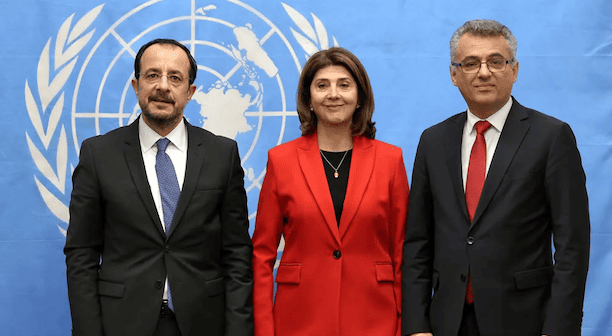
Amid these intensifying domestic debates over legitimacy and governance, the diplomatic dimension has acquired renewed urgency. The United Nations Secretary General’s personal envoy for Cyprus, María Ángela Holguín Cuéllar, is scheduled to visit the island from 26 to 29 January for a new round of contacts with Greek and Turkish Cypriot leaders. The visit is part of a broader UN effort to assess whether sufficient common ground exists to relaunch a political process that has remained stalled since the collapse of the Crans Montana talks.
Holguín’s arrival underscores the growing contrast between international expectations and domestic political realities on the island. While the United Nations continues to search for openings to reengage the sides, political conditions north and south of the Green Line are evolving in markedly different directions. In the south, fragmentation, institutional inertia, and scandal-driven polarization constrain leadership flexibility. In the north, by contrast, rising public pressure for governance reform and political recalibration is reshaping expectations about what a renewed process must deliver in order to be credible.
The envoy’s visit takes place against a backdrop of heightened skepticism, particularly among Turkish Cypriots, toward open-ended diplomatic initiatives that reproduce past asymmetries. Whether this renewed UN engagement can bridge the widening gap between international process-driven optimism and local demands for political equality, time-bound negotiations, and tangible guarantees remains an open question. What is clear is that any future talks will now unfold in a far more complex political environment than in previous cycles, with domestic legitimacy emerging as a decisive factor alongside diplomacy itself.
Symbolism, omission, and the limits of EU engagement
The growing divergence between north and south was underscored by a seemingly routine but politically charged episode during Cyprus’s assumption of the EU Council presidency. Tufan Erhürman publicly protested the approach of Ursula von der Leyen, who, while stressing that a Cyprus settlement remains a European Union priority, failed to refer even once to the Turkish Cypriot people in her public remarks. Instead, her visit featured a tour of the Nicosia Green Line, conducted under the customary escort of the Greek Cypriot president.
For Turkish Cypriots, the issue was not protocol but symbolism. The Green Line, often framed internationally as a post-1974 phenomenon, was first drawn during the final phase of British colonial rule, long before the current political arrangements hardened. Its routine presentation as a neutral sightseeing stop for visiting dignitaries, absent any reference to Turkish Cypriots as political equals, is increasingly perceived in the north as a tacit endorsement of asymmetry rather than an exercise in balance.
The timing of this episode added further weight. It coincided with the passing of George Vassiliou, the Greek Cypriot leader who initiated Cyprus’s EU accession bid and later chaired the process with a declared commitment to reconciliation. Vassiliou viewed EU membership as a bridge between communities, not as a unilateral lever. The contrast between that vision and contemporary EU optics has not gone unnoticed. For many Turkish Cypriots, the episode reinforced a long-held perception that European rhetoric on reunification is increasingly disconnected from European practice on the ground.
Parallel crises, divergent political logic
These symbolic tensions reflect deeper political transformations unfolding simultaneously on both sides of the island. In the Greek Cypriot polity, corruption scandals and institutional insulation are producing fragmentation and polarization without corrective momentum. Allegations touching the presidency have eroded trust, but the presidential system absorbs scandal rather than transforming it into reform. Political consequences are displaced into the parliamentary arena, weakening parties, fragmenting the legislature, and hardening identity-based narratives.
In Northern Cyprus, by contrast, governance fatigue, economic hardship, and a growing perception of political dispossession are generating a tangible demand for recalibration and renewal. Here, dissatisfaction is directed not only at individuals but at the governing architecture itself. Economic stress, institutional erosion, and the sense that political agency has been hollowed out are converging into a broader legitimacy crisis that increasingly points toward systemic change.
These parallel but asymmetrical dynamics are reshaping domestic politics and redefining the parameters of the Cyprus problem. While the south grapples with dispersion that narrows room for compromise, the north is seeking to reframe long-standing assumptions about governance, negotiation, and political equality.
Fragmentation and legitimacy erosion in Greek Cypriot politics
Greek Cypriot politics is approaching parliamentary elections scheduled for 24 May 2026 in a climate of acute volatility. The vote will determine 56 Greek Cypriot members of the House of Representatives, elected through proportional representation across six districts, with Nicosia and Limassol emerging as the most competitive battlegrounds. Early polling points to a fragmented outcome, with no party positioned to dominate the legislature. This fragmentation reflects a deep erosion of trust in traditional political actors and a widening space for protest voting, particularly among younger and urban constituencies.
Institutionally, this structure is the product of a long-unresolved constitutional rupture. Under the 1960 Constitution, the House originally comprised 50 seats, allocated on a 70:30 basis between the two communities, with 35 seats for Greek Cypriots and 15 for Turkish Cypriots. Following the forcible exclusion of Turkish Cypriot deputies from parliament in 1963–64, amid intercommunal violence, the Greek Cypriot administration began operating the legislature unilaterally under the so-called doctrine of necessity. This arrangement was later formalized through a unilateral constitutional amendment in 1985, expanding the House to 80 seats, of which 24 were designated for Turkish Cypriots and 56 for Greek Cypriots. The Turkish Cypriot seats have remained unfilled ever since, reflecting the unresolved collapse of the bi-communal constitutional order rather than voluntary non-participation. As a result, parliamentary elections today effectively contest only the 56 Greek Cypriot seats.
Against this background, the traditional pillars of Greek Cypriot parliamentary politics, DISY and AKEL, are polling at historically modest levels, roughly 22–23 percent each. Both parties are struggling to retain relevance in a political environment increasingly shaped by distrust and fatigue. At the same time, the rise of the far-right ELAM, projected to secure 15–16 percent, introduces a hardening dynamic into parliamentary politics, particularly on issues of immigration, identity, and the Cyprus problem.
Corruption allegations surrounding President Nikos Christodoulides have further intensified this legitimacy crisis. While Cyprus’s presidential system insulates the executive from direct parliamentary confidence votes, a fragmented House retains decisive power over budgets, legislation, and investigative scrutiny. The likely post-election landscape is therefore one of ad hoc alliances, legislative gridlock, and constrained governance, limiting the executive’s room for maneuver both domestically and diplomatically.
A different kind of change in Northern Cyprus
North of the Green Line, political change is unfolding along a different trajectory. The election of Tufan Erhürman as president has not merely altered the balance within the presidency; it has exposed the fragility of the existing governing arrangement and accelerated pressure for early parliamentary elections, increasingly discussed as a plausible scenario by September 2026. Rising living costs, persistent allegations of corruption, favoritism, and nepotism, and deepening rifts among the three coalition partners have weakened the government’s claim to democratic legitimacy.
Within this context, the recent Ankara visit by Sıla Usar İncirli, leader of the Republican Turkish Party (CTP), has assumed outsized political significance. Widely interpreted in Northern Cyprus as more than a courtesy call, the visit was seen as a moment of political positioning ahead of a likely early election. Expectations are growing that, should such an election take place, İncirli could emerge as prime minister, heading a government committed to governance reform and strategic recalibration.
İncirli has been explicit that the Ankara visit was “more than a goodwill gesture.” Her primary objective, she has stressed, was to convey the depth of Northern Cyprus’s social and economic distress and the extent to which the current government has lost its capacity to translate popular will into policy. The signals perceived in Ankara, including an apparent expectation among Turkish political interlocutors that early elections in 2026 are increasingly likely, have reinforced the sense that the existing political configuration in the north lacks durability.
The Immovable Property Commission and strategic continuity
One of the most emphatic messages delivered by İncirli in Ankara concerned the Immovable Property Commission. Recognized by the European Court of Human Rights as the sole effective domestic remedy for property claims pending a comprehensive settlement, the commission occupies a central place in Northern Cyprus’s legal and political strategy. İncirli has described it as a “fortress” that has protected both Turkish Cypriots and Türkiye in the international legal arena, warning that its weakening would expose Northern Cyprus to renewed legal vulnerability and undermine any future political process.
This emphasis highlights a key distinction between north and south. While Greek Cypriot politics is increasingly inward-looking and reactive, Northern Cyprus’s opposition discourse places strategic continuity and legal positioning at the center of its reform agenda.
Federation as a “toxic concept”
It is within this broader recalibration that the debate over federation must be understood. In Northern Cyprus, federation has not been formally abandoned, but it has unmistakably become a toxic concept in public perception. As the CTP leader explains, this toxicity does not stem from the federal model itself, but from the historical experience attached to it: decades of open-ended negotiations, repeated cycles of talks that produced no outcome, and the persistent questioning of Turkish Cypriot political equality. Over time, federation ceased to represent a credible path forward and instead became synonymous with stagnation and asymmetry.
Echoing President Erhürman’s approach, Sıla Usar İncirli has sought to fundamentally reframe the debate. Federation, she argues, cannot function as an article of faith or as an automatic endpoint to which Turkish Cypriots are expected to return regardless of past experience. In her view, two principles are non-negotiable. First, besides being an agreed parameter, political equality of the two communities of Cyprus is defined by UN Security Council resolution 716, dated 1991, hence should not be subjected to negotiation, nor to a transaction against any other chapter. Second, any future negotiation process must be time-bound, conducted within a clearly defined framework that rules out endless talks without consequence. Without these conditions, federation ceases to be a solution model and becomes a mechanism for perpetual disillusionment.
İncirli further underlined that, as President Erhürman has repeatedly stated, all convergences reached between the two sides up to the 2017 Crans-Montana process must be preserved and not reopened for renegotiation. A new negotiating round cannot begin from scratch. Equally important, she stressed that if talks were once again to collapse due to Greek Cypriot disengagement or withdrawal, Turkish Cypriots must be assured that there would be no automatic return to the pre-talks status quo.
What does this assurance mean in practical terms? İncirli was explicit. It means that the international isolation of the Turkish Cypriot state must be addressed. Restrictions on direct international engagement should not remain intact indefinitely as a default penalty for failed negotiations. In concrete terms, she pointed to the opening of Ercan Airport to international traffic as a necessary step. “We must be assured before any new Cyprus talks,” she said, “that we will have direct flights, the ability to engage in direct trade, and direct contact with the international community.” Without such guarantees, she warned, renewed negotiations would lack credibility among Turkish Cypriots and risk reproducing the very dynamics that rendered federation a toxic concept in the first place.
Parallel crises, divergent trajectories
When viewed together, developments north and south of the Green Line reveal parallel crises of legitimacy but divergent political trajectories. In the south, fragmentation and the rise of the far right risk narrowing the space for compromise and reinforcing a politics of veto. In the north, the emphasis is on recalibration: redefining governance, restoring credibility, and stripping long-contested concepts like federation of the ambiguities that have rendered them politically radioactive.
The interaction of these trajectories will shape the island’s future. A fragmented and polarized Greek Cypriot parliament combined with a recalibrated but still constrained Northern Cyprus raises profound questions about whether the next phase will bring renewed engagement or further entrenchment.
The question ahead
If early elections do take place in Northern Cyprus in late 2026 or earlier, they will not merely determine the composition of the next government. They will redefine Northern Cyprus’s relationship with Ankara, reshape its negotiation posture, and determine whether federation can be rehabilitated as a credible framework or will remain burdened by its toxic legacy. At the same time, the outcome of the May 2026 parliamentary elections in the south will condition the political space available for any renewed process.
The island of Cyprus thus stands at a dual inflection point. The decisive question is no longer whether change is coming, but whether the parallel transformations on both sides of the island can be aligned into a coherent political architecture capable of moving beyond stagnation, or whether they will deepen an already entrenched divide.