



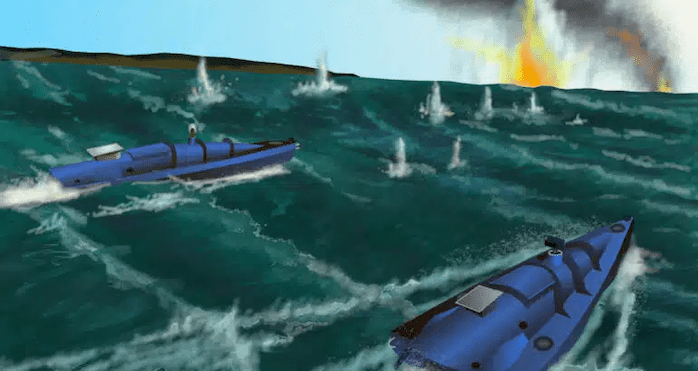
(Artist’s impression of the maritime drone (USV) attack on Sevastopol. Although the Russian Navy was able to destroy some of the drones, several got through. More attacks could follow.)
The sinking of the Russian cruiser Moskva is one of the greatest naval victories in decades, and will deserve its place in history. But the attack on Sevastopol, with maritime drones, can be seen as a bigger deal in the long term. It had a dramatic effect on the Russian Navy. Here is why it may have an effect on navies around the world.
Few would have predicted that, 9 months after the invasion, the once-mighty Russian Black Sea Fleet is tied up in port. But that is exactly what has happened.
This is a result of a series of Ukrainian naval victories and increasing capabilities. Not least the sinking of the cruiser Moskva, the retaking of Snake Island and the arrival of Harpoon missiles. But of all the developments, it is a small local innovation which will be remembered as a turning point in naval history.
On October 29 2022 seven small ‘maritime drones’, called USVs (uncrewed surface vessels) in navy parlance, attacked the Russian Navy at Sevastopol. Barely the size of a canoe, they raced across the waves, skimming towards their intended targets. A frigate and minesweeper were hit.
The damage was less than may have been hoped, the warheads barely scratching their victims. But their impact went far beyond the sound of their explosions. It sent the Russian Navy into protection mode, essentially locking them in port.
The maritime drones penetrated the protected harbor. This must have had a dramatic effect on the Russian Navy’s morale and sense of security. New defenses were quickly added, new procedures imposed and there was much less activity. Russia’s most powerful warships in the war are now mostly tied up in port.
Why the Sevastopol Attack Is Historically Significant
The attack on Sevastopol was less spectacular than the sinking of the landing ship Saratov, which was blown to smithereens in Berdyansk on March 24. And much less so than the sinking of the Slava class cruiser Moskva on April 13-14. It may have less individual impact on the outcome of the war than the Moskva, but from a naval perspective it is likely to be the attack which is remembered for its significance. For many it marks the start of a new age in naval warfare.
This is not the first time that explosive laden USVs have been used to attack enemy ships in conflict. But it is the clearest and cleanest example to date, and the maritime drones involved more closely match modern technologies. These drones leveraged modern communication systems (likely Starlink), and mass tactics. The number involved and degree of coordination was short of ‘swarm tactics’, but it was halfway there. So it may be a preview of wars to come.
The drones were small and relatively cheap. Despite using the latest technology, they were the sort of thing which can be built in almost any garage. They leverage off-the-shelf civilian components such as popular jet skis.
This means that the risk of use is very low. Ukraine had very little to lose, in naval terms, from making the attack. They may have lost their surprise factor now, but they remain a threat to the Russians and they could easily be used again.
Defense analysts have been predicting swarm attacks for years. And Western navies have been arming and training to better defend against close-in surface threats. We can speculate that had the same drones been attacking the U.S. Navy, or Royal Navy, they would have faired much worse. But that doesn’t make them easy targets, or a threat which can be dismissed. Western navies have invested so much into this threats precisely because it is dangerous to expensive warships. But until now it was largely theoretical.
What World Navies Can Learn From Ukraine’s Maritime Drones
Stepping back, the weaponization of small USVs seems obvious. It is analogous to the weaponization of UAVs, especially the commercial quadrotor types. Those too are changing the landscape of war. Yet, this new trend in USVs was not as obvious as we may now believe.
Up to now, the growing number of USV programs in navies have completely overlooked this use case. A survey of the USV programs of any leading navy show many advanced and relevant designs. But they are focused on unarmed tasks such as intelligence, surveillance and reconnaissance (ISR), or mine countermeasures. Some are armed, but more for a defensive role.
Indeed, putting a warhead on a small USV and ramming an enemy warship should have been obvious. But for political reasons, and possibly a lack of imagination in some quarters, that’s not what navies were asking for. That may now change.
These USVs will remain, individually, a relatively low threat to a well trained and equipped navy. Especially as the element of surprise recedes. But they could be a regular threat in any future war, part of the fabric which cannot be ignored.
These types of weaponized USVs should not be the preserve of smaller navies hoping for an asymmetric answer to a larger adversary. They should be in the arsenals of major navies too. At the same time, it should be recognized that part of their advantage is in their cheapness. This is what translates into low risk of use and ability to sustain a persistent threat through numbers. This means that requirements and specifications need to be kept in check.
How quickly the USV market adapts to the new role remains to be seen. But analysts and navies will be looking at this type of scenario for years to come.