



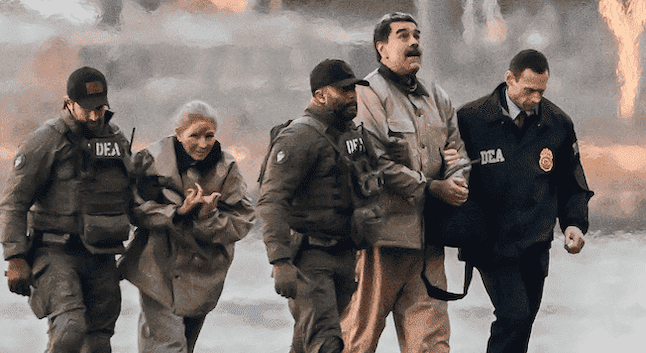
The U.S. operation that captured Venezuelan President Nicolás Maduro and flew him to New York did more than topple a man. It stress-tested the thin membrane that separates “rules-based order” rhetoric from raw power practice.
Washington’s own framing has swung between two claims that do not sit comfortably together: first, that this was a “surgical” law-enforcement action, and second, that the United States will “run Venezuela for now.”
If a state can seize a sitting head of state by force inside another U.N. member country, transport him across borders, and then speak openly about administering the country, the world hears one message regardless of the legal memos: sovereignty is conditional. That is why the most dangerous part of the episode is not Maduro’s fate. It is the “precedent” it sets for everyone else.
Piracy, kidnapping, or “law enforcement”: the category is the signal
Under the U.N. Charter, the baseline rule is clear: states must refrain from the threat or use of force against the territorial integrity or political independence of any state. The recognized exceptions are narrow: Security Council authorization, or self-defense in response to an armed attack. The Reuters legal analysis circulating since the operation underlines the core critique by international-law experts: drug-trafficking charges do not, by themselves, create a lawful international basis for military force on another state’s territory, especially absent host-state consent and absent clear congressional authorization at home.
Washington’s defenders argue that this was an arrest mission against an indicted “narco-terrorism” figure and that it belongs in a lineage that includes Manuel Noriega. Critics respond that this is exactly the problem: rebranding coercive regime-change methods as “law enforcement” is a shortcut around the political costs of war and the legal constraints of sovereignty.
Whatever label one chooses, the optics resemble what smaller states have always called piracy: a strong actor enforcing its will outside any shared policing framework, then inviting the world to accept the new reality.
Türkiye’s muted reaction is not confusion. It is risk management
Ankara’s official response has been the careful, familiar formula: call for restraint, stress stability, invoke international law, avoid naming the United States, offer “constructive contribution,” and keep the embassy line open.
The story inside Türkiye, as your attached text captures, is the tension between principle and exposure. A presidential adviser posts a harsher condemnation then deletes it. The opposition frames Erdoğan’s silence as hypocrisy given Ankara’s past embrace of Maduro. The nationalist ally MHP uses more confrontational language and draws parallels to the July 15 coup attempt.
This is not merely theater. It reflects structural constraints:
So the muted reaction is a form of strategic self-defense, even if it looks like timidity to domestic critics.
The EU’s shallowness is a capability problem wearing a values mask
The European Commission’s initial tone, as reported by Reuters, treated the episode as an “opportunity” for democratic transition and signaled it was “premature” to assess all legal implications. That is diplomatic language for: “We dislike Maduro, we dislike disorder, we cannot confront Washington, and we have limited leverage anyway.”
This is why the EU’s response reads shallow. Not because European officials cannot recite legal principles, but because the EU often lacks the coercive instruments and political unity to act on them when the actor is the United States. The EU has spent years debating “strategic autonomy,” essentially the ability to act without dependency. It remains, as the EU’s own diplomatic service has admitted, a long process rather than a magic switch.
In crises, the gap shows up as a pattern:
This is not only hypocrisy. It is dependency. And dependency is exactly what undermines deterrence: if Europe cannot defend the norm when its closest ally violates it, the norm becomes a talking point, not a constraint.
Why the UK bowed, again: “Special relationship” as strategic habit
Britain’s posture has been even more revealing because it is more nakedly political. Keir Starmer’s reported line was essentially that it is for the U.S. to justify its actions, while reaffirming a preference for democratic transition and insisting that Russia’s invasion of Ukraine should not be equated with the Venezuela raid. UK commentary and reporting also suggests London is reluctant to back condemnation at the U.N. Security Council.
This is the “special relationship” dilemma in real time: the UK prizes intelligence, nuclear, and defense-industrial intimacy with the U.S., and those are not symbolic assets. They are core to Britain’s security posture. Institutions like CSIS and UK-focused policy explainers detail how dense the cooperation is, including the broader ecosystem in which AUKUS sits.
So London defaults to a familiar move: separate legality from alignment. Let the lawyers argue later, keep the alliance intact now. That is what “bowing to muscle” looks like in modern form: not applause, but abstention; not endorsement, but refusal to condemn.
The “precedent” problem: What Russia and China learn
The most important strategic question is not “Was Maduro good or bad?” It is “What behavior just got normalized?”
If the world accepts an extraterritorial seizure of a sitting leader with minimal penalty, Russia and China will not copy the specific theater. They will copy the logic.
Even in the UK debate, senior voices have warned that the Venezuela operation could embolden Russia and China in exactly these kinds of theaters.
This is how norms die: not by being formally repealed, but by being selectively violated until they become optional.
The uncomfortable reality: The “rules-based order” is only as strong as enforcement
The U.N. system has always had a built-in weakness: the Security Council veto. When a permanent member acts, accountability mechanisms become political theater. Reuters reporting on the U.N. reaction captures this problem directly: condemnation and emergency meetings can happen, but punitive action against the U.S. is structurally blocked.
That means the real enforcement mechanism is not the U.N. It is collective cost-imposition by other major actors: sanctions, isolation, diplomatic retaliation, legal action in national courts, and alliance friction. But here is the catch. When the actor is the United States, Europe and the UK are reluctant to impose costs. And when costs are not imposed, the lesson spreads.
Bottom line for Türkiye and Europe
For Türkiye, the Maduro seizure is not a Latin American story. It is a stress test of the principle Ankara frequently needs: sovereignty, non-intervention, and predictable rules. Your attached text captures the domestic resonance: the government’s cautious tone, the opposition’s accusation of inconsistency, and the coalition’s pull toward sharper anti-imperialist language. The dilemma is that Türkiye can defend the principle loudly and pay a price, or defend it softly and risk looking complicit in its erosion.
For the EU and the UK, the episode is a mirror. They can either admit that dependency limits their moral authority, or they can continue the ritual: condemn enemies, rationalize allies, and hope norms survive selective use. But selective use is exactly what turns law into propaganda.
If “kidnapping” can be repackaged as “law enforcement,” then everyone will eventually claim they are policing. And that is the point at which the sea-lanes of international politics fill again with pirates, except now they fly flags and file legal briefs.