



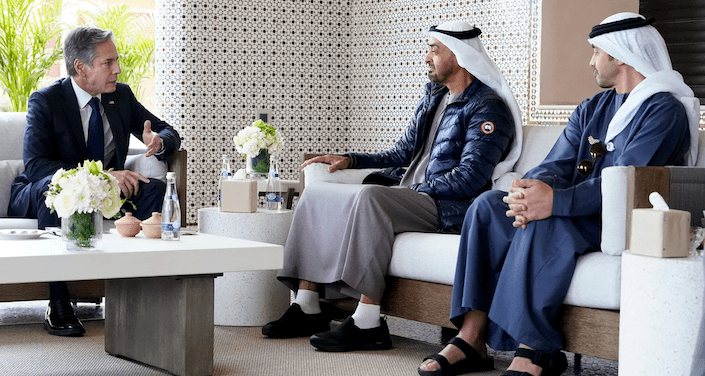
MBZ refused to meet CENTCOM commander Gen. Kenneth McKenzie in February because it had taken him 22 days to make the trip.
Russia’s invasion of Ukraine spotlights seemingly widening differences between the United States and its closest Middle Eastern allies, sparking eulogies for an era of bygone American regional dominance.
“America’s Middle East Friendships are Dying a Natural Death” predicted foreign policy analyst Steven A. Cook this week after countries like Israel, Saudi Arabia, and the United Arab Emirates, to varying degrees, rebuffed US requests to help reduce energy prices and join sanctions against Russia.
A Saudi television satire that could not have been broadcast without at least tacit government approval mocked US President Joe Biden as a leader who had lost his memory and needed Vice President Kamel Harris as a prop. The reference to Mr. Biden’s memory was an apparent reference to Saudi and Emirati assertions that Mr. Biden has forgotten who America’s longstanding regional allies are.
In a further sign of strained US-Saudi relations, Saudi Arabia this week pushed the Organisation of Petroleum Exporting Countries (OPEC) and its partners, including Russia, to stop using oil data from the International Energy Agency’s (IEA) numbers when assessing the state of the oil market because of the United States’ alleged sway over the organisation.
Swan songs for US regional partnerships may be premature, despite the daylight in attitudes towards the Ukraine crisis, a divergence in perceived national interests, Saudi and Emirati frustration with recent American policies towards Iran, and uncertainty about Washington’s continued commitment to regional security.
Analysis of the impact and political significance of the US military presence in the Middle East suggests a degree of interdependence between the United States and its regional partners that makes their partnerships both indispensable and irreplaceable for Middle Eastern autocratic rulers.
The analysis also suggests that neither China nor Russia have the capability, or a military strategy predicated on the ability to project force in any part of the world or the wherewithal to replace the United States as the guarantor of the Middle East’s autocratic rule.
Moreover, the Russian military performance in Ukraine laid bare logistical and maintenance problems that, coupled with the sanctions, make Russia a less attractive alternative arms supplier.
Saudi and Emirati crown princes Mohammed bin Salman and Mohammed bin Zayed may be testing the limits of the leverage they derive from their interdependence with the United States by refusing to increase oil production to reduce oil prices and condemn Russia.
They may also be venting their anger at a US refusal to respond more robustly to Iranian and Iranian-backed Houthi rebel attacks on their oil facilities and critical infrastructure.
The US Navy said this week that it would initiate a new task force with allied countries to patrol the Red Sea in response to Houthi attacks on shipping in the strategic waterway without identifying the rebels by name.
US Secretary of State Antony Blinken reportedly apologized to Mr. Bin Zayed last month for the slow US response to the attacks. Yousef Al Otaiba, the UAE ambassador to Washington, said a meeting between the two men had helped “move the relationship between the UAE and the US back on the right track.”
The announcement and Mr. Biden’s apology reaffirmed that the US military presence in the Gulf remains one pillar of the Gulf states’ multi-faceted regime survival strategy.
A study by political scientists and international affairs scholars Andrew Stravers and Dana El Kurd argues that, despite paying lip service to democratic values, the US commitment to autocratic rule in the Gulf is as much a function of US military strategy as it is of the Middle East’s strategic geography that straddles some of the world’s most important maritime chokepoints.
“American forces have an autocratising effect on host nations in strategically valuable regions. American and host interests align…in supporting regime survival where the location is critical to the United States and its global system of trade and military pre-eminence. This alignment produces increasing autocracy rather than simple regime stability,’ Mr. Stravers and Ms. El Kurd wrote.
The authors argue that an American military presence can increase autocracy in strategic regions “where American planners are uncertain of the (national) military’s ability to withstand regime change.”
Some leaders in the Gulf have at times shared that uncertainty. Mr. Bin Zayed, for example, contracted Erik Prince, founder of the controversial private security firm Blackwater, more than a decade ago to help ensure regime security.
Mr. Stravers and Ms. El Kurd go on to reason that the US military presence “produces a need for the host regime to suppress opposition, in order to maintain perceived stability and entrench its domestic position. This increases the level of authoritarianism over time.”
This phenomenon is particularly true for the Gulf, where the loss of a military base would have far more far-reaching consequences for the US global position than the need to close or move a facility in, for example, Japan.
The authors’ emphasis on the significance of strategic geography in support of autocracy or democratization is borne out in a comparison of US policy regarding the 2011 popular uprising in Bahrain, home to the US Fifth Fleet, and protests six years earlier in Uzbekistan, where the US had a significant military presence at the height of the Afghan war.
The US stood aside when Saudi-led Gulf troops quashed the revolt in Bahrain. In Uzbekistan, Washington had no problem losing its military facilities after taking the government to task for repressing protests and violating human rights.
“An American military presence has an autocratising effect in particular regions of strategic importance. In areas of less strategic importance, American presence has relatively little effect on regimes,” the authors concluded.
Mr. Stravers and Ms. El Kurd’s analysis raises the question of whether recent Gulf moves related to Ukraine and Emirati efforts to return Syrian President Bashar al-Assad to the Arab and international fold signal a watershed in relations with the United States or an effort by Gulf leaders to flex their muscles at a time that the US may need them most.
The tendency of the US military presence to encourage increased autocracy may be something Messrs. Bin Salman and Bin Zayed don’t want to lose, particularly not without an immediate replacement.
That is all the truer, given that it is not clear that either man has full confidence in the ability of his security forces to fend off a concerted effort at regime change or an assault by Iran.
Messrs. Bin Salman and Bin Zayed’s problem is that the decision about the future of the US presence in the Gulf is beyond their grasp.
Washington is lowering its valuation of the strategic importance of the Gulf’s geography as its interest in the free flow of the region’s energy diminishes.
Messrs. Bin Salman and Bin Zayed may be placing a risky bet: put the relationship with the US on edge in the hope that the need to replace Russian energy will return Washington to its senses.
That may be a long shot. But, just like Saudis and Emiratis remember that the US did not respond robustly to attacks on their critical facilities even if it took steps to reassure them, US policy and opinion makers are likely to recall friends who were absent when they needed help most.
To see a video version of this story, please click here.
A podcast version is available on Soundcloud, Itunes, Spotify, Stitcher, TuneIn, Spreaker, Pocket Casts, Tumblr, Podbean, Audecibel, Patreon, and Castbox.
Dr. James M. Dorsey is an award-winning journalist and scholar, a Senior Fellow at the National University of Singapore’s Middle East Institute and Adjunct Senior Fellow at Nanyang Technological University’s S. Rajaratnam School of International Studies, and the author of the syndicated column and blog, The Turbulent World of Middle East Soccer.