



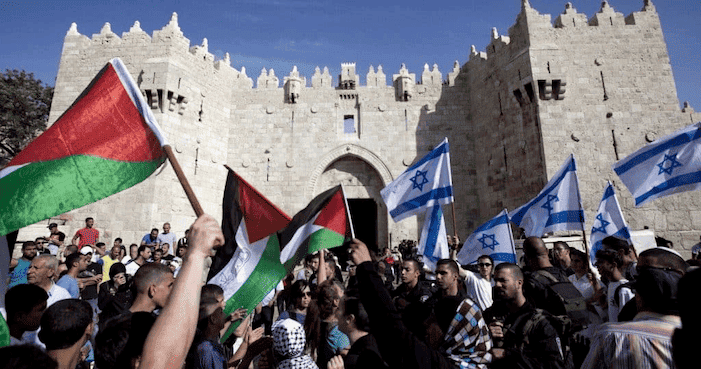
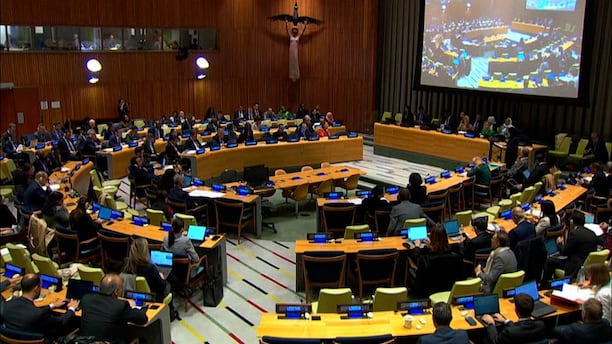
On Friday, it was reported that next week’s planned UN conference in New York to resolve the Palestine-Israel conflict had been postponed following Israel’s military strike on Iran. Originally, the meeting had been envisioned as an opportunity for several UN member states – including some permanent UN Security Council members – to recognise Palestinian statehood. That ambitious agenda has apparently been scaled back, however, with UN Secretary General Antonio Guterres now indicating that the objective is “to keep the two-state solution alive”.
Not surprisingly, Washington won’t attend the now-postponed UN confab. It’s not that US President Donald Trump necessarily opposes Palestinian statehood. Rather, it seems his administration is largely disinterested. The conflict is just too time-consuming and intractable. During his trip to Riyadh last month, the President abjured from discussion of two states. Mr Trump didn’t explicitly rule out the formula but instead talked about “a future of safety and dignity” for the Palestinian people.
In 2020, however, during his first term, the President advocated for a two-state solution in his much-maligned peace plan. Alas, the Palestinians rejected the Trump proposal before the Israelis had a chance to do so. Still, the fact is that every US president since Bill Clinton has supported the two-state solution, at least rhetorically.
Mr Trump hasn’t articulated his current position on Palestinian statehood. Recently, the administration’s ambassador to Israel, Mike Huckabee, indicated that the US no longer backed the project. His statement was quickly walked back by the State Department spokesman, who said Mr Huckabee “speaks for himself”.
The current ambiguity of administration policy contrasts with that of George W Bush, the last Republican president. During the second intifada, the Bush administration conditionally backed Palestinian statehood. In his June 24, 2002, Rose Garden speech, he said: “If Palestinians embrace democracy, confront corruption and firmly reject terror, they can count on American support for the creation of a provisional state of Palestine.” This was notable in making clear that not only Israel, but also the Palestinians have obligations if a Palestinian state were to come into existence.
In that same speech, Mr Bush pledged that the US, along with the EU and other international organisations, would oversee governance, financial and judicial reforms, help to create a “working democracy”, and increase humanitarian assistance “to relieve Palestinian suffering”. In 2007, Mr Bush convened the Israelis, Palestinians and 40 countries in Annapolis to end the “bloodshed, suffering and decades of conflict”.
To be sure, the Hamas-led attack of October 7, 2023, had an impact on Mr Trump’s perspective on the immediate feasibility of a Palestinian state. That day, and the nearly two years of war in Gaza that have followed, soured already-sceptical Israelis and Palestinians on the notion of peace and compromise – traditional prerequisites for statehood. Mr Trump probably doesn’t see this moment as conducive for advancing the peace process.
At the same time, his second term has been characterised by transactionalism, an emphasis on burden-sharing, an aversion – as he articulated in Riyadh – to “nation-building” and a strong preference to local solutions to regional problems. The President is looking for quick foreign policy and economic wins and for partners willing to assume responsibility for solving thorny problems.

From Afghanistan to Iraq to Palestine, Mr Bush was a “nation-builder”, committed to promoting democracy and American values abroad. Not only did he pledge US technical support and financial assistance to Palestinians, but his administration also helped engineer the appointment of a technocratic, non-corrupt prime minister to usher in reforms. Mr Trump opposes this type of US engagement abroad.
His focus on wins explains why his first planned foreign visit was to Saudi Arabia, the UAE and Qatar. The President was seeking investment deals with partners to benefit the US economy, rather than discussions about further financial, political and military commitments for Washington in the Middle East. Along these lines, Mr Trump’s most successful meetings to date appear to be those in which a foreign head of state offers to do something for the US instead of asking something of Washington. To wit, King Abdullah of Jordan’s Oval Office meeting in February concluded successfully after he proposed bringing sick Gazan children to Amman for treatment. Ukrainian President Volodymyr Zelenskyy’s didn’t end so well.
The bottom line is that the Palestine-Israel conflict offers no obvious wins to the President. In lieu of significant diplomatic investment in an improbable peace process, the Trump administration will remain narrowly focused on the urgent and important short-term goal of a Gaza ceasefire and the return of the hostages held by Hamas.
Many Middle East governments are applauding Mr Trump’s new approach, especially his criticism and rejection of western states “giving you lectures on how to live and how to govern your own affairs”. At the same time, there is clearly plenty of disappointment in the region with the US policy on Gaza. For better or worse, however, this is unlikely to change anytime soon.
The bottom line is that the Palestine-Israel conflict offers no obvious wins to US President Donald Trump
Which brings us back to the UN conference on the two-state solution. Notwithstanding signs that Mr Trump may be frustrated with the Israeli government’s refusal to end the war in Gaza, expectations that his administration will pressure Israel into peace talks are misplaced. Mr Trump may eventually press harder for Prime Minister Benjamin Netanyahu to wrap up the campaign – Gaza is undermining prospects of enlarging the Abraham Accords – but he is not going to deliver the Israelis to the negotiating table right now. There will be no Annapolis II during this administration. As Mr Trump himself likes to point out, he is the antithesis of Mr Bush.
The Trump administration’s reaction to the conference, when it takes place, will be shaped by the meeting’s outcome. Reiterating old, tired diplomatic resolutions and embracing symbolic recognitions will be met with antipathy – or at best apathy – in Washington. Alternatively, a meeting could produce a series of tangible steps outlining not only Israeli obligations, but also what Palestinians need to do. Even more importantly, the European and Arab states could put skin in the game and commit to the post-war diplomatic and financial heavy lifting, including direct engagement to ensure that the Palestinians can be an effective partner in future diplomacy. If this is the outcome of a rescheduled UN meeting, a reticent US administration might be encouraged to engage.
The war in Gaza has gone on far too long. It would be a shame if such a high-level international meeting – like the last Middle East Peace Summit in 2017 hosted by then-French president Francois Hollande – failed to deliver a workable plan for a better way forward for Palestinians and Israelis.