



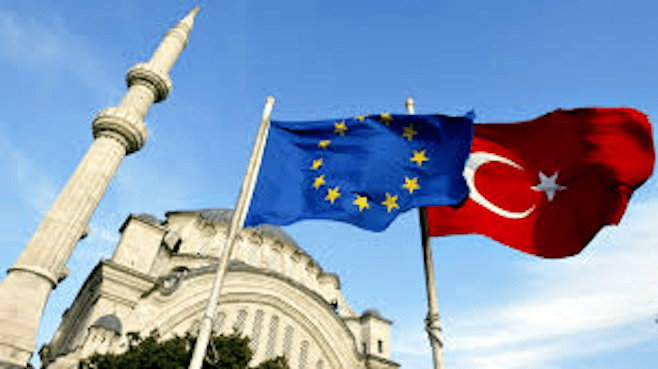
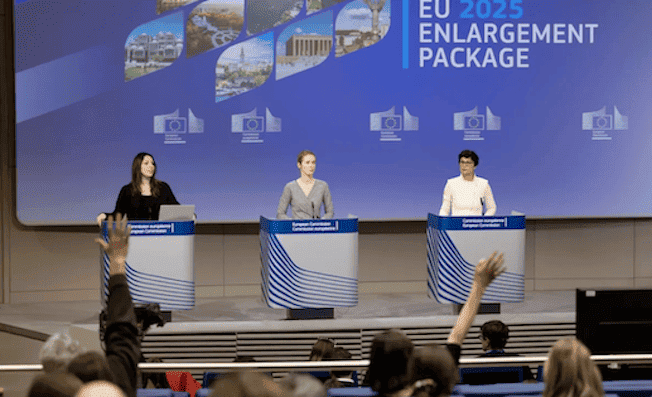
The European Commission’s 2025 Enlargement Package arrived this week with the predictability of an unchanging calendar — polite encouragement for the Balkans, optimism for Ukraine and Moldova, and the same frosty paragraph for Türkiye.
Formally still a candidate country, Türkiye remains politically delegated to the margins: “strategic partner, not prospective member.”
But if one steps out of Brussels’ corridors and looks at Europe’s actual security map, the irony becomes striking: the very country the EU keeps at arm’s length now guards its borders, feeds its diplomacy, and anchors its defense.
Strategic relevance without political recognition
Just weeks before the report, Ankara hosted two of Europe’s most powerful leaders — British Prime Minister Keir Starmer and German Chancellor Friedrich Merz. Both came not to lecture but to negotiate.
The British visit sealed a long-negotiated £5.4 billion Eurofighter Typhoon deal, giving Türkiye access to 20 brand-new fighter jets and training packages — a symbol that Ankara is no longer waiting for Washington’s goodwill or Brussels’ permission. Germany’s parallel visit, though more discreet, quietly signaled Berlin’s readiness to lift its political objections to the same purchase.
In plain terms: while the EU bureaucracy freezes Türkiye politically, its member states race to cooperate with it militarily.
The reason is simple — Europe’s security architecture cannot function without Türkiye.
From the Aegean to the Caucasus, from the Black Sea to the Mediterranean, Ankara is now the hinge that keeps the continent’s eastern flank from collapsing.
Whether Europe admits it or not, Türkiye has become the EU’s unofficial border police, the gatekeeper of migration, and the buffer against chaos spilling in from Syria, Gaza, and now Ukraine.
The return of realpolitik
The Gaza war, the Syrian collapse, the Israel–Iran confrontation, the Russian onslaught in Ukraine — all have redrawn Europe’s neighborhood.
Every single corridor of conflict now runs through, or depends upon, Türkiye.
The EU’s newest obsession — strategic autonomy — is impossible without Turkish cooperation. Refugee flows, energy transit, grain shipments, counter-terror operations: all roads lead to Ankara.
And yet, when it comes to political norms, Türkiye is frozen out.
The 2025 Enlargement Package acknowledges the country’s “geostrategic importance” but then recites the familiar litany of democratic backsliding, judicial weaknesses, and lack of media freedom. It is a diplomatic paradox: Europe’s defense umbrella rests on a partner it no longer considers democratic enough to join its club.
Security as substitute for trust
Brussels insists that enlargement must be “merit-based.” Ankara counters that “merit” has become a euphemism for selective inclusion.
After all, Ukraine — under martial law — is praised for its “progress on reforms,” while Türkiye, a NATO member hosting nearly four million refugees, is treated as a case file to be managed rather than a partner to be embraced.
It is not that Europe is wrong about Türkiye’s democratic deficiencies — it is that it applies its virtues asymmetrically.
A Türkiye that stabilizes NATO’s south and mediates in the Black Sea is invaluable; a Türkiye that seeks equal voice in Europe’s political institutions is inconvenient.
Thus, Ankara has been quietly re-cast from “future member” to “indispensable subcontractor.”
It protects the borders, hosts the refugees, provides the drones, negotiates with Tehran and Moscow — and in return, receives polite thanks but no seat at the table.
The double game of mutual need
For Ankara, the lesson is sobering but not unfamiliar.
It has learned that strategic dependence cuts both ways. The Eurofighter deal with the United Kingdom and Germany was not just an arms contract; it was a signal — Türkiye will modernize its defense, with or without Washington, with or without the EU.
The same logic drives its active diplomacy in Gaza and Syria: when Europe dithers, Türkiye acts.
Refugee control, which once gave Brussels leverage, now gives Ankara bargaining power. Every time the EU preaches democracy but pleads for migration management funds, the moral hierarchy in the relationship collapses a little more.
Europe needs Türkiye’s stability more urgently than Türkiye needs European lectures.
Two Europes, one Türkiye
There are, in truth, two Europes today.
One is the Europe of values — the rule-of-law club that writes annual reports and grades Türkiye like a difficult student.
The other is the Europe of interests — the one that buys Turkish drones, welcomes Turkish grain mediation, and signs defense deals while quietly ignoring the political freeze.
Türkiye stands awkwardly between the two: normatively excluded, strategically indispensable.
This is not sustainable. A relationship built on mutual usefulness but not mutual respect breeds cynicism, not integration.
The cost of delegation
In Ankara, officials increasingly say that Türkiye’s EU bid is “on life support.” Yet the EU still claims the door is open. Both are right — and both are wrong.
The door exists, but the hallway has moved.
Others — Ukraine, Moldova, the Western Balkans — are walking toward it. Türkiye, once the flagship of enlargement, is now guarding the building from outside.
The tragedy is not that Türkiye has been forgotten; it’s that it has been reduced to utility.
A bridge is useful only when others decide to cross it.
The road ahead
If Türkiye wants to escape this limbo, it must reclaim the initiative not by pleading for inclusion, but by proving that democratic self-confidence is not a concession to Brussels but a prerequisite for its own stability.
Rule-of-law reforms, judicial transparency, and a freer media are not EU gifts — they are the currency of global credibility.
And Europe, if it truly believes in enlargement, must confront its hypocrisy: you cannot lecture a country on democracy in the morning and sign arms deals in the afternoon, then call it “unfit for membership” by evening.
A divorce?
The 2025 Enlargement Package may mark the moment Europe’s moral narrative and security reality finally divorced.
Türkiye stands at the center of both — essential for one, expendable for the other.
The Eurofighter jets now thunder over Turkish skies; British and German leaders will likely keep flying into Ankara; and millions of refugees will continue to find shelter under Türkiye’s protection. Yet without the revival of genuine, institutional trust, this relationship will stay what it has become — transactional, not transformational. Europe may have the luxury of forgetting Türkiye for a while.
Türkiye, however, will remain exactly where it has always been — guarding the tracks, while the EU’s train keeps leaving the station.