



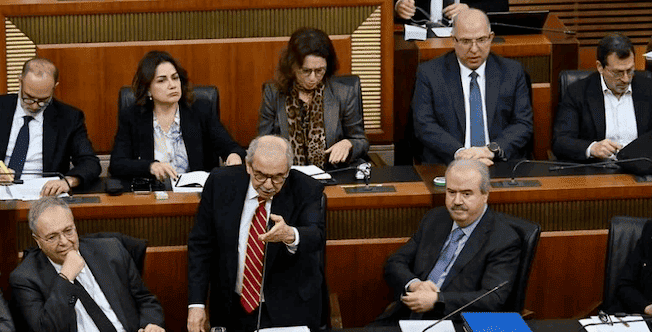
Lebanon’s 2026 state budget was approved in parliament with a razor-thin majority that failed to reach even half of the chamber’s members, exposing deep political divisions and raising serious concerns over constitutionality, transparency, and the true purpose of newly added expenditures.
Major predominantly Christian parliamentary blocs voted against or abstained from voting, arguing that the budget approved by the legislature no longer reflects the version endorsed by the cabinet. They pointed in particular to last minute substantial amendments introduced by the parliamentary Finance and Budget Committee, in spite of the opposition of the Lebanese Forces Party, most notably the addition of approximately $160 million in new appropriations approved promptly by parliament in violation of established constitutional and financial procedures.
Critics argue that these funds are not linked to any clear reform agenda or economic priority. Instead, they are widely seen as politically motivated allocations designed to sustain patronage networks and finance upcoming electoral campaigns, primarily benefiting Hizbollah and its allies through state-linked institutions.
No Reconstruction, Only Redistribution-
While some of the newly added appropriations are officially justified as reconstruction or relief spending, particularly for southern Lebanon, lawmakers and observers stress that no meaningful reconstruction work can currently take place. Continued Israeli targeting of construction machinery and infrastructure in the south has effectively halted any large-scale rebuilding efforts, making these budgetary justifications largely fictitious.
As a result, the funds are expected to be redirected away from reconstruction and instead channeled through alternative mechanisms that allow political spending under the guise of social support, most notably healthcare assistance.
Hijacked Healthcare and State Agencies as a Political Conduit
According to parliamentary and policy sources, a significant portion of the money is likely to be distributed through the primary healthcare centers and hospital network affiliated with Hizbollah, a structure that has long functioned as a key pillar of its social and political influence.
The breakdown is as follows:
– Ministry of Health: USD 50 million
– Council of the South: USD 67 million
– Higher Authority for Relief: USD 22 million
– Ministry of Education: USD 17 million
– Ministry of Environment: USD 4 million
This process would occur without effective accountability or oversight, particularly as the Ministry of Health is currently headed by a Hizbollah-appointed minister, raising serious questions about conflict of interest, monitoring, and financial controls.
Additional funds are also expected to pass through the Higher Authority for Relief and the South Lebanon Council, two bodies that have repeatedly been criticized for opaque spending practices and for operating as instruments of political clientelism rather than neutral state institutions.
A Budget Detached from Government Responsibility
Supporters of the budget are, primarily, MPs from the Shiite duo Hizbollah and Amal, their allied blocs, in addition to a key role played by the Progressive Socialist party of Walid Jumblatt, who convinced other blocks that a vote against the budget would be considered a vote against Nawaf’s government. They defended their lobbying for a “yes” vote as a necessary step for financial continuity or as implicit confidence in the government.
Opponents argue that this stance ignores a fundamental reality: the final budget was no longer the original government’s budget, but rather the product of parliamentary bargaining that undermines transparency and accountability.
This concern was reinforced by the notable silence of the prime minister during the parliamentary session, as he refrained from defending the government’s original draft and left the task to the Shiite finance minister, an absence widely interpreted as evidence of political lenience toward Hizbollahand weak executive authority.
Institutional Breakdown and Political Spending
The passage of the budget under these conditions entrenches a broader legislative dysfunction in Lebanon, where critical financial laws are passed with fragile majorities, without national consensus, and in defiance of reform principles. It further marginalizes the role of the government in shaping fiscal policy, despite the budget’s constitutional status as one of the most fundamental laws requiring broad approval.
More critically, it reinforces concerns that public money is increasingly being used to finance political power structures and election campaigns, circumventing international efforts to block money traffic towards terrorist-designated Hizbollah, rather than addressing Lebanon’s ongoing financial collapse or serving genuine public needs.
In this context, the newly added $160 million appears less as emergency spending and more as state-backed election financing, routed through healthcare aid and relief institutions that operate beyond meaningful scrutiny, at a time when Lebanon can least afford further erosion of public trust.