



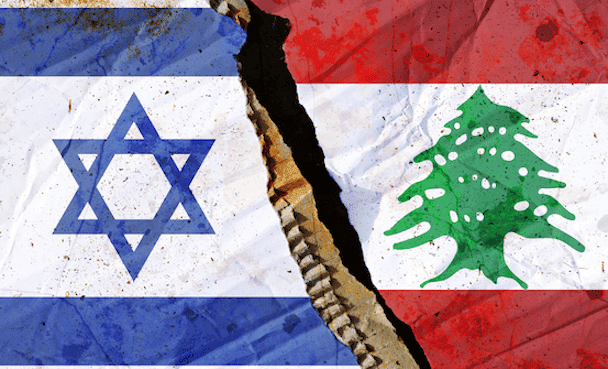
The agreement has withstood all challenges so far, thanks in large part to the mechanism that Israel and the United States set up to ensure Hezbollah’s southern assets are addressed—one way or another.
After four months of relative calm, the tenuous cease-fire in Lebanon was interrupted on March 22 by salvos of rockets launched into Israel. Lebanon-based militant group Hezbollah denied responsibility, and the missiles failed to reach their targets. But Israel responded with waves of airstrikes in south Lebanon and Beirut on what it said were the Iran-backed militia’s personnel and launchers.
While the exchanges have sparked concerns about a resumption of the war, in truth, the incidents were unremarkable. Israel has been attacking Hezbollah targets in Lebanon on a routine basis since the cease-fire was signed last November.
Notwithstanding Israel’s habitual sorties and last week’s rocket barrage, to date, the cease-fire has proved an unexpected success. Not only is there relative calm along the frontier, but also, the agreement—which allows for some continued Israeli strikes as the government in Beirut contends with Hezbollah—is holding. The Lebanese Armed Forces (LAF) have deployed almost 6,000 troops to south Lebanon; consistent with the agreement, they are collecting weapons and dismantling Hezbollah infrastructure.
To be sure, the current number of LAF soldiers falls short of the promised 10,000, but U.S. and Israeli officials quietly say that they are pleasantly surprised with the LAF’s performance to date. Israelis understand that it will take the LAF time to recruit and deploy more troops to fill its depleted ranks, given that enlistments have been decimated by a financial crisis that saw a 98 percent devaluation of the Lebanese lira. But so far, the trajectory is positive.
For the first time since 2007, the Lebanese military appears to be making an earnest effort to implement U.N. Security Council Resolution 1701, which requires Hezbollah to be disarmed south of the Litani River. Meanwhile, the selection earlier this month of Gen. Rodolph Haykal to replace Joseph Aoun (now the president and head of state) as the commander of the LAF has been widely praised, raising hopes that the military will continue to pacify the border region.
Importantly, the LAF’s mission in the south now has unprecedented political backing within Lebanon. Beirut has taken a more ambivalent approach to other undertakings—in particular, its cease-fire obligation to demobilize militias in the northern part of the country. To his credit, in his address at his presidential inauguration on Jan. 9, Aoun vowed to establish a state “monopoly on the possession of weapons,” a commitment not only to U.N. Security Council Resolution 1701, but also to Resolution 1559, a 2004 resolution that mandates the disarmament of Hezbollah not just along the Israeli border, but also throughout all of Lebanon.
Not surprisingly, Hezbollah refuses to acquiesce to its neutering. On March 10, the group’s new secretary-general, Naim Qassem, made it clear that his organization was not accountable to Beirut. “We do not consider the president’s words about the exclusivity of weapons to be directed at us,” he said. Hezbollah clearly intends to preserve and rebuild its depleted military, and at present, the short-staffed and overextended LAF lacks the capability to contest the militia north of the Litani. Worse, despite Aoun’s assuring statement at his inauguration, the government in Beirut is now led by viscerally anti-Israel Prime Minister Nawaf Salam, a former judge at the International Criminal Court. He and his government lack the will to take on Hezbollah, fearing that direct confrontation with the Shiite militia might reignite Lebanon’s dormant sectarian civil war.
Wisely, the cease-fire agreement anticipated Hezbollah’s recalcitrance and the Lebanese government’s reticence to confront it. Instead of futilely trying to compel Beirut to oppose Hezbollah or relying on perennially ineffectual United Nations peacekeepers, the agreement established a “mechanism,” led by the United States, for Israel to channel information to Lebanon about Hezbollah military sites requiring demolition. After the details have been conveyed, Israel has been giving the LAF 72 hours to proceed before Israel targets the positions. When Israel observes moving targets—such as Hezbollah transporting weapons or ammunition anywhere in Lebanon—it acts without notice. Since the cease-fire was signed in November, Israel has launched more than 330 missile, drone, and airstrikes against Hezbollah.
The Lebanese government has voiced its exasperation with Israel’s continued bombing of Hezbollah throughout Lebanon, but much of it may be performative. There is little doubt that Aoun—and much of the Lebanese national security establishment—welcomes the arrangement. For the foreseeable future, Israel’s continued strikes against the militia will spare the LAF from dreaded direct clashes with Hezbollah. Both the government and military have sought to avoid awkward and potentially deadly military confrontations with the battle-hardened group, which also has 15 seats of the Lebanese Parliament (representing 12 percent of voters); two cabinet ministers as part of the ruling coalition; and an alliance with the Amal party, which controls another 15 seats.
No doubt, Israel’s continued occupation of five strategic hilltop positions in south Lebanon is a political irritant for Beirut. The cease-fire agreement stipulated that Israel would withdraw from all Lebanese territory by Jan. 26, a date subsequently extended with U.S. mediation to Feb. 18, with no end in sight. Israel’s continued military presence—arguably justified by insufficient LAF troops but widely considered a violation of the cease-fire—is putting additional pressure on Lebanon’s new government, already tasked with implementing contentious reforms during an economic crisis.
The recent Israeli airstrikes targeting members of Hamas and Hezbollah in the Hezbollah-controlled southern suburbs of Beirut further complicate the Lebanese government’s ostensible support for the cease-fire. At some point, if there are indications that continued Israeli occupation and airstrikes are discrediting Lebanon’s president and government, then Israel would be wise to reassess their utility.
Notwithstanding the degradation of Hezbollah, the LAF’s impoundment of weapons, and Israel’s ongoing kinetic activity in Lebanon, the threat to residents of northern Israel—and Israeli targets abroad—persists. Following the first post-cease-fire rocket barrage on March 22, Israeli Defense Minister Israel Katz said that “the Lebanese government is responsible for everything that happens on its territory.” The statement was intended to threaten and compel Beirut to take a more robust approach to Hezbollah.
To be fair, four months on, the LAF is doing a credible job in fulfilling its obligations in the south. Critiques and anxieties aside, the Lebanon cease-fire is functioning so far, and it appears to be durable. More can and should be done over time by the LAF to disarm Hezbollah both to the south and north of the Litani. Until that happens, however, Israel will play its part, and not everyone in Lebanon is unhappy about that.
David Schenker is the Taube Senior Fellow at The Washington Institute and director of its Rubin Program on Arab Politics. This article was originally published on the Foreign Policy website.