



During a televised address on July 26, Syrian president Bashar al-Assad admitted for the first time that his regime is suffering from “a lack of human resources” in the ongoing civil war, implicitly acknowledging the casualties inflicted on the various Iranian-sponsored forces assisting his troops. Since first mentioning Lebanese Hezbollah’s activities in Syria in early 2013, he has rarely credited the Iranian proxy for its “important” and “effective” role in the war, instead maintaining the claim that Tehran’s participation is limited to the provision of “military experts.” In this, he has echoed Iranian officials, who typically declare that Iranian nationals killed in Syria are not military operatives deployed there by the government, but volunteer “martyred guardians of the shrine” (shohada-ye modafe-e haram), a reference to Shiite pilgrimage sites in Damascus.
The real number of Iranian casualties in Syria is not known, and Tehran has every reason to downplay the degree of its involvement and losses there. Yet a survey of funeral services for Iranian, Afghan, and Pakistani Shiite fighters killed in the war over the past two-and-a-half years provides some indication of the Islamic Republic’s military engagement. According to open-source data collected from Persian-language accounts of funerals in Iran, 113 Iranian nationals, 121 Afghan nationals, and 20 Pakistani nationals — all Shiites — have been killed in combat in Syria since January 2013. (The formidable number of Iraqi and Lebanese Shiite casualties are not included in this survey; for more on that subject, see “Hezbollah’s Victory in Qalamoun: Winning the Battle, Losing the War” and “Iraqi Shiite Foreign Fighters on the Rise Again in Syria.”)

Tellingly, public accounts indicate that all 113 of the Iranian casualties served in the Islamic Revolutionary Guard Corps. Breaking down the casualties by IRGC branch, 8 served in the IRGC Ground Forces, 8 were identified as members of the Qods Force, and 3 served in the Basij militia; funeral photos and online biographical materials suggest that the remaining 94 were active-duty IRGC members as well, though it is not known in which branch they served. For some of these individuals, the lack of information may reflect the IRGC’s attempt to obscure their service in the Qods Force (an elite unit focused on extraterritorial operations) or cover up the deployment of IRGC Ground Forces.
As for the Afghan and Pakistani nationals killed in action, all of the former were members of the Fatemiyoun Brigade, while the latter served with the Zainabiyoun Brigade. Both of these militias were apparently organized by — and still report to — the Qods Force.
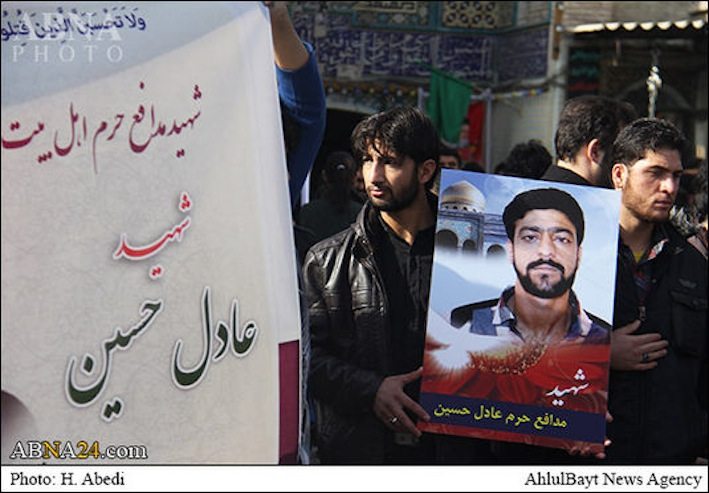
The earliest record of an Iranian national to fall in combat in Syria is that of thirty-year-old Ali Asgari Taqanaki, a Qods Force operative killed in Damascus on January 28, 2013. The first reported Afghan Shiite casualty was Azim Vaezi, killed in an undisclosed location in Syria sometime prior to September 2013. And the first record of a Pakistani Shiite death is that of Hossein Adel, killed in Damascus sometime before February 6, 2015.

While the first IRGC personnel killed in Syria were Qods Force members, published accounts since July 2014 indicate an increasing number of casualties from the IRGC Ground Forces. This is clear when analyzing their place of burial in Iran: Qods Force members are recruited from all over the country and are buried individually in their native province, but the Ground Forces are organized according to Iran’s administrative divisions, with a local IRGC unit serving each province. Therefore, mass funeral services in one province indicate that a Ground Forces unit from that province has been sent to Syria.

Deployment of the Ground Forces seems to have taken place in the wake of mounting casualties among the Qods Force, a relatively small unit. This left the IRGC with no other choice but to deploy its “regular” forces to Syria.
In contrast, deployment of the Fatemiyoun and Zainabiyoun Brigades was seemingly planned early in the conflict, perhaps in late 2012, when Iran and Hezbollah recognized the Assad regime’s plight. This would fit with the Qods Force plan to provide Afghan and Pakistani Shiites with combat experience — that is, it was not a reaction to Iranian casualties. Yet maintaining the Fatemiyoun Brigade in Syria despite its high casualties may reflect the IRGC’s manpower shortage and Assad’s continuing need for troops.
A survey of the rank and technical skills of the casualties reveals potentially significant differences between some of the Iranian and non-Iranian personnel. Among the 113 Iranians, 10 were commemorated as sardar, which refers to high-ranking IRGC officers. To judge by reader commentary on websites commemorating them, they were technical advisors, combat advisors, trainers, combat personnel (including one tank driver), special operations forces, intelligence officers, and even journalists and television documentarians. In contrast, the Afghan and Pakistani nationals seem to have served exclusively as foot soldiers, with four exceptions: brigade commander Ali Reza Tavasoli (an Afghan volunteer who fought in the Iran-Iraq War), his deputy Reza Bakhshi, company commander Mehdi Saberi, and Muhammad Rezaei, a cleric. On Facebook, some Afghan casualties are presented as “snipers,” but this may reflect the influence of Western popular culture more than actual expertise on their part.
Very little information is available about the specific operations in which these fighters were engaged. To further complicate matters, the place of death for most of them is listed as “Syria” or “the shrine in Damascus,” which is meant to back up the fiction that they were martyred while defending Shiite pilgrimage sites rather than, for example, fighting in Aleppo far to the north. One source admitted that the Fatemiyoun Brigade suffered heavy casualties during the Syrian military’s initial takeover and later withdrawal from Dokhaniyeh, east of Damascus, in October 2014. The same source also reported that the brigade was involved in an unsuccessful Syrian army offensive against Aleppo, likely in February 2015.
CONCLUSION
The Qods Force and its Afghan/Pakistani recruits are spread thin and suffering significant casualties, spurring the deployment of the IRGC Ground Forces to Syria. Even so, Iran is unlikely to abandon its commitment to its proxy regime in Damascus in the short term. The Islamic Republic in general, and the IRGC in particular, have invested so much blood and treasure in the war that they no longer believe they can withdraw their support. Arguably, easier access to foreign currency in the wake of the U.S.-led nuclear deal will translate into increased funding for the IRGC’s operations in Syria. Looking further ahead, Qods Force efforts to provide Afghan and Pakistani Shiites with combat experience serves as a forewarning of worse times to come for Afghanistan when these fighters return home.
Ali Alfoneh is a senior fellow at the Foundation for Defense of Democracies.