



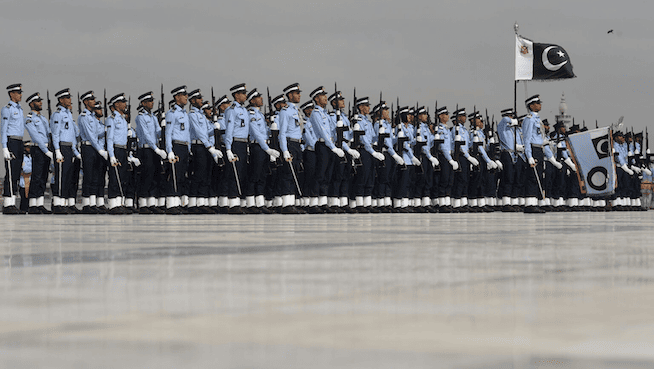
“The agreement stipulates that a foreign aggression on one is an attack on both,” Faisal Al Hamad, a retired Saudi Air Force Brigadier General and defense analyst, told Breaking Defense
RIYADH — The Saudi-Pakistani joint defense accord appears set to be a significant game-changer in the turbulent geopolitical security landscape of the Middle East — primarily because it now puts Riyadh under the nuclear umbrella of Pakistan, thus ending Israel’s monopoly on the possession of nuclear capabilities in the region.
When the defense accord was signed Sept. 17, the role of nuclear weapons was not clear. But any doubts about the regional impact were dispelled two days later, when Pakistan’s Defense Minister Khawaja Asif asserted that under the agreement, Saudi Arabia will fall under the Pakistani nuclear umbrella.
In an interview with the Pakistani Geo television, Asif said under the accord, “Whatever we have, our capabilities, will absolutely be available” to Saudi Arabia, later adding “Any aggression against either country shall be considered an aggression against both.
Reuters quoted a Saudi official as saying, “This is a comprehensive defense agreement that encompasses all military means.”
Fundamentally, “The agreement stipulates that a foreign aggression on one is an attack on both,” Faisal Al Hamad, a retired Saudi Air Force brigadier general and defense analyst, told Breaking Defense. This is almost the exact statement made by Asif, who said, “Any aggression against either country shall be considered an aggression against both.” The surprise agreement between the oil-rich Saudi Arabia and the only Islamic nuclear state, Pakistan, has taken everybody by surprise.
There has not been an official reaction by US officials on the accord, which came only a few days after the Israeli air raid on Doha, Qatar, that caused a regional uproar about the reliability of the American security commitments to its Arab partners.
The lack of action by the US — whose Al Udeid airbase in Qatar is the largest in the region — in alerting the Qataris or preventing the attack harmed the US image as a reliable security ally. Ever since, US officials have doubled down on efforts to control the damage done to the regional security architecture they had built over the past five decades.
Join us on October 9th for a conversation with DoD CIO Zero Trust leader Randy Resnick to discuss the Defense Department’s progress on Zero Trust, the implementations now in full compliance, and what Zero Trust looks like for operational technology and weapon systems.
However, unnamed Saudi officials were quoted by the local media that the pact with Pakistan had nothing to do with the Israeli raid, and that discussions to reach it started two years ago.
In fact, Saudi officials and experts have stated in the past few days that the accord was not aimed at anybody, something Hamad stressed to Breaking Defense.
“This agreement is not aimed against any specific country,” he said. “It is against any country that intends to launch an aggression against either of them.”
Relations To India And Israel In Focus
Despite those statements, it is hard not to feel the deal has an outsized impact on two countries: India and Israel.
India is an arch foe of Pakistan, and the two neighboring powers have fought several wars against each other and have longstanding border disputes that often spark military confrontations. The last major exchange, in April, ended with Pakistani jets shooting down Indian fighters.
But India and Saudi Arabia have not had any historic issues, and in fact have industrial ties together, so the idea that Saudi Arabia is spoiling for a war with New Delhi doesn’t make much sense. A spokesman for the Indian Ministry for External Affairs told reporters on September 19 that India has a “wide-ranging strategic partnership” with Saudi Arabia, “and we expect that this strategic partnership will keep in mind mutual interests and sensitivities.”
Counterintuitively, the Saudi defense analyst and retired Air Force Major General Abdullah Al Kahtani believes the Saudi-Pakistani pact will increase stability between India and Pakistan.
“This accord will increase the prospects of stability between India and Pakistan, because India has very strong economic relations with Saudi Arabia and has a large labor force in the Kingdom, and there is a high-level political relationship between Riyadh and New Delhi based on trust,” Kahtani said.
“All this will increase Riyadh’s ability to be an effective mediator between India and Pakistan.”
Meanwhile, the concept of a nuclear umbrella now enveloping Saudi Arabia shifts the axis of power for Israel, an undeclared nuclear power, and is the only Middle East country with such a capability. There has been no reaction from Israel to this development yet.
The Pakistani Defense Minister emphasized that this agreement was for defensive purposes, meaning they would not initiate any military aggression against others.
“Having a nuclear umbrella is extremely important for Saudi Arabia because it considerably bolsters its deterrence,” added Kahtani. “Riyadh realizes that it would be extremely challenging to start a nuclear program now to enhance its deterrence against other potential nuclear threats in the region.”
He was referring to Israel and the Iranian nuclear program, which many believe has reached advanced levels on track towards weaponization, even after the Israeli strikes on the nuclear facilities in the recent 12-Days War.
Moreover, Saudi Arabia is an NPT signatory and has not embarked on any steps to build advanced nuclear capabilities.
What About US-Saudi Relations?
It remains unclear how the United States feels about this pact. Washington has been negotiating with Saudi officials for some time now to reach a security agreement. However, sources have previously indicated that the level of defense relations the Saudis were seeking were not conceivable by the United States.
“It is difficult for the US to provide Saudi Arabia with the strong security guarantees similar to the ones that Washington gives Israel,” said Abdulkhaleq Abdulla, UAE political science professor.
Kahtani agreed, pointing out that “The Saudis realize that they will never be on the same level of strategic relationship that the US has with Israel.”
However, Kahtani emphasized that this agreement does not mean that Riyadh intends to downsize it relationship with the United States.
“Saudi Arabia does not want to abandon its security relationship with the United States because it gives it a big advantage, with the benefits tied to it like the good technology, the training, and the modern weapons,” he added.
Hamad noted that Saudi Arabia will honor all its commitments and agreements with the United States, especially with respect to safeguarding US technology and preventing any leaks to a third party.
Finally, it’s important to note that Pakistan has very close military relations with China and an advanced defense industry, which may raise concerns in some American political circles.