



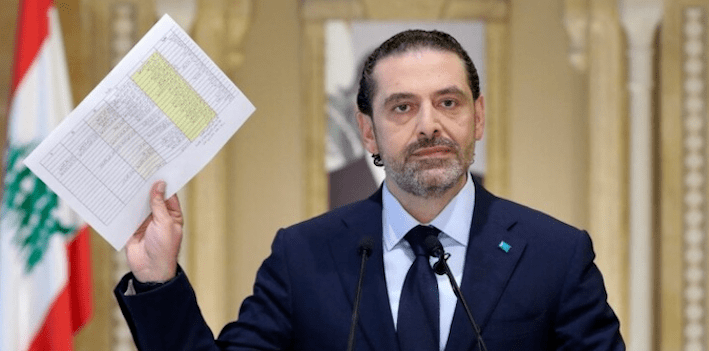
Lebanon’s prime minister-designate, Saad al-Hariri, has announced he would withdraw from the government-formation process, after trying unsuccessfully for nine months to put together a cabinet. Under the Lebanese constitution the prime minister-designate must sign the decree forming a government with the president of the republic, and Hariri and President Michel Aoun have been unable to reach any sort of agreement. Complicating matters is that the constitution is not clear on the authority the president has to intervene in naming and approving ministers.
Aoun has repeatedly returned the proposed governmental lineups that Hariri has brought him, because he disapproves of names. He insists that he has a right to have a say in the government-formation process. As proof of this, he and his entourage argue that the key prerogative the constitution has granted the president of cosigning the decree forming a government affirms that his role involves more than passively approving the prime minister-designate’s choices.
In turn, Hariri and much of the Sunni community, from which all prime ministers are appointed, argue that the prime minister-designate has the major role in putting together a government. While the president may ask for changes here and there, he cannot effectively form the government himself by repeatedly vetoing names the prime minister-designate brings him. They cite Article 64 of the constitution, which states that the prime minister-designate “shall conduct parliamentary consultations in forming a cabinet.” To them, the president is not accorded equal status under the constitution.
Why Is It Important?
The constitutional implications aside, Hariri’s withdrawal is significant because Lebanon is in the midst of a major economic collapse, and has been without an effective government since August 2020, when Prime Minister Hassan Diab stepped down in the wake of the horrific explosion in Beirut port. It is not clear who will replace Hariri, the leading representative of the Sunni community. Hariri believes that Aoun and his son in law Gebran Bassil sought to undermine his chances of becoming prime minister because of the political differences that divide the two sides.
If Hariri refuses to endorse another Sunni to replace him and obstructs the government-formation process as payback against Aoun and Bassil, it will be difficult, if not impossible, to find a credible Sunni willing to form a government. Lebanon will suffer as a consequence, since international organizations such as the International Monetary Fund, the World Bank, and countless governments have told the Lebanese that no help can be forthcoming before a new government is put in place and introduces economic reforms to unlock financial assistance.
Even if parliament recommends a replacement for Hariri (as it must do constitutionally), and Hariri goes along with the nominee, that person is almost certain to interpret the prime minister-designate’s role in the same way as Hariri did, or risk losing communal support. In other words, Aoun’s and Bassil’s victory may be a pyrrhic one.
Meanwhile, Lebanon’s national currency, the pound, continued to tumble on news of Hariri’s withdrawal. After his announcement, the pound’s value fell to around $1 = LL21,150, when in the morning it was hovering around $1 = LL20,000. Well over half the population lives below the poverty line and in June the World Bank released a report underlining that the country faced a “severe and prolonged economic depression,” which had been caused deliberately and that possibly ranked among the top three most severe economic and financial crises since the mid-19th century.
What Are the Implications for the Future?
Unless Lebanon’s political forces can quickly name a replacement for Hariri, a lengthy vacuum could destabilize the country even more than it already is. By hindering Hariri, Aoun has also opened the door to sectarian tensions between Christians and Sunnis, even if many Christians also oppose the president. While the Lebanese are resilient, without a horizon of improvement in the foreseeable future, popular anger could rise dramatically and spread to the streets.
How likely is it that a another Sunni will be named soon, however? Lebanon’s divided political class may decide that to avoid the fiasco of the latest government-formation process, it would be best to agree on a government behind the scenes before parliament names a prime minister-designate. But this is likely to be contentious, unless Aoun and Bassil are more flexible with Hariri’s replacement. More likely, the politicians will prefer to name the head of a transitional cabinet that organizes parliamentary elections, which are scheduled for next spring, hoping that the results will facilitate a breakthrough.
This raises the question of how Hezbollah will respond. When Hariri announced last October that he would try to form a government, it was clear that he was relying on Hezbollah to pressure Aoun and Bassil into being more amenable to a government he would form. This was overoptimistic, however, as Hezbollah was unwilling to compel the president to make concessions that could weaken him in the face of Hariri. Aoun’s primary ambition is to bring Bassil to power after he steps down next year, something that Hariri would like to prevent. For Hezbollah to have sided with Hariri against Aoun would have meant creating a conflict with the president over an issue he regards as vital. The party wants to avoid tensions with Aoun given the valuable cover he provides for Hezbollah’s weapons.
The reality is that Hezbollah may also mistrust Hariri due to his connections in the Sunni Arab world and his desire to strengthen ties with Western countries, particularly France and the United States. It’s conceivable that the party may also want Bassil as president next year, or at least would like to keep that option alive. Above all, Hezbollah may see that a Sunni-Christian clash over prerogatives creates space to push for its own agenda in Lebanon, one that involves exploiting the economic crisis to enhance relations with Iran. All this could explain why the party repeatedly said it wanted a government under Hariri, but never took decisive steps to bring it about.