



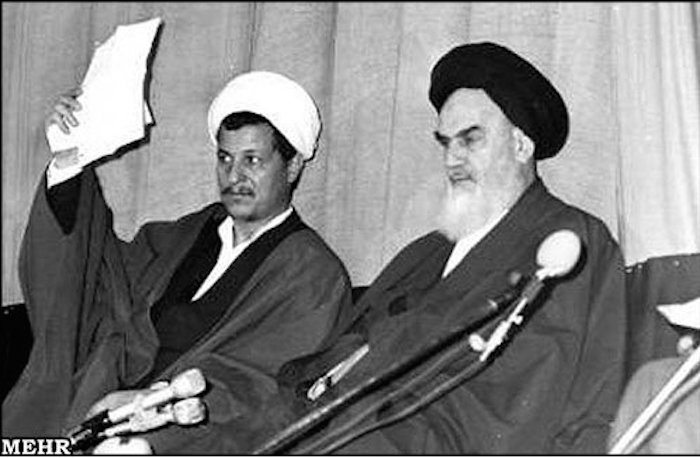
Unlike in 1989, the Revolutionary Guards and other powerful Iranian institutions will probably play an outsize role in determining and influencing the next Supreme Leader, especially now that another major revolutionary figure has passed away.
The unexpected death of Akbar Hashemi Rafsanjani could be the first scene in Iran’s nascent leadership transition theater, whose subsequent acts are probably yet to be written. The former president played a unique role in consolidating the power of both the Islamic Republic’s founder, Ayatollah Ruhollah Khomeini, and his successor Supreme Leader Ali Khamenei. Later, he paved the way for the rise of Mohammad Khatami as a “reformist” president after his own two terms in that office. And in 2013, his well-known protege Hassan Rouhani won the presidency due in large part to Rafsanjani’s vital support. It is therefore important to consider how Iran’s upcoming transitions — the June 2017 presidential election and the eventual task of determining the elderly Khamenei’s successor — will play out in the absence of a man whose fingerprints can be found on most every such moment in the regime’s four-decade history, and who embraced his role as a major irritant to Khamenei in his later years.
In practical terms, Rafsanjani’s positions as head of the Expediency Council and a key member in the Assembly of Experts will presumably be filled by a figure who is more loyal to Khamenei and the regime’s hardcore military camp — no surprise given his advocacy for replacing the position of Supreme Leader with a leadership council. Yet such an appointment would not necessarily produce a more united hardliner front. If regime “moderates” become even more marginalized following the death of one of their main boosters, new divisions will likely emerge in the radical camp as various figures jockey for position in order to take power post-Khamenei.
The legal procedure for appointing the Supreme Leader’s successor is clearly stated in the constitution, but neither Khomeini nor Khamenei came to office through that process. The Experts Assembly and its eighty-eight ayatollahs are the sole legal institution in charge of naming his successor. In the event that the Supreme Leader dies and the assembly needs more time to fill the position, the country is to be run by a provisional council consisting of the president, the judiciary chief, and a Guardian Council member selected by the Expediency Council.
The constitution is silent about the expiration date of this triad, and some might argue that an indefinite provisional arrangement is better than a new Supreme Leader. Yet one should not presume that such a council would take a less hardline approach than Khamenei — after all, the current judiciary chief and the overwhelming majority of Experts Assembly and Guardian Council members are dyed-in-the-wool radicals, and the hardline Islamic Revolutionary Guard Corps (IRGC) has an abiding interest in shaping Iranian decisionmaking post-Khamenei. Not even Rouhani’s presence would dilute such hardline pressure, assuming he is even reelected in June.
Although the Experts Assembly is not planning to discuss the succession process or potential Supreme Leader candidates publicly, Ahmad Khatami and other assembly members have individually indicated that a three-person committee was formed to study qualified candidates and provide a short list exclusively to Khamenei. Although this list is highly confidential, four potential candidate names have been mentioned more frequently than others in Iranian political circles and foreign media analysis:
- Sadeq Larijani, the judiciary chief
- Mahmoud Hashemi Shahroudi, a member of the Guardian Council and the Expediency Council and head of the arbitration committee tasked with resolving disagreements between three branches of government
- Mojtaba Khamenei, the Supreme Leader’s second son
- Ebrahim Raisi, custodian of Imam Reza Shrine.
At first glance, Shahroudi may seem like the most suitable candidate given his more senior clerical status (he is the only “marja” among these names) and his less outspoken stance against the “reformists,” which could widen his appeal. But Khamenei himself was not a natural successor to Khomeini on paper, so a long list of qualifications does not necessarily translate to more favorable candidacy. More important, none of the four men is less radical than Khamenei on domestic or foreign policy.
Yet nothing is guaranteed — the next Supreme Leader could just as well be someone else entirely. During the previous succession in 1989, Khamenei was not regarded as a top politician, and he lacked the charisma and clerical credentials of his predecessor. But he had never been accused of economic corruption or a direct role in violating human rights, suppressing dissidents, or silencing critics. In addition, the IRGC was a fundamentally different creature at the time — a popular military entity that had played a heroic spiritual role in the Iran-Iraq War and had not yet assumed its current prominence in regime affairs.
Today, however, it is difficult to find any prominent hardline or “moderate” figure who has not been publicly accused of massive corruption, human-rights abuses, or suppression of civil society (e.g., Larijani, Rouhani, and Shahroudi have all been the subject of widely disseminated reports and statements related to financial corruption). The IRGC has been transformed into a military-political-financial complex with an unmatched official and hidden role in controlling all aspects of Iranian public life, economy, and politics. And the regime can no longer rely as much on revolutionary sentiment to mobilize an increasingly disenchanted populace. This legitimacy deficit could prevent the succession process from moving forward as smoothly as it did in 1989.
Another complication lies in the fact that so many “revolutionary” institutions — not just the IRGC, but also the Imam Khomeini Committee, the Foundation for the Oppressed and Disabled, and others — have undergone major transformations over the years. Their gigantic size and vital political/economic role will likely force them to interfere in the succession process to one degree or another. Similarly, the colossal networks associated with the Imam Reza Shrine will certainly look for a privileged place in shaping the future leadership. Interestingly, the clergy — who are theoretically supposed to be the backbone of the regime’s semi-theocratic character — may prove to be much less influential in this process due to their growing financial and political dependence on the government and their declining popularity.
In short, while the key decisionmakers in appointing the Supreme Leader’s successor in 1989 were a handful of prominent, largely cooperative individuals like Khomeini’s son and Rafsanjani, the next succession will likely be driven by a wide array of competing institutions, with the IRGC on top. Consequently, the identity of the next Supreme Leader may be less important than it was in the past because the institutions that bring him to power will expect him to implement their agenda, using their ample leverage to convince him to protect their interests above others. In that case, one could reasonably assume that the IRGC will be Khamenei’s de facto successor.
CONCLUSION
The incoming U.S. administration should be prepared to witness a great deal of political transition in Iran over the next four years, including the death of Ayatollah Khamenei and the rise of a new Supreme Leader. Whether or not this transition results in actual transformation inside Iran, it will undoubtedly affect the entire Middle East. Khamenei’s successor stands to inherit his effective control over the region’s vast Shiite military and financial network. This fact — coupled with the old age of Ayatollah Ali Sistani, the powerful Iraq-based cleric who represents the last remaining alternative to Tehran in terms of transnational Shiite authority — should put the new leader in a comfortable position to expand Iran’s influence abroad and defy the interests of the United States and its allies.
Mehdi Khalaji is the Libitzky Family Fellow at The Washington Institute and author of the forthcoming study Future Leadership in Iran and the Shiite World.