



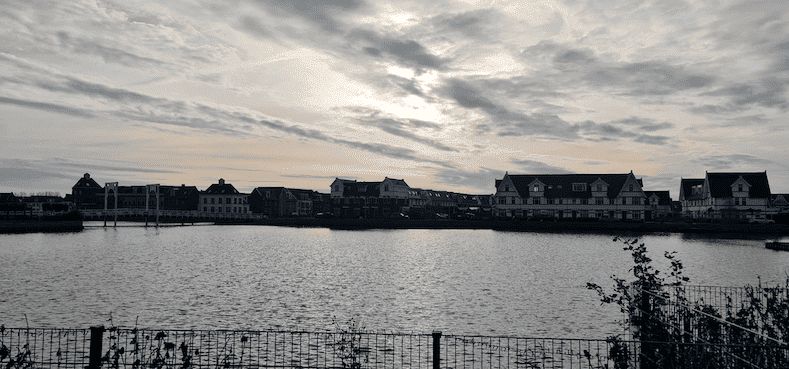
I woke up to one of those rare mornings in Weesp: No clouds, no haze, no rain. The sun had just risen, leaving a clear reflection on the surface of the artificial lake. In the Weesp suburb of Amsterdam, at my daughter’s house, I am squinting at an electronic screen, trying to read the news. I am not really a guest in this house. For a while, I am back inside the feeling of “home.” I am at my daughter’s place. Our three-year-old twin grandchildren are sleeping upstairs. My wife and I are living the great and hard-to-describe happiness of being reunited with them, of spending a few weeks under the same roof. One only understands with age: some mornings are illuminated not by the view outside, but by the life breathing inside the house.
The lake is calm. The water softens the sunlight and reflects it back. Cormorants glide slowly across the surface. Ducks are on their morning breakfast rounds. Some dive, some wait, some keep watch. They look thoroughly content. They are in no hurry. They have nowhere they must be. It feels as if the world has been complicated only by humans.
Before the grandchildren wake up, I want to catch a few minutes of silence. The news on the screen is as harsh as ever, as frantic as ever. The world is once again fighting with big sentences. Yet just a few meters away, a quiet order is at work on the water. Nature goes about its business without consulting anyone.
On the opposite shore, a neighbor has put two children into a small boat and is heading out for morning shopping. He rows slowly; the boat moves silently across the water. One of the children has dipped a hand into the lake, testing the coolness; the other is telling the birds something. Probably a story he has made up. But it is convincing. Because children do not yet weigh truth against falsehood; they try to understand the world. As we grow older, we stop trying to understand and start trying to explain.
Looking at this scene, one inevitably thinks of the Netherlands. The myth of the planned country. Cities built with maps. Victories won against water. Bicycle lanes, pedestrian priority, a philosophy of slow living. A system in which the municipality is almost sacred. At least, that is the story. From a distance, it looks like that.
But when you look a little more carefully at where you live, the picture starts to crack.
The main road connecting the homes on both shores is closed to vehicles. Construction work. No one knows how long it will last. There is a sign, but it measures patience more than it provides information. Just nearby, there is an exit to the highway. That too is closed, reserved for major construction projects in the area. Not open to the public. So even if you have a car, the road you theoretically own does not exist in practice.
Of course, there is also a small bridge connecting the two sides. Only pedestrians and cyclists can use it; cars cannot pass. The philosophy is clear: reduce the number of vehicles, encourage people to walk, cycle, live slowly. On paper, there is nothing to object to. It is even admirable.
But life is not always lived on paper.
It is possible to cross to the other side on foot or by bicycle. Yet this is not always as easy as it sounds. Today the weather is sunny. The morning is cool but clear. But this is the Netherlands. In winter, rain is not the exception but the norm. Rain falling several times a day, combined with wind, quickly evaporates the romance of “slow living.” Especially when grocery shopping is involved. If your bags are full, if you have children with you, if you are elderly, or simply tired, a ten or fifteen minute walk does not feel short at all.
Here one encounters a contradiction. A correct principle does not always produce correct results under every condition. The ideal of a car-free life stumbles when it collides with infrastructure and climate realities. And this stumbling is felt most sharply in the everyday lives of ordinary people.
Because the road is closed, those who want to cross by car have to take a long detour. You must circle the neighboring residential area, Muiden, from end to end. You smile when you look at the map. When you live it, the smile fades. You know the exaggeration people use: to get to the grocery store, the market, the children’s daycare or school, you have to go via Sofia and Belgrade. That is exactly how it feels.
Neighbors talk. The same sentences circulate at doorsteps, in the park, at the market. “Why is it closed?” “When will it be finished?” “Why were we not consulted?” There are many questions. There are no answers. The municipality and the construction company have email addresses. The replies are automated. Problems hit standard texts and bounce back.
At this point, one inevitably thinks of Türkiye. The lack of planning there, the excess of planning here. The indifference we are used to there, a version of it we did not expect here. The difference is this: in Türkiye, no one claims to be perfectly planned. Here, the claim is grand. Expectations are high. And therefore the disappointment is quieter, but deeper.
There is also the matter of time. It is not the construction itself that wears people down, but the uncertainty. It has a beginning, but the end is vague. You cannot organize your life around it. A child’s school, an elderly person’s doctor’s appointment, working hours. A city should regulate not only space, but time as well. Here, time feels as if it has been suspended.
The birds on the lake are unaware of these troubles. For them, there is no road, no direction, no alternative route. They cross by flying. Perhaps that is the real issue. Humans think they dominate nature when they build cities, but then they get stuck behind a construction barrier. The ducks simply pass over the water and go on their way.
A sound comes from upstairs. One of the grandchildren is awake. The other will wake up soon. The house will come alive. Toys will scatter across the floor. Life will move from theory to practice. At that moment, neither the closed road nor the municipality’s silence will matter. Because some mornings, despite all the world’s flaws, you greet the day with a simple sense of gratitude.
Still, it is worth taking note. A city is not built on good intentions alone. It must be thought through together with climate, with people, with the elderly, with children. Slow living should be a choice, not an imposition. Otherwise, a good idea turns into a small daily hardship.
I take my coffee and step back to the window. The sun has climbed a little higher. The light is no longer blinding. I have adjusted. People adjust to everything. Perhaps that is the most dangerous thing of all. Adjusting to closed roads, to detours, to not being listened to.
The lake is still calm. The birds are still content. Children’s voices rise inside the house. Life goes on, with all its contradictions. The city stumbles, but morning is still morning. And sometimes, amid all the poor planning, the best plan of all is simply having breakfast at the same table with your grandchildren.