



The Palestinian president, who comes from Safed in present-day Israel, will forever be seen as a foreigner in Ramallah and the West Bank cities
Mahmoud Abbas has often threatened to resign, dismantle the Palestinian Authority and hand the keys over to Israel. The threats, as always, blow over and he stays there at the Muqata in Ramallah, playing the president of Palestine.
Arab leaders don’t quit and clear a path for new leaders. They will never utter a phrase like “I cannot go on any longer.” Moreover, a man like Abbas is someone who never leaves the Muqata for anything but meetings with leaders abroad.
He hasn’t toured Qalqilyah and Tul Karm. He hasn’t visited Jenin or walked around Hebron. He hasn’t gone to Bil’in to be with the protesters against the separation barrier, as did Salam Fayyad, who briefly served as prime minister until he was removed. Fayyad did so because he’s a son of the place. Not so Mahmoud Abbas, who comes from Safed.
This is about the perception of the homeland in the Arab and Palestinian experience. Unlike the broader Zionist view, the Palestinians see the term “homeland” in a narrow sense. The Palestinian approach limits the homeland to the community’s boundaries, to the tribe’s borders, no further.
To understand this issue we should consider the words of Mahmoud Darwish, often considered the Palestinian national poet: “I come from there and I have memories / Born as mortals are, I have a mother / And a house with many windows, / I have brothers, friends, / And a prison cell with a cold window. / … I learned all the words and broke them up / To make a single word: Homeland ….”
And what is Darwish’s homeland? It’s not the entire Palestinian space. Darwish’s homeland is very restricted. Darwish was born under the British Mandate in what is now Israel. In an interview with The New York Times in 2001, he admitted: ‘’I had never been in the West Bank before. It’s not my private homeland. Without memories you have no real relationship to a place.’’
In other words, the Palestinian national poet’s homeland is different from the homeland in the Zionist sense. The Palestinian homeland is personal and limited to the village, the clan and the tribe. This perception may be the biggest obstacle to settling the Israeli-Palestinian conflict.
As long as Abbas bears the title “president of Palestine,” he will keep sitting there praising Palestine. But he will be bearing this name in vain. Abbas, who comes from Safed, will forever be seen as a foreigner in Ramallah and the West Bank cities.
So Abbas won’t quit. To him, to quit means leaving Palestine. He won’t go to Jericho or the Jordan Valley to make the Palestine wilderness bloom. Abbas knows that if he quits, he has nothing to look for in Ramallah and he will leave Palestine to one of the Gulf states, or perhaps to Jordan, to be with his family, with his personal homeland that isn’t there.
If the Palestinians had a developed Arab imagination they’d act differently. In the present situation they have two options – one is to throw the keys onto the Israeli government’s table, let it handle the occupation, and fight for one state with equal rights for all citizens. The second option is to organize broad protests against the “corrupt” Palestinians who signed the Oslo Accords – who were brought in from afar as leaders subordinate to Israel’s whims. They should make way for authentic leaders deeply rooted in the place.
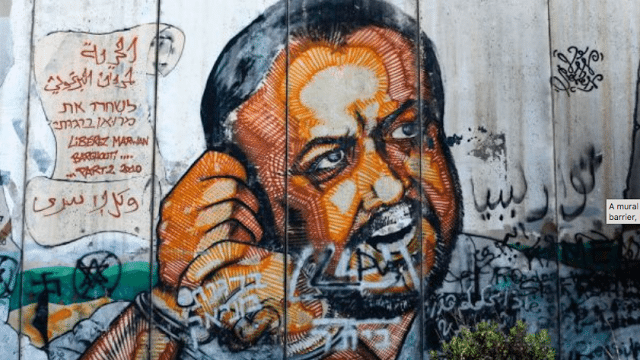
Such leaders exist and they’re doing time in an Israeli prison. The Palestinians must elect Marwan Barghouti as Palestine’s president while he’s sitting in an Israeli prison cell. They must appoint Salam Fayyad, an honest, reputable man, the prime minister of occupied Palestine.
Only Palestinian leaders deeply rooted in their personal homeland can make decisions on an agreement between Palestine and Israel, about peace between two nation-states.
*
Haaretz, December 17, 2017
*
For Hebrew, press here