



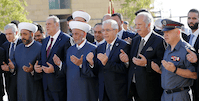
(Former foes in the community are realigning, many rallying around Saudi Arabian sponsorship.)
To honor the mufti of the republic, Sheikh Abdel Latif Derian, in early September, parliamentarian Faisal Karami hosted a banquet at his summer residence in Bqaa Sifrin. The gathering brought together figures once positioned on opposing ends of Lebanon’s political spectrum, signaling a new reality within the Sunni arena.
Karami invited Hassan Mrad, Adnan Traboulsi, and Taha Naji, who were long regarded as being in Hezbollah’s orbit, as well as Fouad Makhzoumi, Ashraf Rifi, Abdel Rahman al-Bizri, Bilal Hasheimi, Ahmad Kheir, Abdel Aziz al-Samad, Waddah Sadeq, Mohammed Yahya, and Nouhad Machnouq, who tended to be in the rival camp.
The choice of the occasion was no less symbolic. Honoring the mufti was a deliberate gesture, reflecting a broader trajectory that has unfolded since the conflict with Israel last year, and whose foundations were laid during this year’s municipal elections. The rapprochement brought together independent opposition figures, former Hezbollah allies, and the Sunni religious establishment, crystallizing a shift in the Sunni community’s political alignments.
The guests listened to an intervention by Karami. He has supported a state monopoly over weapons while maintaining hostility toward Israel, but from the perspective of the state and its sovereignty, not from that of the resistance. Until recently, Karami was an ally of Hezbollah, but he did not take part in the funeral of Hezbollah’s late secretary general, Hassan Nasrallah.
As for Derian—who is now a rallying figure for Sunnis in the absence of a unified Sunni leadership—he did not diverge from Karami’s position. He confirmed his support for the Lebanese government’s decision to restrict weapons to the state. He also emphasized the importance of strengthening Lebanon internally and called for “a unifying approach that fortifies the nation in the face of crises.” This was a stance shared by all. Hassan Mrad, another political figure who had been close to Hezbollah and Syria’s Assad regime, made similar comments to those of Karami and Derian, adding that he stood behind President Joseph Aoun and Prime Minister Nawaf Salam. He also declared that he rejected any provocations directed against Saudi Arabia.
The phrase was not coincidental. It came within the context of a Saudi strategy to draw Sunni politicians away from Hezbollah and integrate them into a coalition with the kingdom’s own supporters, whether in the Sunni community or beyond. This coalition would support Saudi orientations, at least on the main issues, and would not be a temporary alliance of convenience. Only three Sunni political forces remain outside this framework—the Future Movement, or rather leading figures from the movement after the suspension of the party’s activities; the Jamaa al-Islamiyya, which was founded as the Lebanese branch of the Muslim Brotherhood; and a group of reform-oriented parliamentarians from the so-called Change Bloc.
The Future Movement figures are currently gathered in the Moderation Bloc, which includes parliamentarians Walid al-Baarini, Mohammed Sleiman, Abdel Aziz al-Samad, Ahmad Rustom, Sajii Atiyeh, and Ahmad Kheir. Recently, they declared that “the Lebanese government’s decision to restrict weapons to the state is historic,” calling on Hezbollah to “cooperate with the Lebanese authorities under the roof of the state,” a position that another Sunni parliamentarian from Beirut, Nabil Badr, effectively endorsed as well. Among the parliamentarians from the Change Bloc, Ibrahim Mneimneh has also argued that Hezbollah must hand its weapons over to the state without further discussion.
The differences between the Moderation Bloc, the Change parliamentarians, and the parliamentarians who gathered around Derian are very small when it comes to Hezbollah’s weapons and giving the Lebanese state a monopoly over weapons. Their positions have been driven by domestic and regional calculations. A majority has voiced support for the government, including those who were once allied with Hezbollah.
However, there have been some differences on weapons among Sunni groups. This was highlighted when Imad al-Hout of the Jamaa al-Islamiyya met “alone” with Lebanese President Joseph Aoun to present a proposal for a “national defense strategy.” This marked a continuation of the Jamaa’s longstanding approach since 2006 of calling for such a strategy. While the Jamaa remains a Sunni outlier in advocating for the continuation of holding weapons to defend against Israel, implicitly it also agrees to deny Hezbollah weapons that it can use domestically.
This position stems from the fact that the Jamaa itself is among the targets of the state’s disarmament process, reinforced by its enduring ideological conviction of the legitimacy of armed resistance, even if its military capacity is widely regarded as modest. This was reflected in the nature of the Israeli strikes against the group during the conflict last year, which targeted individuals rather than centers, stockpiles, or tunnels—capabilities it does not possess.
Moreover, the Jamaa today lacks both internal political cover and external support. For example, ten Jamaa members have remained imprisoned for more than two months on charges of possessing weapons and ammunition, despite the Lebanese army’s announcement that their case was not terrorism-related. Nonetheless, a clear message was conveyed to the organization, according to three Jamaa leaders who spoke to me, namely that it had to tread carefully as there would be no leniency in matters related to weapons. Moreover, any consequences would extend to the entire organization, not just its military wing. Despite such pressure, the Jamaa has not altered its discourse, continuing to defend a national defense strategy.
Thus, the Sunni political landscape has reconstituted itself along relatively clear lines since the end of the war a year ago, and the subsequent shift in Lebanon’s balance of power. On the one side is a coalition that emerged from unified lists during this year’s municipal elections—the same forces that gathered at Karami’s residence—portraying itself as aligned with Saudi Arabia.
On the other side is the Future Movement, or rather those of its members who have remained active in political life. They, at times, have expressed even harsher positions with regard to Hezbollah than the first group. Added to this are the divided Change parliamentarians, most of whom have opposed Hezbollah and its arms. Meanwhile, the Jamaa al-Islamiyya remains isolated, leaving it openly exposed to potentially existential risks.
Looking ahead, these divisions are expected to persist into the next parliamentary elections. These elections will be shaped by the continued absence of the Future Movement, the Jamaa’s marginalization, and attempts to forge a coalition among the remaining forces, with Saudi Arabia acting, at least nominally, as the sponsor. Still, such support does not guarantee an electoral victory. Sunni electorates in Beirut and Tripoli have repeatedly demonstrated their aversion to coalition lists imposed from above, which funnel often antagonistic candidates into artificially unified lists.
In the recent municipal elections in Tripoli, for example, a broad coalition list was level with one led by civil society candidates. Similarly, in Beirut, a unity list effectively lost within the Sunni street. In light of this, there has been growing talk of reviving a reform-oriented current within the Sunni community—one that builds on the momentum of the municipal elections. Yet even if this were to happen, the impact would not fundamentally alter the Sunni community’s broader alignment with Saudi Arabia as an external reference point, or diverge from the kingdom’s positions inside Lebanon, whether regarding Hezbollah or reinforcing the authority of the Lebanese state.
ALSO READ:
انتخابات أيار/مايو 2026: كَسر احتكار “الثنائي” للتمثيل الشيعي”!