



The government’s unprecedented decision to disarm Hezbollah is brave, but as U.S. officials have repeatedly discovered, continual pressure will be needed to ensure that Lebanon and Israel actually implement their obligations under the new plan.
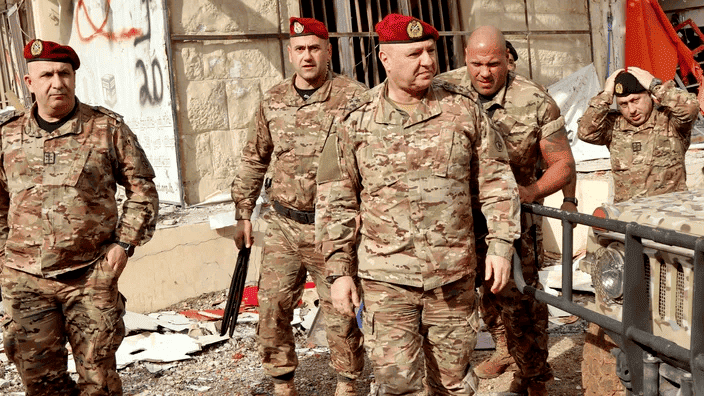
After months of vacillating, the government of Lebanon announced on August 7 that it would disarm all militias—including Iran-backed Hezbollah—throughout the state. The new policy was adopted under duress. Although Beirut tacitly agreed to confiscate all of Hezbollah’s weapons in the November 2024 ceasefire agreement with Israel, the militia and its political allies strongly opposed the idea, raising fears of potential civil war and undermining the government’s resolve. Yet repeated visits by U.S. envoy Tom Barrack and continuous pressure to respond to Washington’s disarmament roadmap eventually ended the impasse. The government has now tasked the Lebanese Armed Forces (LAF) to deliver a disarmament plan by August 31.
The coming weeks will reveal not only the seriousness of the LAF proposal, but also the nature of Hezbollah’s response (violent or otherwise) and Beirut’s political commitment to the initiative. Equally important will be how Israel reacts to demonstrable progress on the Hezbollah front, with U.S. pressure potentially being brought to bear on Jerusalem as well. In particular, Barrack seeks reciprocal Israeli measures correspondent to Beirut’s efforts, such as withdrawal from some occupied positions inside Lebanon and/or reduced military strikes.
Stalled Progress in the North
Like many ceasefire deals, last year’s agreement to end the Hezbollah-Israel war was deliberately ambiguous on certain issues. Lebanon explicitly agreed to implement UN Security Council Resolution 1701, which called for removing Hezbollah’s weapons and presence south of the Litani River along the frontier with Israel—the same commitment Beirut made after the 2006 war. Yet the deal’s provisions about disarming Hezbollah north of the Litani (originally expressed in Resolution 1559) were less explicit. Paragraph 7 of the agreement directed Lebanon to dismantle Hezbollah sites “starting with the southern Litani Area” but did not clarify what would come next. Israel and the United States understood that Lebanon would continue these efforts in the north, and Beirut almost certainly had the same interpretation. Yet the phrasing enabled the government to plausibly deny that it had committed to full disarmament in the near term, avoiding (at least temporarily) Hezbollah retribution.
As a result, both the LAF and the new government that came to power early this year largely embraced disarmament activities in the south, but then balked at the idea of continuing these activities north of the Litani. With momentum stalled for months, Barrack returned in June to deliver a detailed disarmament plan, then paid another visit in July to push the process forward. On August 7, the cabinet approved the portion of the U.S. roadmap requiring Lebanon to bring “all arms under the authority of the state” nationwide. Notably, Hezbollah ministers and their Shia allies withdrew from the contentious meeting before the vote.
Barrack’s Proposal
The U.S. roadmap lays out a 120-day schedule of actions for Lebanon and Israel to undertake simultaneously. Chapter I—which covers the first fifteen days and focuses on declared commitments and preparatory actions—mandates that Beirut commit to fully disarming Hezbollah by December 31, and that Israel cease military operations in Lebanon during these initial weeks. In addition, the LAF is expected to establish fifteen border posts south of the Litani, while the government is to give the Red Cross details regarding prisoners held by Israel in preparation for a future exchange.
In Chapter II (spanning forty-five days), the LAF is to present a plan for implementing disarmament north of the Litani, with approval from the government and military technical assistance from the United States. The LAF plan and deployments will be monitored by the same U.S.-French mechanism that has been overseeing the ceasefire. Concurrently, Israel is to begin withdrawing from three of the five hilltop positions it occupies in south Lebanon, while the United States, France, Qatar, Saudi Arabia, and others organize a fall conference to raise reconstruction funds.
Further out, the roadmap envisions a broader LAF deployment and checkpoints throughout the country, a full Hezbollah and Israeli withdrawal from the south, complete Hezbollah disarmament, and cessation of Israeli overflights. Should Lebanon breach the agreement, it would be subject to economic sanctions and a freeze on U.S. military assistance; an Israel breach would spur a Security Council “censure” and, more ominously, “military deconfliction reviews” (i.e., a potential downgrading of bilateral security coordination with the United States).
The Future of UNIFIL
August 31 is also the annual renewal date for the UN Interim Force in Lebanon, which has failed to fulfill its mandate in spectacular fashion for years despite being granted 10,500 troops to patrol the south and $500 million per year in funding. (The United States previously paid $125 million of this amount annually, though the Trump administration has zeroed out the $1.2 billion U.S. contribution for UN peacekeeping efforts worldwide in 2026.) Still, the organization has its supporters, principally France (the UN penholder on UNIFIL) and Lebanon (which benefits economically from the deployment and has used it as an excuse to deploy fewer LAF troops in the south).
In 2020, the first Trump administration threatened to veto UNIFIL’s mandate renewal unless significant changes were made, but the Beirut port blast scuttled that effort. The current administration is also a UNIFIL skeptic and appears poised to finally end the mandate, allowing sufficient time for an orderly drawdown. This is the right decision, since the arguments against UNIFIL are legion: its utility is limited, its primary substantive contribution (convening discussions between Israeli and LAF officers) has been absorbed by the U.S.-French mechanism, and its presence has enabled Beirut to sidestep responsibility for the south for too long. If the administration continues to press Beirut under the roadmap process—and with UNIFIL gone—the latter sovereignty problem should dissipate
Now Comes the Tough Part
Beirut should be commended for its unprecedented and difficult decision to disarm Hezbollah. Now it is time for the historically risk-averse LAF—which has long deconflicted with Hezbollah and even collaborated with the militia—to come forward with a workable plan. Even if the military receives unstinting government support, however, there is no guarantee the plan will succeed. Although Hezbollah is now a much smaller force than the LAF (which has nearly 85,000 personnel), the potential for deadly sectarian conflict is real, with Hezbollah threatening civil war if the government moves forward on disarmament. The militia has a history of assassinating its political opponents, and six LAF troops were killed earlier this month while dismantling Hezbollah infrastructure.
As such, the LAF might balk at executing the government’s decision on Hezbollah. In 2008, for example, military leaders refused to follow government orders to dismantle the group’s fiber-optic network and remove a Hezbollah-affiliated officer as head of security at Beirut airport. Hezbollah responded to the orders by sending its forces into the streets, killing nearly a hundred civilians while the LAF essentially did nothing. Alternatively, the LAF could proceed with a disarmament plan but organize it in phases to minimize conflict with the militia—though as the saying goes, “no plan survives first contact with the enemy.”
Another complication is Israel. During his visit to Beirut just days ago, Barrack told reporters, “I think the Lebanese government has done their part. They’ve taken the first step. Now, what we need is Israel to comply.” He was referring to withdrawal from military positions in Lebanon; he has also reportedly asked Israel to reduce “non-urgent” strikes. Jerusalem will be hesitant to honor these requests until Beirut actually begins implementing its brave political decision. Indeed, the roadmap’s timelines are somewhat unrealistic and call for concrete actions from Israel in return for statements from Lebanon. Yet U.S. officials should still remind Jerusalem that an undue delay in reciprocating tangible steps by Beirut—even well short of what the plan proposes—could gradually discredit Prime Minister Nawaf Salam and President Joseph Aoun, the new leaders who took the risky move of opposing Hezbollah.
In the end, Lebanon may still miss another once-in-a-generation opportunity for state sovereignty, whether by flinching to avoid armed confrontation or proving inadequate to the military task despite years of U.S. training and funding. Even so, the Trump administration should persist with its pressure by leveraging U.S. funding for the LAF, threatening sanctions against obstructionist politicians, and conditioning reconstruction on implementation of the disarmament plan. The LAF has shown some promise of late by establishing effective border posts along the frontier with Syria, including in the Hezbollah heartland of Beqa Valley. On paper and on the ground, the force should be more than capable of preventing a weakened Hezbollah from controlling the south, as well as moving incrementally but inexorably toward a state monopoly on weapons. This is no doubt a risky endeavor, but the alternative is a failed state perpetually at war with Israel.
David Schenker is the Taube Senior Fellow at The Washington Institute and director of its Rubin Program on Arab PoliticsP