
Close Menu
    Facebook Instagram LinkedIn
    • العربية (Arabic)
    • English
    • Français (French)
    Facebook Instagram LinkedIn
    Middle East Transparent
    • Home
    • Categories
      1. Headlines
      2. Features
      3. Commentary
      4. Magazine
      5. Cash economy
      Featured
      Headlines Shaffaf Exclusive

      Talk and Plot: Teheran Double Game with the Sharaa Regime

      Recent
      6 January 2026

      Talk and Plot: Teheran Double Game with the Sharaa Regime

      5 January 2026

      When “law enforcement” looks like piracy: The Maduro seizure, Türkiye’s caution, and the “precedent” problem

      5 January 2026

      The Financial Stabilization and Deposits Repayment Act: A Controversial Step in Lebanon’s Crisis Management

    • Contact us
    • Archives
    • Subscribe
    • العربية (Arabic)
    • English
    • Français (French)
    Middle East Transparent
    You are at:Home»Categories»Features»Israel sets to annex disputed maritime border area

    Israel sets to annex disputed maritime border area

    0
    By Ynet on 20 March 2017 Features
    The dispute between Israel and Lebanon over the maritime border between them has been going on for years, with both countries claiming a specific area as part of their territory; Now, Israel plans to propose a bill that includes the aforementioned area as part of its own territory—and as such, under its sovereignty.

    Amir Ben-David|

    It was recently decided to bring a bill to define the maritime economic border with Lebanon to be read and voted on by the government and the Knesset. The move comes after years of delaying the ruling on Israel’s maritime border, partially due to efforts by the United States and the United Nations to mediate between Israel and Lebanon.


    The proposed bill includes a large territory still under dispute with Lebanon.
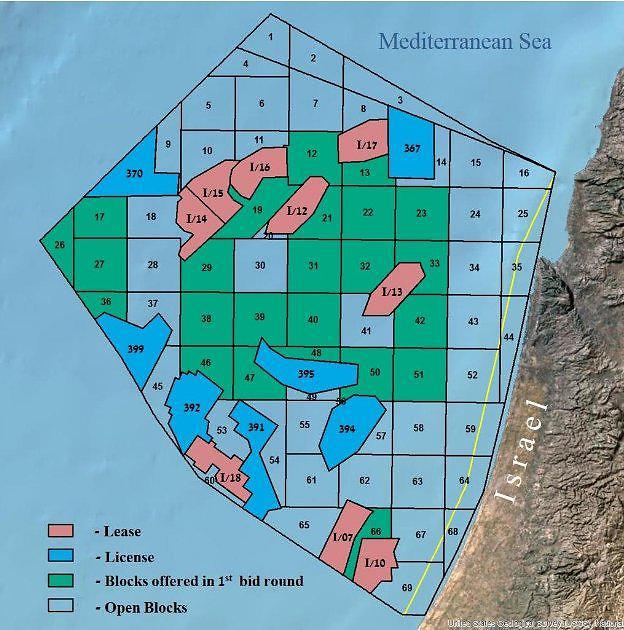
    Israel-Lebanon maritime border

    Israel-Lebanon maritime border


    The bill is aimed to claim Israel’s sovereignty over the area, mainly for the purpose of harvesting natural recourses like oil and gas.

    According to international law, dividing territory between states that reside near the same maritime area is done through their mutual agreement and is largely based on the “mid-point” between the two.

    Though Israel and Lebanon have been in dispute over what the mid-point between their maritime borders is, both countries are fighting over an 800 square kilometer trianglular maritime area (seen in the picture as areas 1-3), with both claiming they have the right to extract oil and gas from the area.

    After Lebanon recently broke the status quo, advertising a tender to search for natural resources in the disputed area, Israel began promoting a bill that aims to define the area within the Israel’s maritime territory.

    Minister of Environmental Protection Ze’ev Elkin and Minister of National Infrastructure, Energy and Water Resources Yuval Steinitz (Likud) consolidated other agreements regarding what government body would have the authority over the area, eventually giving it to the Ministry of Energy. The Ministery of Environmental Protection agreed to stay as a non-authority advisory agency.

    The Ministry of Environmental Protection responded that “the bill has many positive aspects regarding the environment, as it promises certainty of the application of environmental laws in the area. However, the ministry is not satisfied with the current arrangement which does not clarify what agency will be the one overseeing the impact on the environment.”

    YNET
    Share. Facebook Twitter LinkedIn Email WhatsApp Copy Link
    Previous ArticleSyria claims it shot down an Israeli combat plane; Israel denies: dissecting the latest IAF strike on Damascu
    Next Article Six Years of War: Is Assad Still Relevant?
    Subscribe
    Notify of
    guest
    guest
    0 Comments
    Newest
    Oldest Most Voted
    Inline Feedbacks
    View all comments
    RSS Recent post in french
    • La liberté comme dette — et comme devoir trahi par les gouvernants 2 January 2026 Walid Sinno
    • La « Gap Law »: pourquoi la précipitation, et pourquoi les Français ? 30 December 2025 Pierre-Étienne Renaudin
    • Au Liban, une réforme cruciale pour sortir enfin de la crise 23 December 2025 Sibylle Rizk
    • Le Grand Hôtel Abysse sert toujours des repas en 2025 16 December 2025 Walid Sinno
    • Au cœur de Paris, l’opaque machine à cash de l’élite libanaise 5 December 2025 Clément Fayol
    RSS Recent post in arabic
    • لعبة طهران المزدوجة مع نظام الشَّرَع: عروض مالية وتحريك “الساحل” 6 January 2026 خاص بالشفاف
    • ردّاً على فاخر السلطان: إما قانون دولي يُحترم، أو فوضى يدفع ثمَنَها الجميع 5 January 2026 د. فيصل الصايغ
    • بيان جمعية المصارف حول “مشروع قانون الانتظام المالي واسترداد الودائع” 5 January 2026 الشفّاف
    • فنزويلا الملاذُ الآمن لقيادات حزب الله والعلماء النوويين الإيرانيين! 4 January 2026 خاص بالشفاف
    • دونالد ترامب ممزّق بين الإمارات العربية المتحدة والمملكة العربية السعودية 4 January 2026 خاص بالشفاف
    26 February 2011

    Metransparent Preliminary Black List of Qaddafi’s Financial Aides Outside Libya

    6 December 2008

    Interview with Prof Hafiz Mohammad Saeed

    7 July 2009

    The messy state of the Hindu temples in Pakistan

    27 July 2009

    Sayed Mahmoud El Qemany Apeal to the World Conscience

    8 March 2022

    Russian Orthodox priests call for immediate end to war in Ukraine

    Recent Comments
    • P. Akel on The Grand Hôtel Abysse Is Serving Meals in 2025
    • Rev Aso Patrick Vakporaye on Sex Talk for Muslim Women
    • Sarah Akel on The KGB’s Middle East Files: Palestinians in the service of Mother Russia
    • Andrew Campbell on The KGB’s Middle East Files: Palestinians in the service of Mother Russia
    • farouk itani on A Year Later, Lebanon Still Won’t Stand Up to Hezbollah
    Donate
    © 2026 Middle East Transparent

    Type above and press Enter to search. Press Esc to cancel.

    wpDiscuz