



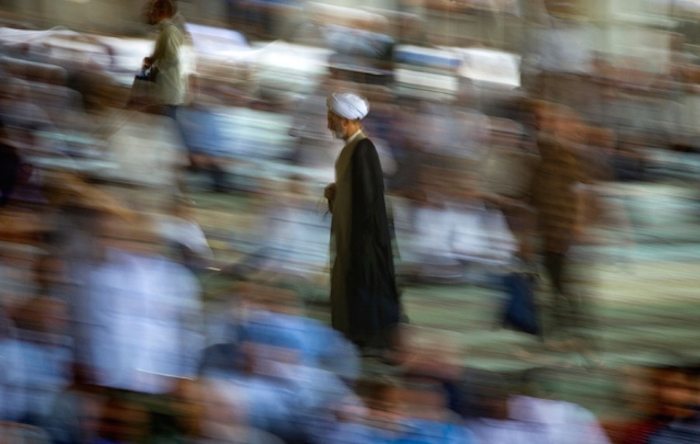
As clerics are pushed ever further to the political margins, the regime will need to double down on its current strategy: relying more on security measures than spiritual authorities to ensure its survival.
This PolicyWatch is the third installment in a three-part series on Iran’s upcoming election. Read part one (on differentiating between Tehran’s elected and revolutionary power centers) and part two (on economic issues).
The clergy’s decreasing role in Iranian politics is becoming more visible than ever in the current presidential campaign. Two major clerical institutions issued their candidate endorsements much later than expected this year, and the relevance of their advocacy is questionable. The Association of Qom Seminary Teachers, a political organization based in the center of Shiite learning, endorsed hardliner Ebrahim Raisi, as did the Association of Militant Clerics in Tehran, which is supervised by Supreme Leader Ali Khamenei’s Paydari Front and closely linked with powerful conservative ayatollah Muhammad Taqi Mesbah-Yazdi. Since 1997, however, all of the presidential candidates endorsed by these associations have lost, including to current incumbent Hassan Rouhani in 2013. Furthermore, they appear to have only limited influence over the regime’s most committed hardliners, while other key religious authorities tend to refrain from public endorsements altogether.
DE-CLERICALIZED BUT STILL ISLAMIST
The Islamic Republic’s constitution and political practice give unique privileges to clerics. They are not bound by the country’s compulsory military service, and both they and their institutions are exempt from taxes. In addition, ayatollahs have an exclusive claim on most of the regime’s top positions, including Supreme Leader, minister of intelligence, judiciary chief, the Assembly of Experts, and half of the powerful Guardian Council.
These privileges have helped transform the clerical establishment from a traditional organization relying on religious resources to a gigantic entity with modernized bureaucracy, unlimited access to national resources, and the ability to rival the private sector on all fronts. Yet this growth has been a double-edged sword for the establishment — although they gained a windfall of personal wealth and top posts in various regime organs, they have lost much of their independence, popularity, and actual power to other regime institutions or social groups.
The emergence of former president Mahmoud Ahmadinejad — a lay politician who rose to prominence with the military’s backing and defeated Ayatollah Akbar Hashemi Rafsanjani at the polls — was a landmark moment in the Islamic Republic’s shift from a clergy-led government to a regime led by “lay Islamists” who use the clergy solely to maintain their legitimacy. The Islamic Revolutionary Guard Corps has been the main driver behind this change — today, it is difficult to find any facet of public or private life, from the economy to foreign policy to the nuclear program, that is not controlled by the IRGC.
During his first widely broadcast campaign speech on April 27, President Rouhani asked IRGC-affiliated companies and intelligence agencies to stop weakening the private sector: “In the economy, competition should be healthy. Private companies cannot compete in the market if other corporations benefit from political and intelligence support.” He offered similar criticisms in 2014, arguing that if Iran’s money, military capabilities, media outlets, and cyberspace all become subject to the unmatched power of a single institution (i.e., the IRGC), then that institution will necessarily be corrupted.
Likewise, in August 2015, deputy speaker of parliament Ali Motahhari called the Guards “the people’s rival” in the economy. And in 2009, the IRGC’s increasing role in Iranian decisionmaking, economics, and electoral manipulation spurred the late Ayatollah Hossein Ali Montazeri to note, “Iranian leaders should be brave enough to declare that the existing government is neither a republic nor Islamic.” This indictment was particularly damning given his legacy as the theoretician of velayat-e faqih, the doctrine granting the Supreme Leader his authority.
The military’s overwhelming presence can also be measured by the public’s loss of interest in discussing the regime’s religious legitimacy. In the 1980s and ’90s, velayat-e faqih was a matter of hot debate in the media and other public forums, with many secular intellectuals and religious figures criticizing the theory inside and outside Iran. Since then, however, most observers have seemingly concluded that such discussions are irrelevant, at least in terms of swaying regime supporters or mobilizing the anti-regime camp. The decline in debate is also related to the inertial power of the status quo — the regime’s “legitimacy” stems at least in part from the fact that it is entrenched in all aspects of Iranian life and would be difficult to change rapidly (not to mention the likely personal costs of even trying to do so).
DECLINE OF SOCIAL AUTHORITY
Despite expanding their social network and using more government resources to guide public thinking, Iran’s clerics have lost their formerly paramount social authority. Their irrelevance in Iranian political campaigns is only one of many examples. In the past, the regime relied heavily on clerics to influence citizens into following its directives, but now it uses movie stars and sports figures to speak to the people on politics and even morality. Despite its sky-high wealth, the clergy has seen its role in managing religious rituals and ceremonies decrease significantly over the past two decades, with maddahs (lay religious singers) taking over many such duties.
The clergy’s concern about this deteriorating influence has become serious enough to go public. In 2016, the Office for Islamic Outreach, a colossal regime clerical organization supervised by Khamenei, held a seminar titled “Sociopolitical Prestige of the Clergy in the Islamic Republic’s Fourth Decade.” Speakers examined the reasons behind their declining political and social stature and admitted that the problem had reached a critical point.
In reaction to the clergy’s over-politicization, a new generation of seminarians has been trying to depoliticize itself. This trend worries Khamenei so much that he has tightened control over management of the clerical establishment. As Mesbah-Yazdi disciple Ayatollah Mohsen Gharavian stated last month, “The erudite seminarians are increasingly keeping their distance from politics and government…We see fewer clerics interested in dealing with political issues in their courses. For instance, in the seminary, they do not raise Imam Khomeini’s thought in their courses and textbooks.”
CONCLUSION
Paradoxically, the theory of velayat-e faqih has undermined fiqh (Islamic jurisprudence) since the 1979 revolution. Shiite clerics at all levels have found that there is little point to studying fiqh and becoming faqihs (Islamic jurists) when the Supreme Leader treats them like anyone else, forcing them to obey his rulings alone on all religious and non-religious matters. Indeed, velayat-e faqih gives the Supreme Leader unique authority to overrule Islamic law whenever it contradicts the regime’s interests. As the clergy become less and less relevant, the regime will need to double down on its current strategy, relying more on security measures than spiritual authorities to ensure its survival.
Mehdi Khalaji is the Libitzky Family Fellow at The Washington Institute and author of its recent study The Future of Leadership in the Shiite Community.