



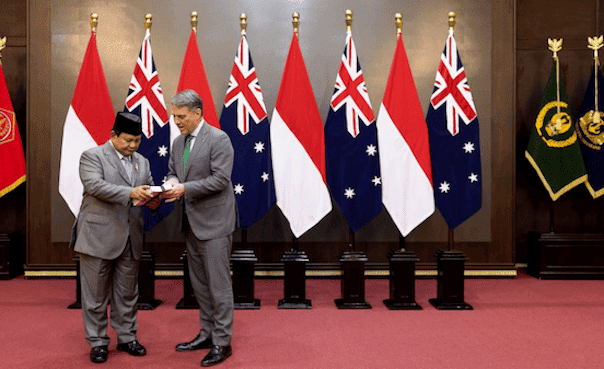
For more than decade, there have been signs that Australia is losing diplomatic access and influence in Indonesia.
This is cause for concern, given Indonesia’s size and influence in the Indo-Pacific, and because of the strategic benefit of its location along Australia’s northern approaches. Last month, Janes reported that Russia had requested aircraft access to Manuhua airbase at Biak in Indonesia’s Papua Province. And earlier this year, to circumnavigate Australia, the Chinese navy transited through Indonesia’s straits. At the same time, Indonesia has become increasingly enmeshed with China in economic, foreign policy and security terms.
As Australia considers the unreliability of the US security umbrella, it must pay more attention to the near north.
The causes of Canberra’s declining influence and Jakarta’s closer alignment to Beijing are complex and attributable to systemic and policy factors on both sides. In short, Indonesia’s economy and international political influence rose in the years after its 1998 democratic transition, reducing the traditional power asymmetry that had favoured Australia in economic and military terms.
The 2014 election of Joko Widodo, who replaced internationalist president Susilo Bambang Yudhoyono, saw a more transactional foreign policy. This policy emphasised trade, tourism and investment, placing them above democratic-norm promotion or strong leadership in the Association of Southeast Asian Nations to counter Beijing’s South China Sea divide-and-conquer tactics.
During Jokowi’s two terms (2014–2024), Chinese investment cooperation became central to Indonesia’s broader national development agenda, including the digital economy, infrastructure, energy transition and extractives.
With the increasing political influence of Indonesia’s military-security apparatus under President Prabowo Subianto, Indonesia’s interpretation of its ‘independent and active’ foreign policy doctrine is now more unpredictable. It is also less concerned about the optics of democratic regression domestically, or alignment with authoritarian states externally.
After his inauguration, Prabowo moved quickly to diminish the decision-making authority of the country’s liberal institutionalist foreign policy establishment. He appointed Sugiono, a former Army Special Forces lieutenant, as foreign minister and slashed the foreign ministry’s budget by more than 20 percent.
In November, Indonesia announced it would join BRICS and hold a naval exercise with Russia, undermining ‘Indonesia’s stated commitment to international law and weakening the country’s moral standing.’
Earlier that month, Indonesia announced a joint maritime development agreement with China acknowledging ‘overlapping claims’ in the South China Sea that seemed to legitimise Beijing’s illegal claims to parts of Indonesia’s exclusive economic zone. This prompted claims that the country was ‘sleepwalking’ into strategic alignment with China.
But beyond Indonesia’s domestic politics and China’s rise, Australia too is responsible for its declining access and influence. The 2021 announcement that Canberra would acquire nuclear-powered submarines under the AUKUS agreement created deep, pervasive and lingering unease in Indonesia.
Moreover, successive Australian governments failed to align national defence and foreign policy priorities with an education policy that would nurture the next generation of Indonesia-literate Australians, as Hamish McDonald highlighted in a recent article.
Instead, Australia’s international policy bureaucracy has preferred generalists, who can be deployed anywhere in Canberra or on overseas postings. But this approach indicates that, unlike China, Australia has failed to understand that regional influence is based on trust built through enduring relationships, language and deep country expertise.
If Australia wants to stave off more unwelcome surprises, it must now use the networks of Australians with access to Indonesia’s inner military and political circles.
Considering the uncertainty around the Australia-US alliance under President Donald Trump’s administration, the prospect that Indonesia could indirectly facilitate a Chinese or Russian security presence through its waters and airspace must be addressed in Australia’s strategic calculus.
Changes in Indonesia’s domestic politics and the broader strategic environment over the past decade seem to conspire against us, but Australia is also responsible for its current dilemma. Australia’s policy approach to Indonesia requires new ways of thinking about how we can better use influence and access through defence, business, education, development and diplomatic networks. A more substantive tilt in Indonesia’s foreign and strategic policy alignment could create a strategic nightmare scenario for Australia.
ASPI (Australian Strategic Policy Institute)