
Close Menu
    Facebook Instagram LinkedIn
    • العربية (Arabic)
    • English
    • Français (French)
    Facebook Instagram LinkedIn
    Middle East Transparent
    • Home
    • Categories
      1. Headlines
      2. Features
      3. Commentary
      4. Magazine
      Featured
      Headlines Jerusalem Post

      Argentina knew Josef Mengele was living in Buenos Aires in 1950s, declassified docs reveal

      Recent
      1 December 2025

      Argentina knew Josef Mengele was living in Buenos Aires in 1950s, declassified docs reveal

      28 November 2025

      A Year Later, Lebanon Still Won’t Stand Up to Hezbollah

      26 November 2025

      BDL Opened the Door to Digitization — The State Must Walk Through It

    • Contact us
    • Archives
    • Subscribe
    • العربية (Arabic)
    • English
    • Français (French)
    Middle East Transparent
    You are at:Home»Categories»Headlines»In the heart of Dahieh: The daring Mossad operation that led to the assassination of Nasrallah

    In the heart of Dahieh: The daring Mossad operation that led to the assassination of Nasrallah

    0
    By Ron Ben-Yishai on 21 September 2025 Headlines

    Israeli spies infiltrated the Hezbollah stronghold in Beirut under fire, planting devices that guided airstrikes that killed Hassan Nasrallah, top commanders and hundreds of fighters, in an operation that reshaped the war in Lebanon

     

    ByQdhaKXY_0_0_200_200_0_medium

    Ron Ben-Yishai|
    Some Israeli security officials say preparations for the covert pagers operation were simple compared with the planning that went into a different mission, carried out under fire and at grave risk to Mossad operatives.
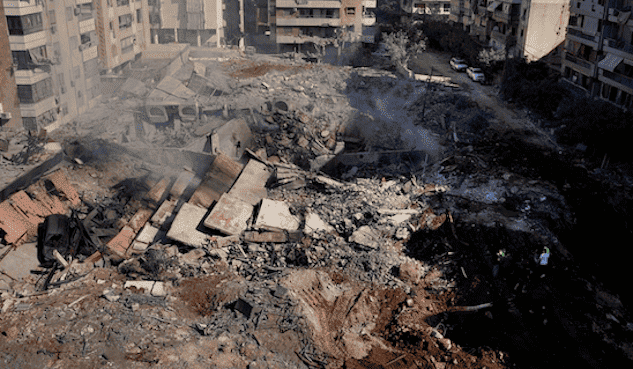
    That mission unfolded in September 2023, as Israeli warplanes pounded Hezbollah strongholds in Beirut’s southern suburb of Dahieh. Several operatives slipped into Haret Hreik, a densely built Shiite neighborhood, carrying carefully disguised packages. They knew full well that if Hezbollah men caught them, death was certain. And if the devices in their hands were discovered, Israel’s security would face a devastating blow.
    The Mossad team crept through narrow alleys, hugging walls, hoping their handler had coordinated with the IDF so the air force would not bomb the very path they were taking. Their destination was a high-rise apartment block. Beneath it sat Hezbollah’s most sensitive secret — the underground bunker serving as its main command headquarters.
    Intelligence delivered to Unit 8200 and Military Intelligence indicated that Hezbollah’s leader Hassan Nasrallah was scheduled to meet there with Iran’s Quds Force commander in Lebanon, Gen. Abbas Nilforoushan, and Hezbollah’s southern front chief, Ali Karaki, who was viewed as a possible successor to Nasrallah.
    Only a handful of Hezbollah’s security guards and inner circle knew the bunker even existed. The Mossad operatives were to place their devices at pre-planned points inside the building above the compound. They assessed their chances of survival at no better than 50-50. Even if Hezbollah’s men failed to spot them, they still risked being struck by shrapnel from Israeli bombs raining down nearby.
    Just hours before setting out, the agents held a tense discussion with their Mossad handler. They said they were prepared for the mission but demanded that the air force halt its heavy bombardments during their infiltration. The handler insisted the opposite: the raids would not only continue but intensify, forcing Hezbollah guards to take cover and giving the agents a chance to reach the bunker.
    Under the pounding of Israeli bombs, the Mossad team completed its mission. They planted the devices exactly where planned and slipped away undetected.

    What was hidden in the bunker

    The equipment they carried sounded like something out of science fiction. Completed in 2022, about a year before Hamas’ Oct. 7 attack, it was designed to allow precision strikes at varying depths underground. The Mossad had sought the technology not only for Lebanon but also for a potential strike on Iran’s nuclear program.
    The project involved the Defense Ministry’s weapons development unit, intelligence and technology specialists, the air force, and defense companies Rafael and Elbit. Together they developed guidance systems and penetrating warheads for Israel’s bombs, ensuring they could strike precisely in rocky terrain.
    That precision was essential. Even a one-meter deviation could mean a bomb striking beside — rather than into — a tunnel. In that case, those inside might survive with only injuries.
    On Sept. 27, 2023, at 6:20 p.m., 10 Israeli fighter jets dropped 83 one-ton bombs on the target. The strike involved F-15I Ra’am jets from Squadron 69, known as the Hammers, and F-16I Sufa jets. The bombs, U.S.-made BLU-109 bunker busters known in Israel as heavy hail, carried both GPS guidance and the specialized targeting system placed earlier by Mossad.
    Originally, the air force planned to use about half that number of bombs. But then–Defense Minister Yoav Gallant insisted the payload be doubled to ensure Nasrallah’s death.
    The strike killed Nasrallah, Karaki, Nilforoushan and some 300 others, mostly Hezbollah terrorists who were present. Israeli officials said the assassination marked the effective collapse of Hezbollah’s central command.
    Hezbollah retaliated with a barrage of rockets, drones and anti-tank missiles, naming its counteroffensive Operation Khaybar, after a 7th-century Muslim victory over Jewish tribes in Arabia.
    The group’s Shura Council quickly appointed Hashem Safieddine, head of its executive council, as Nasrallah’s replacement. But on Oct. 4, 2024 — just one week later — he too was killed in an Israeli strike using the same methods. Naim Qassem, Hezbollah’s deputy leader, then took over.

    The letter from Mossad’s chief

    The success against Hezbollah was the result of both Israeli strategic decisions and critical mistakes made by Nasrallah after Oct. 7. But it almost did not happen.
    After Hamas’ attack, Gallant and then–Chief of Staff Herzi Halevi pressed for an immediate assault on Hezbollah to neutralize its arsenal of more than 130,000 rockets and drones. At the time, Hamas’ forces inside Gaza had been pushed back, while Hezbollah posed the greater long-term threat.
    But Mossad director David Barnea, joined by former IDF chiefs Benny Gantz and Gadi Eisenkot, argued Israel must first deal with Hamas, which still held 251 hostages and was firing rockets daily. They warned that striking Hezbollah could trigger direct Iranian involvement and a regional war.
    The Biden administration also urged restraint. Netanyahu ultimately canceled a strike on Hezbollah already in motion, with Israeli jets recalled at the last moment.
    Ten months later, in August 2024, Barnea sent Netanyahu a letter urging a full offensive in Lebanon before the November U.S. presidential election. He argued both President Joe Biden and former President Donald Trump would back Israel during campaign season, while after the vote — especially if Vice President Kamala Harris won — support might be weaker. Netanyahu approved the plan, shifting forces from Gaza to the north in September.
    Israel began dismantling Hezbollah’s senior command in July 2024. Fuad Shukr, Nasrallah’s top military adviser, was killed in late July, depriving Nasrallah of his main strategist. Israel then assassinated Hezbollah commanders one by one. By the time of Operation New Order, Hezbollah’s leadership was reeling.
    The IDF also crippled Hezbollah’s battlefield capabilities, systematically striking anti-tank squads and rocket launchers, and in mid-September carried out the pagers operation, which disabled Hezbollah communications and caused mass casualties among its terrorists.
    Israeli intelligence officials said Nasrallah failed to grasp the scale of Israel’s campaign. He still believed in his equation — that Israel would avoid escalation for fear of heavy losses. His conviction that Israel lacked the resolve for total war proved to be his fatal miscalculation.
    Even with intelligence pointing to Nasrallah’s planned meeting in the bunker, Israeli leaders remained divided. Gallant and Halevi favored alerting Washington to avoid escalation with Syria, Iran and beyond. Barnea and others argued Israel must act immediately, without U.S. coordination.
    Netanyahu initially hesitated. Then, while en route to the United Nations General Assembly, he received updated intelligence suggesting the opportunity might not return. He gave the order mid-flight. After a final phone consultation from his hotel in New York, the green light was given.

    The deception that brought down Nasrallah

    Another decisive factor was deception. Even after Mossad and the IDF crippled Hezbollah’s communications on Sept. 17-18, Nasrallah did not realize Israel had launched a total offensive.
    Israel staged its campaign in phases — first eliminating Shukr in July, then disabling communications in September, then striking rocket stockpiles in Operation Northern Arrows. Nasrallah, clinging to his spider web theory that Israel was weak-willed despite military strength, assumed Israel would not dare target him personally.
    But Oct. 7 had altered Israel’s national mindset. Security officials said the country’s post-Holocaust resolve — the instinct of “never again” — proved stronger than Nasrallah expected.
    Nasrallah’s death marked a turning point, but Israeli officials say Hezbollah remains a serious threat. Naim Qassem, its new leader, is seen as capable if less charismatic. The group has lost support among Lebanon’s Shiite population, which suffered from Israel’s strikes, and faces pressure to disarm.
    Yet Hezbollah retains precision rockets and drones north of the Litani River. Israeli officials warn the group still has the ability to strike Israel and destabilize Lebanon.
    “The story of Nasrallah has ended,” one senior intelligence officer said. “But the story of Hezbollah has not.”
    YNET NEWS
    Share. Facebook Twitter LinkedIn Email WhatsApp Copy Link
    Previous ArticleIs America entering a new era of McCarthyism?
    Next Article The Kılıçdaroğlu–Özel rivalry: A mirror of Türkiye’s opposition struggles
    Subscribe
    Notify of
    guest
    guest
    0 Comments
    Newest
    Oldest Most Voted
    Inline Feedbacks
    View all comments
    RSS Recent post in french
    • Au cœur de Paris, l’opaque machine à cash de l’élite libanaise 5 December 2025 Clément Fayol
    • En Turquie et au Liban, le pape Léon XIV inaugure son pontificat géopolitique 27 November 2025 Jean-Marie Guénois
    • «En Syrie, il y a des meurtres et des kidnappings d’Alaouites tous les jours», alerte Fabrice Balanche 6 November 2025 Celia Gruyere
    • Beyrouth, Bekaa, Sud-Liban : décapité par Israël il y a un an, le Hezbollah tente de se reconstituer dans une semi-clandestinité 20 October 2025 Georges Malbrunot
    • L’écrasante responsabilité du Hamas dans la catastrophe palestinienne 18 October 2025 Jean-Pierre Filiu
    RSS Recent post in arabic
    • بلدية صيدا لا تلتزم القوانين 4 December 2025 وفيق هواري
    • دراسة لمصرف لبنان: وزارة الطاقة اشترت “فيول” لنظام الأسد بأموال المودعين! 4 December 2025 الشفّاف
    • حبيب صادق وسيمون كرم والممانعة 4 December 2025 محمد علي مقلد
    • السفير سيمون كرم رئيساً لوفد لبنان الى “الميكانيزم” 3 December 2025 الشفّاف
    • ملاحظات أولية على هامش زيارة البابا للبنان 2 December 2025 جريس أبو سمرا البتدّيني
    26 February 2011

    Metransparent Preliminary Black List of Qaddafi’s Financial Aides Outside Libya

    6 December 2008

    Interview with Prof Hafiz Mohammad Saeed

    7 July 2009

    The messy state of the Hindu temples in Pakistan

    27 July 2009

    Sayed Mahmoud El Qemany Apeal to the World Conscience

    8 March 2022

    Russian Orthodox priests call for immediate end to war in Ukraine

    Recent Comments
    • Will Saudi Arabia fund Israel’s grip over Lebanon? – Truth Uncensored Afrika on Lebanon’s Sunnis 2.0
    • farouk itani on A Year Later, Lebanon Still Won’t Stand Up to Hezbollah
    • فاروق عيتاني on BDL Opened the Door to Digitization — The State Must Walk Through It
    • انطوانحرب on Contributing to Restoring Confidence
    • jam on Lives in freefall: The triumph of decline
    Donate
    Donate
    © 2025 Middle East Transparent

    Type above and press Enter to search. Press Esc to cancel.

    loader

    Inscrivez-vous à la newsletter

    En vous inscrivant, vous acceptez nos conditions et notre politique de confidentialité.

    loader

    Subscribe to updates

    By signing up, you agree to our terms privacy policy agreement.

    loader

    اشترك في التحديثات

    بالتسجيل، فإنك توافق على شروطنا واتفاقية سياسة الخصوصية الخاصة بنا.

    wpDiscuz