



A month ago, US envoy Steve Witkoff sparked intrigue by saying the Trump administration was cooking up a new “comprehensive” plan to end Israel’s near two-year war against Hamas in Gaza.
The real estate mogul-turned-diplomat revealed that US President Donald Trump was about to chair a “large meeting” on the initiative at the White House.
That meeting ended with little to suggest it would move the dial on the relentless conflict. But the guest list was telling: those invited to share their ideas included Jared Kushner, Trump’s son-in-law, and former British prime minister Sir Tony Blair.
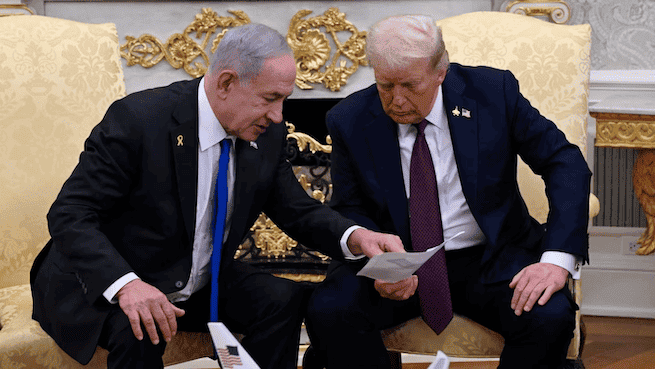
On Monday, the fingerprints of both men could be detected on the proposals Trump unveiled at the White House after convincing Israeli Prime Minister Benjamin Netanyahu to finally accept a plan to end Israel’s ferocious offensive in Gaza.
The president called Blair a “good man” who would sit on an international supervisory body — the “Board of Peace” — to oversee a Palestinian committee administering the strip under the deal.
Standing alongside Trump, Netanyahu thanked Kushner and Witkoff for “their indefatigable work to bring Israel and Arab states and the region closer together”.
Trump’s 20-point plan, yet to be accepted by Hamas, was the culmination of weeks of diplomacy in which Witkoff — Trump’s chief negotiator for Gaza — along with US secretary of state Marco Rubio and Kushner contacted Arab states, notably Saudi Arabia, Qatar and the United Arab Emirates, to exchange ideas.
“It was mostly Witkoff. He dealt with the leaders. Jared dealt with the details,” said an Arab official.
Blair, meanwhile, had been working on his own vision for a postwar Gaza for more than a year. His ideas gained little traction with the Biden administration, but with Trump back in the White House he was once again a player.
In recent weeks, leaks emerged about Blair’s plan, which called for Gaza to be run by an international trusteeship. That proposal worried European and Arab officials, who feared it would sideline Palestinians.
Blair consulted Kushner, who has no official role in the administration, but maintains close business contacts with oil-rich Gulf leaders. Kushner had earlier touted a much-derided “peace to prosperity” plan to Palestinians as Trump’s Middle East envoy during his first term.
There was, however, little sign from Netanyahu that he might be taking any peace plan seriously or come under any pressure from Trump. The Israeli leader stuck to his maximalist mantra of “total victory” against Hamas, and launched a ground offensive on Gaza City in the face of an international outcry over the already dire humanitarian situation.
But behind the scenes, diplomats began talking wryly about the “Kushner-Blair” plan.
Arab states had already endorsed their own postwar proposals after being shocked into action by Trump’s February announcement that Gaza should be emptied of Palestinians and developed into the “Riviera of the Middle East”. But their plan did not deal with the thorny issue of disarming Hamas, and had no chance of acceptance by Netanyahu’s far-right government.
Separately, the UK was working with France on a plan calling for a Palestinian committee to run Gaza, as the Arabs had proposed, alongside the deployment of an international stabilisation force and disarmament of Hamas.
Ultimately, the president’s plan included elements of various proposals — the Palestinian committee, the stabilisation force and the international supervisory body, which Trump would chair.
In Israeli government circles, August’s White House gathering — joined by Netanyahu’s most trusted lieutenant Ron Dermer — triggered alarm bells as Trump appeared to be turning his attention back to the Middle East after failing to make headway on ending Russia’s war in Ukraine.
“The [mood]music is an end to the war, because of Trump and the Americans. There is pressure on Israel to end it soon,” a person familiar with Netanyahu’s government told the Financial Times at the time.
They added that Israeli officials were “extremely bothered” about the pressure Israel could face at the UN General Assembly meeting. By the time world leaders gathered in New York last week, international opprobrium had intensified.
Western allies of Israel, including the UK, France, Australia and Canada, chose the occasion to recognise a Palestinian state — both to keep alive the concept of a two-state solution, and to rebuke Netanyahu.
Experts and scholars, including a UN commission, had accused Israel of genocide in the strip. The UAE was warning that its 2020 deal to normalise relations with the Jewish state was being jeopardised by Israeli threats to annex the West Bank. And Arab nations were infuriated by Israel’s brazen September 9 missile strike targeting Hamas political leaders meeting in Qatar to discuss Witkoff’s latest ceasefire proposal.
Even Trump appeared angered by Netanyahu, saying he was “very unhappy about every aspect” of the attack on a key US ally integral to mediation efforts between Israel and Hamas.
“The plans [for a peace deal]have been in the works for a while, there’s been various variations. But the big push was after the attack on Doha,” said the Arab official.
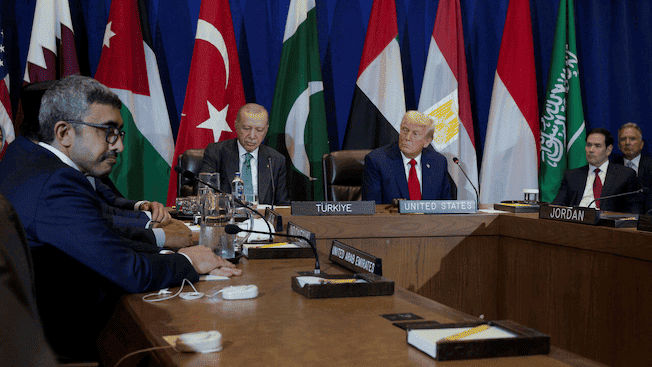
By the time Arab leaders arrived in New York for the UN summit, they were gearing up to make another push with the president and explain what would be acceptable to Palestinians and the broader region, the Arab official said.
Ahead of a meeting with Trump last Tuesday, they delivered the White House a list of six points, which as well as ending the war included no Israeli occupation of Gaza or building of Jewish settlements there, no forced displacement of Gazans, no annexation of the West Bank, and no Israeli steps to alter the legal status of holy sites in Jerusalem.
Arab and Muslim leaders pointed out that any Israeli move to annex the West Bank would threaten a signature foreign policy success of Trump’s first term, the Abraham Accords between Israel and several Arab states.
Trump assured them he would not allow annexation.
The Arabs pressed for a greater role for the Palestinian Authority, which administers limited parts of the West Bank, in postwar Gaza. But overall, they left the more than hour-long meeting more optimistic than they had been in months. Several senior advisers and members of Trump’s cabinet were present.
A second Arab official described it as “extremely productive and decisive”.
“Essentially he agreed with the positions that our heads of delegation were putting forward — that the war had to end, there had to be a ceasefire now, Gaza needed to be rebuilt, and there needed to be a political horizon for the Palestinians,” said the official. “With this administration there’s lots of pluses and there are some things that take creative diplomacy to work through, but the pluses are there’s quick decision-making.
“And there isn’t this sort of ideological bent that ‘it’s this way or that way’. It’s ‘what’s the way to a deal, tell me your ideas to end the war’.”
Trump instructed Witkoff and Rubio to hold follow-up meetings with Arab officials to thrash out details. “The whole plan was drafted over three days,” said the first Arab official.
The sudden momentum appeared to surprise other US allies.
The UK and France had planned to meet US and Arab officials on Wednesday to seek Trump’s buy-in for eight principles on ending the war and postwar Gaza. But that was overtaken by events.
Netanyahu, meanwhile, was not even in New York. He was only due to deliver his speech to the UN summit on Friday and hold talks with Trump at the White House on Monday. When he delivered his address, he was typically defiant, insisting that Israel would “finish the job” against Hamas in Gaza and not allow the creation of a Palestinian state.
But an Israeli official said there was “alarm” and “chaos” inside Israel’s delegation to the US, suggesting Arab leaders had swayed Trump to “support a plan that runs counter” to Israel’s position.
Netanyahu and Dermer huddled with Witkoff and Kushner at least three times in his New York hotel that weekend in a bid to narrow differences, said a second Israeli official. Witkoff told Fox News that he and Kushner were “working all weekend on this . . . and so, the Israelis are bought in”.
As Trump announced his plan on Monday, Netanyahu displayed little emotion. The veteran Israeli leader said Trump’s plan achieved “our war aims”.
But he again rejected any role for the PA and warned that if Hamas, which has not responded to the plan, rejects the deal or undermines it “then Israel will finish the job by itself”.
The person familiar with the Israeli government said Netanyahu agreed to the deal “because he didn’t have a choice”. “You saw it on him,” the person said, alluding to his subdued demeanour.
But he added that Netanyahu got “most of what he wanted”, apart from the plan’s reference to a Palestinian state. In a nod to Arab and Palestinian concerns, the plan says that with the redevelopment of Gaza and PA reform, “the conditions may finally be in place for a credible pathway to Palestinian self-determination and statehood”.
Trump said on Tuesday that Hamas would have three to four days to respond. “We’re just waiting for Hamas, and Hamas is either going to be doing it or not, and if it’s not, it’s going to be a very sad end,” he said.
If Hamas accepts, Arab leaders will be banking on Trump to ensure the plan is fully implemented.
“The key lever, on Netanyahu, on the Israeli government, is the US. And I think part of our effort has also been keeping them as engaged as possible,” the second Arab official said.
“If either Hamas or the Israeli government is the spoiler, then I think we are going to need to see the US administration hold them accountable for that.”