



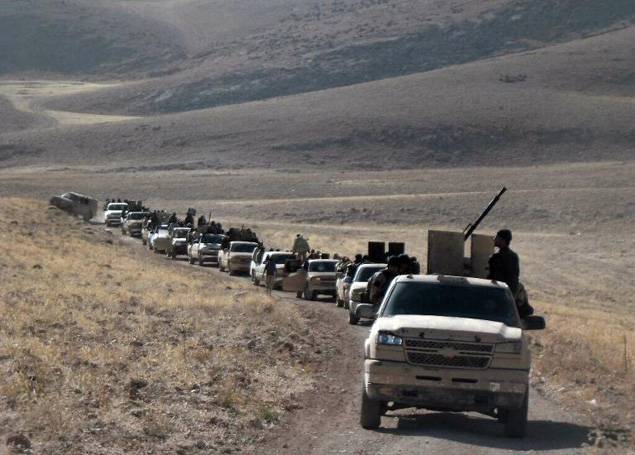
This weekend, Hezbollah leader Hassan Nasrallah gave a speech about the Lebanese Shiite militia’s impending victory in the Syrian border district of Qalamoun. The two-week campaign has seen Hezbollah forces aligned with Bashar al-Assad’s regime roll back a coalition of Sunni Islamists from key positions in the strategic region. Yet while Nasrallah waxed triumphant during his speech, the victory is pyrrhic and likely temporary — Hezbollah and Assad may have won the battle, but they are losing the war for Syria.
QALAMOUN’S IMPORTANCE
In recent years, rebel forces have been using Qalamoun as a base for operations around Damascus, and the region also serves as a critical line of communication with their Sunni backers in eastern Lebanon. At the same time, Assad regime forces backed by Hezbollah and Iranian militias depend on the north-south highway that runs through Qalamoun and connects Damascus with other provinces, including Homs. Equally important, the region links Damascus to the regime’s core supporters, the nominally Shiite Alawites who reside on the coast (for more on these Alawite enclaves, see Policy Focus 132, “The Potential for an Assad Statelet in Syria,” http://washin.st/1l1slO1).
Last summer, forces from the “Islamic State”/ISIS and al-Qaeda affiliate Jabhat al-Nusra (JN) occupied the Lebanese border town of Arsal, in the process snatching dozens of soldiers and security officers. Arsal is also home to an estimated 40,000 Syrian Sunni refugees. In late August, ISIS beheaded two of its captives, one Sunni and one Shiite, and has since killed two others while continuing to hold some twenty-five hostages. Two months later, JN forces overran a Hezbollah outpost in Brital — about thirty miles southwest of Arsal, in Lebanon’s Beqa Valley adjacent to Qalamoun — killing eight Shiite militiamen and wounding twenty others.
While Arsal remained on ongoing but perhaps tolerable irritant for Hezbollah, overall rebel activity in the area increased the urgency of an effective Shiite response along the border. Prior to the Hezbollah-led offensive in Qalamoun, an estimated 3,000-5,000 ISIS, JN, and affiliated fighters were deployed along the frontier. In March, rebel forces launched a series of attacks against Shiite militia positions in the area, later followed by significant advances further north in Idlib and Hama — gains made possible by a new degree of cooperation among Sunni militias under the banner of Jaish al-Fatah (the Army of Conquest). Rebel advances in the southern regions of Quneitra and Deraa only added to Hezbollah’s concerns.
THE BATTLE FOR QALAMOUN
Since November 2013, the Syrian army has been actively targeting major towns in Qalamoun with airstrikes while fighting rebels on the ground alongside Hezbollah forces. The current Hezbollah-led offensive — joined on May 5 in al-Nabak and Yabroud districts in the Qalamoun Mountains — is a more intensive effort to clear and hold territory. Reports in the Arab press have mentioned battles for strategic hilltops in the area, but there is little reliable coverage of individual clashes. Not surprisingly, Hezbollah’s al-Manar satellite television network has been consistently reporting high rebel casualties and tactical setbacks. At the same time, the group has provided press junkets in Qalamoun for Lebanon-based Western journalists. On May 16, the New York Times featured a story about one of these press tours, complete with a description of a staged Hezbollah patrol.
Propaganda aside, rebel forces in Qalamoun do appear to be losing ground. According to Nasrallah, Hezbollah and the Assad regime have regained control of 300 square kilometers in the region, and reports that the group is now closing on the Syrian town of Flita would seemingly confirm this claim.
Less clear, however, are the costs for Hezbollah. Nasrallah admitted that thirteen of his fighters had been killed in the previous two weeks, but this low figure strains credulity given the high number of purported fatalities on the rebel side. Indeed, earlier today, the Lebanese daily an-Nahar published a list of twenty-three Hezbollah militiamen known to have been killed in the battle. More broadly, Lebanese skeptics have begun to suspect that the group is keeping the bodies of some of its dead fighters on ice, rationing funerals as the war drags on in order to propitiate Shiite public opinion.
IMPLICATIONS
According to Nasrallah, the Qalamoun offensive is aimed at driving the rebels out of the area entirely or, at minimum, pushing them back into Arsal, where they would become the responsibility of the Lebanese Armed Forces. While the LAF has a mixed record against ISIS and JN, this tack would alleviate some of the more immediate pressures on Hezbollah. The LAF is already shelling rebel targets on the outskirts of Arsal along the Syrian border. Hezbollah and the LAF may also benefit from the fact that JN and ISIS forces in Arsal are fighting each other even as Islamist elements elsewhere are unifying to attack the Assad regime.
Ultimately, however, the wider battle for Syria is a numbers game. Before the war, 80 percent of the country was Sunni. The nominally Shiite Alawite community — from which Assad and the backbone of his forces hail — comprises just 10 percent of the population, is largely urbanized, and has low birthrates. While attrition has taken a severe toll on both sides, the rebels have been able to replenish their numbers through internal and foreign recruitment. With the Alawite community depleted, Assad has had to rely increasingly on Iran’s Qods Forces and Hezbollah.
Iran remains a robust ally but is increasingly taxed by its military adventures in Iraq and Yemen. Likewise, Hezbollah is showing signs of being stretched thin after four years of war. The militia currently has an estimated 5,000 troops stationed in Syria. According to the Syrian Observatory for Human Rights, nearly 700 Hezbollah fighters had been killed there prior to the battle for Qalamoun, and some sources indicate the number has now climbed to more than a thousand.
The losses are having a noticeable impact on the group’s operations. For one thing, Hezbollah is drafting ever younger conscripts — in an unprecedented development, the group buried a fifteen-year-old fighter earlier this month after he was killed performing his “jihadist duty” in Syria. Equally telling, 400 troops from Amal, a rival Lebanese Shiite militia, were reportedly mobilized to fight alongside Hezbollah in Qalamoun. (Amal leader Nabih Berri subsequently denied these stories.) Unverified reports also indicate that Hezbollah asked the LAF to engage in operations across the border in Qalamoun. If this request was in fact made, it was denied — given the LAF’s concerns about unit cohesion, it could not even contemplate such a mission.
CONCLUSION
While Hezbollah’s deployment in Syria and attendant casualties have caused some grumbling within Lebanon’s Shiite community, the opposition voices are manageable for the time being. Of far more concern to the group is the prospect that the united rebel forces of Jaish al-Fatah will score further successes against Assad. Hezbollah’s thinly spread forces may continue capturing territory from the rebels, but it is unclear whether they can maintain their lines of communication from Lebanon, even in nearby Qalamoun.
To be sure, fighting in Syria has hardened a new generation of Hezbollah militiamen, but it has also depleted the group’s ranks and eroded its carefully cultivated image as an organization devoted to “resisting” Israel. Moreover, the group’s involvement in a war that has killed tens of thousands of Sunnis has spurred ISIS and JN to target Shiites, Alawites, and Hezbollah members back home in Lebanon.
Given what is at stake in Syria — the fall of Assad would dramatically complicate Hezbollah’s supply lines from its Iranian patrons — the militia is all in. If the past four years are any indication, the group will continue to hold its own against Sunni rebels along the border and serve as Assad’s crack force in strategically important areas. As the war drags on, however, Hezbollah’s operational stresses and limitations will become ever more apparent. Bolstered by Tehran and Nasrallah, Assad could hang on for some time, but even his most reliable Shiite allies may not be able to sustain him as the war’s attrition increasingly highlights his demographic disadvantage. For better or worse, the only factor that may forestall his seemingly inevitable fall is the estimated $60 billion in sanctions relief that Iran stands to gain after a nuclear deal is inked.
******************************
David Schenker is the Aufzien Fellow and director of the Program on Arab Politics at The Washington Institute. Oula Abdulhamid Alrifai is a research assistant at the Institute