



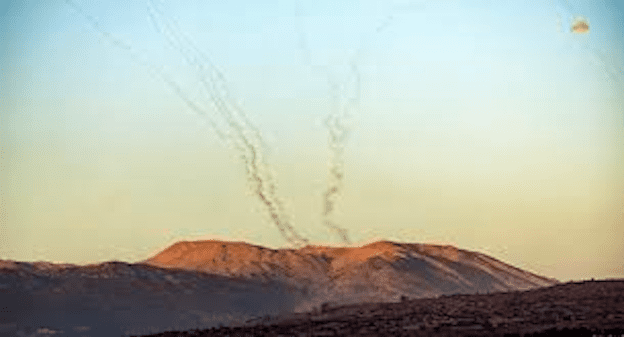
The party may escalate on the southern border with Israel, but that doesn’t necessarily mean it will reach the level of bombing cities.
The speech last week of Hezbollah Secretary General Hassan Nasrallah left many in Lebanon and beyond relieved, as he defended his organization’s limited engagement in the Gaza war and called the Lebanese front against Israel a “solidarity and support” front. Nasrallah did so mostly to underline the party’s secondary role in the conflict, in which Palestinian fighters are taking the lead.
However, beyond the clearer points he made, there were two implicit messages in Nasrallah’s emphasis on Hamas’s independence of decisionmaking, its central role in the fight against Israel, and the certainty of its victory in the battle.
The first was that, since Hezbollah wasn’t aware of the operation of October 7, it also was not prepared militarily for a wider escalation with Israel. Perhaps that explains the slow build-up of violence on the Lebanese-Israeli border, and the reported movement of the party’s combatants from parts of Syria back into southern Lebanon. Engaging in a wider escalation, therefore, required better preparing the southern Lebanese front. And here, Hezbollah is not only engaged in military preparations, but also political and logistical preparations, namely for a wider displacement of Lebanese civilians out of the border region and to secure political backing from significant political actors. That effort is ongoing.
The second was that Nasrallah’s emphasis on a Hamas victory created a tacit redline around its defeat. Despite his relatively restrained tone, Nasrallah and other Hezbollah officials have stressed that Hamas will win the Gaza war just as Israel failed in its declared intention of destroying Hezbollah in the Lebanon war of 2006. The 2006 analogy means that if Hamas cannot slow down Israel’s advances in Gaza and sees its firepower diminished, northern Gaza reoccupied, over 1 million Palestinians displaced, unprecedented destruction, and tens of thousands of people killed or injured, it would be difficult for the organization to claim a victory.
Such an outcome would ultimately be costly for Hezbollah and its allies, first and foremost because Israel would most likely seek to reestablish a new deterrence equation on its northern border once Gaza has been neutralized. Hezbollah understands the profound impact of October 7 on Israel’s military doctrine, in that the Israelis have engaged in a disproportionate response so as to deter their enemies in the future. This also means they are less likely to abide by tacit rules of engagement. In light of this, a wider escalation now by Hezbollah could be better than allowing Israel to choose the timing of a confrontation to its advantage.
However, such an escalation could still remain within the current boundaries. Rather than escalating to the bombing of strategic sites and major urban areas, it could involve attacking a larger number of Israeli positions, and even perhaps conducting ground attacks along the lines of Hezbollah’s tactics in the 1990s, when fighters would take over Israeli military bases inside occupied areas of Lebanon, then withdraw before any retaliation. This escalation will probably avoid the use of medium-range missiles. Hezbollah would likely only bomb Israeli cities within the established rules of engagement, namely in retaliation for Israel’s targeting of Lebanese cities. That said, ground attacks and wider clashes along the border would definitely increase the risks of a major uptick in the level of violence.
Second, Israel has now declared that it seeks to assassinate Hamas leaders, some of whom are based in Lebanon. Given Israel’s previous assassination attempts in the country, including an attempt to kill Hamas operative Mohammed Hamdan in 2018, there is a high possibility of such an operation taking place inside Lebanese territory. While Hezbollah deterred Israel previously, this is more doubtful after the October 7 attacks and as the Gaza conflict subsides.
Third, even if Hezbollah manages to avert a wider conflict with Israel and unilaterally deescalates in southern Lebanon, a change in Israel’s leadership is likely. Prime Minister Benjamin Netanyahu may well be forced out of office in favor of Benny Gantz, which may bring with it a renewed Israeli determination to deter and weaken the party. Such a change in leadership could also be coupled with support from Western countries, especially if takes place in parallel with revived negotiations with the Palestinians, to which the Arab states would agree. This could further embolden Israel to adopt an aggressive policy against Hezbollah in order to prevent the party from derailing such a process.
Finally, Nasrallah and Hezbollah need to build a Lebanese alibi for the war, aside from solidarity with the Palestinians. This is needed both for the party’s constituency and for internal political reasons. Nasrallah’s first speech after the October 7 attack and Israel’s campaign in Gaza began the build-up for the case, threatening Israel if it decided to attack Lebanon. Now that Israel has killed Lebanese civilians, including three young girls and their grandmother, the case is growing, and will probably be the focus of Nasrallah’s next speech tomorrow.
With the current trajectory of Israel’s Gaza operation, it would be highly unlikely if a wider escalation by Hezbollah did not occur in Lebanon. The timeframe is narrowing for such an intervention to have an impact on the outcome in Gaza. If Hamas’s pushback against Israeli advances wanes in the coming weeks, Hezbollah could emerge as a target of Israel’s military.
Hezbollah and Palestinian factions are already engaging Israel’s military across the southern border. A further Hezbollah military escalation could raise the pressure on the Israelis, boost the morale of Palestinian fighters in Gaza, and perhaps pave the way for a negotiated ceasefire. Such a ceasefire in Gaza and Lebanon is Hezbollah’s preferred outcome, as the party does not want to unilaterally deescalate while Israeli retains the option of continuing to strike across its northern border.
While Hezbollah is conscious that an expanded war would be catastrophic for Lebanon, it appears to believe such a war as inevitable. Therefore, it is conceivable that it may prefer to decide on the timing itself and not hand that advantage to Israel.