



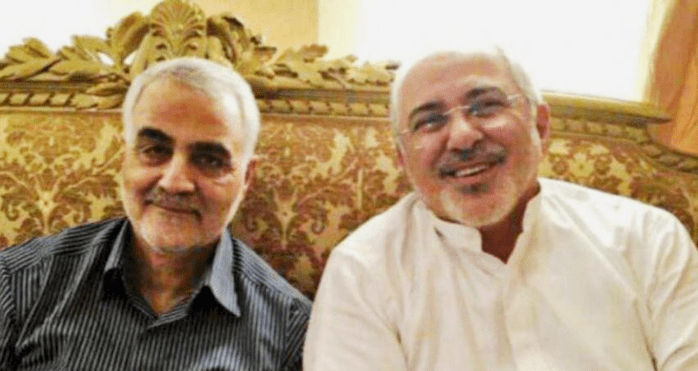
Iran International TV has gotten hold of an audio recording in which Iran’s Foreign Minister Mohammad Javad Zarif says he has been forced to “sacrifice diplomacy for the IRGC’s operations”, because of interventions by former Qods Force Commander Qasem Soleimani in Iran’s diplomatic affairs. Soleimani was killed by a US air strike in Baghdad in January 2020.
Zarif made the statement in an interview in March, apparently intended to be released after the Rouhani administration leaves office in early August. The interview was conducted by Iranian journalist Saeed Laylaz who is close to Rouhani’s economic team. Zarif’s statements in the recording can put him under further pressure by Iran’s hardliners, or the leak could be an attempt to put him under a better light for the West, blaming Soleimani for Iran’s interventionist policies in the Middle East.
Zarif said that his ministry followed a “cold war strategy,” but under Soleimani’s influence, he had to further a diplomacy that would serve Iran’s interests in its military operations in the region.
“On the other hand, I have never been able to ask Soleimani to do something that would serve my diplomatic moves,” he said.
Zarif said that Soleimani intervened in his meeting with his Russian counterpart Sergei Lavrov, adding that Soleimani would never accept a demand by Zarif. “He would not accept to refrain from using the Iranian national airline for transportation to Syria,” he said, possibly referring to transportation of arms and ammunition. Zarif said that under Soleimani’s pressures Iran air increased the number of its flights to Damascus six times more than usual.
The international community sanctioned several Iranian companies and airlines for transporting weapons for Bashar al-Assad’s forces and those fighting under Iranian command.
The foreign minister stressed that Iran always attached priority to its war operations. He said his role in determining Iran’s foreign policy was “nil.” Meanwhile he maintained that Soleimani’s visit to Moscow immediately after the 2015 nuclear deal was forged as an attempt to destroy the nuclear deal.
“That trip was made upon Moscow’s initiative without the Iranian Foreign Ministry having any control on it. Its objective was to destroy the JCPOA,” Zarif further maintained. His explanation of how Russia harmed JCPOA had to do with its policy of using Iran in the Syrian civil war as the ground fighting force.
Zarif added that Rouhani did not know about Soleimani’s intervention in diplomacy. He also said that the foreign ministry was kept in the dark about Iran’s military operations in Syria. “It was former US Foreign Secretary John Kerry who told me Israel had launched more than 200 attacks on Iranian forces in Syria,” he said.
Both these claims are not very credible. It would be highly unusual for Zarif not to inform his boss about Soleimani’s interventions. Israeli attacks were discussed in international media as far back as 2017.
“The United States knew about the attack on Ain al-Assad [January 8, 2020] in Iraq before I was informed of it,”Zarif said, adding that Iranian military officials told him about the missile attack on the Ukrainian civilian airliner on the same date, a day or two after the plane was shot down killing all 176 people onboard.
Elsewhere in the interview, Zarif reiterated that Russia tried to destroy the JCPOA, and that he had to use a “rude and non-diplomatic language” in his talks with Lavrov at times. Nonetheless, he said that he supported the ties with Russia and China, although he also said Iran’s relations with America is against Russia’s interests, so Russia opposes the normalization of Iran’s ties with the United States.
Elsewhere in the interview, Zarif said the Iranian foreign ministry has a “security structure,” adding that a group of people in Iran benefit from such structures present in all institutions.
Explaining the Iranian psyche, he said that the people prefer a military champion to a diplomat, adding that as a result of that his popularity dropped from 90 percent to 60% while Soleimani’s popularity grew from 70% to 90%. But he did not say what time period he was referring to.
In the interview Zarif expressed his support for “revolutionary” policies and responding to critics who called him a “traitor,” Zarif said: “Ask Lebanese Hezbollah leader Hassan Nasrallah if I am a traitor or not.”