



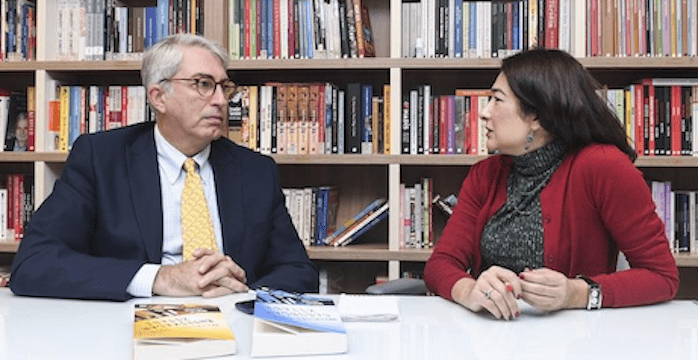
Espionage and intelligence have rather been taboo issues few writers have dared to tackle, says veteran journalist Murat Yetkin, adding that his new book will open Pandora’s Box on spying in Turkey. Yetkin says Turkey was, and will remain, a stage for international spying activities.
Turkey will always remain the setting stage of international politics’ open or veiled games, sometimes being a part of it, sometimes an actor of it, and sometimes a target herself, according to veteran journalist Murat Yetkin, who finished writing “The Book of Spying for the Curious.” Yetkin said the book will open a door to darkness and shed light on the historical evolution of the Turkish intelligence.
Q: The “Book of Intrigues for the Curious” is now followed by “The Book of Spying for the Curious.” What motivated you to write them?
A: These are some taboo issues that, except for a handful of writers, no one wanted to tackle in Turkey. This is my hobby, but I am also interested due to my profession. Espionage and intelligence issues are part of politics, which has an open side but also an unseen, veiled side. In order to understand the real nature of politics you need to be interested in both sides. Ninety percent of what I wrote is from open sources, but you need to know where to look.
Q: What will the Turkish audience realize after reading the last book on spying?
A: They will find out, for instance, that some of the things we were told were just rubbish. For years we were told that the Turkish intelligence organization had finished off ASALA [Armenian terrorist organization]. But not at all. It is the infighting that finished off ASALA. They will find some information revealed for the first time about the notorious Cicero incident [the butler of a British ambassador during World War Two who sold information to the Germans]. He was used by the Turkish intelligence.
Q: In one chapter you seem to claim that the CIA had played a role in dividing the leftist movement in Turkey.
A: The Turkish left had caught its highest strength in the 1965 elections. CIA agent Duane Clarridge, known for his interference in the elections in India in 1962, was assigned to Turkey during that period. Americans are currently complaining about Russian meddling in their elections, but the CIA was the first to start it. The CIA’s first such operation was the Italian elections in 1948.
Clarridge came in 1968 and stayed five years. Just as in India, this is the period the left gets involved in violence. He definitely played a role in the division of the leftist movement in Turkey.
Q: What would be most interesting for non-Turkish readers?
A: There is a chapter called “Three Turkish Spy Chiefs of the Cold War.”
The Turkish intelligence is headed by Fuat Doğu, who, despite his military past, started to civilianize the organization.
During the same period, Ruzi Nazar, an Uzbek Turk, worked as a CIA agent in Turkey, with all of Central Asia and the Caucuses included in his area of responsibility.
In the same period, Haydar Aliyev [the late president of Azerbaijan], an Azeri Turk, was responsible for all of the [Soviet spy agency] KGB’s operations in the Middle East, including Turkey. I believe there is lot of information that will draw the interest of foreign readers if the book gets translated.
Q: What does that tell us? Three Turkish-origin spy chiefs operating in the same region at the same time?
A: Starting from Turkey’s entry to NATO in 1950, Turkey comes to the forefront in the fight against communism and the Soviets. A CIA operator and a MİT [Turkish National Intelligence Organization] official are quoted in the book as saying that the Turkish-Islamic synthesis is fully an American invention, a project developed by America. It is not a coincidence that a spy like Nazar was kept in Turkey for 11 years. The CIA’s first action towards the Islamic world was undertaken by Nazar in 1954 in Mecca. He played a critical role in mobilizing Turkish and Muslim groups in Central Asia and the Caucasus against the Soviets.
Looking at the map, you see that it is not a coincidence that Baku is chosen to direct the KGB’s operations in the Middle East.
Q: So that proves that geography is fate?
A: The straits are Turkey’s most strategic asset. Turkey will always remain as the stage of international politics’ open or veiled games, sometimes being a part of it, sometimes an actor of it, sometimes a target herself. This is a very difficult region.
There was a very fast shrinking period during the transition from the empire to the Turkish Republic. And also during the fight against the Soviets, it becomes a region where many refugee groups and dissidents from Central Asia and the Caucasus have deemed as a safe haven. This creates a fertile ground. Some want to use these groups. Currently, a lot of Arab dissidents are in Turkey, and the Khashoggi incident [the Saudi dissident’s murder in the Saudi Consulate in Istanbul]took place.
Q: What will the readers learn about the Turkish intelligence?
A: We are opening a Pandora’s Box in Turkey, a door to darkness, and there will be a follow-up.
There are four institutions crucial in the transition to the republican Turkey, securing the continuity. The army, the intelligence, and the foreign and finance ministries. The core of the intelligence agency during World War One is made up of soldiers. Some of them joined the war of liberation. They are mostly of Balkan or Caucasian origin. For them, there is this concept of “[here is]the last homeland, we need to protect it.” They have a high sense of loyalty to the state.
Following the entry to NATO we see a sense of erosion. What is expected from Turkey within NATO is to fight the Soviets, to hunt the communists in the country and set up stay-behind organizations. The so-called counter-guerrilla comes from that time period.
This approach has negatively affected the Turkish intelligence’s foreign operation capability. There were even rumors that the salaries of MİT officials were being paid by the CIA.
Then came a period of recovery. Doğu started the civilianization, Sönmez Köksal became the first civil to head MİT. Şenkal Atasagun and Emre Taner became the heads of MİT thanks to Doğu’s earlier civilianization policy.
With Hakan Fidan, and together with the Arab Spring, foreign operations started gaining importance again. It takes time to regain some [intelligence]capabilities. That’s why there has been some teetering; we have seen it in Syria and Iraq. Now I think there is a recovery period.
Q: What makes you say that?
A: I think some lessons have been taken, especially after the coup attempt [in 2016 by FETÖ]. And Turkey has managed the Khashoggi incident well. I see there the traces of the old Turkey’s mind. This time, there was a collective mind: Joint action, the intelligence, and the Foreign Ministry working together in coordination. This was good crisis management.
Q: What does this murder tell us?
A: Just like during the Cold War, Turkey is becoming a stage for all intelligence activities. This is inevitable when there are so many dissidents [here]. The rise in the number of all these activities and the fact that they have become so bloody; let me recall how the Russian intelligence also committing murders in Turkey attest to an accumulation of energy in the global fault lines. I hope this will not turn into all-out wars.
Q: When you look at the latest activities of MİT, what does it tell us about Turkey? Some say Turkey wants to be a regional player, a game changer, etc.
A: It is only natural. If no one finds Israel’s global operations strange, there is nothing more natural for the Turkish intelligence to increase its operations in this circle of fire.