


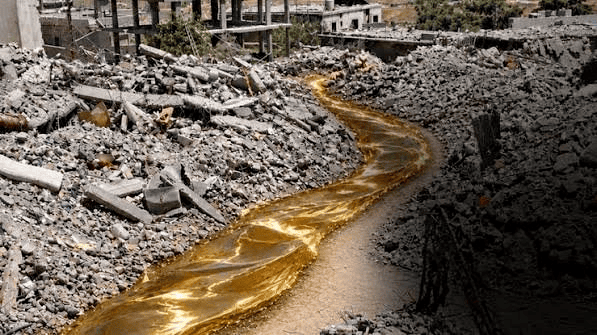
The battle over Lebanon’s gold has taken a dangerous political turn. What should have been a financial discussion about restoring liquidity to a bankrupt banking system is increasingly becoming a negotiation over how to finance the reconstruction of the South.
As reported by Nidaa Al-Watan, Hezbollah’s proposed bargain is straightforward: parliamentary support for legislation allowing the use of Banque du Liban’s (BDL) gold to repay depositors, in exchange for allocating $15 billion towards reconstruction. نداء الوطن
What is perhaps more disturbing is that Prime Minister Nawaf Salam’s government has yet to categorically reject such a proposition. Its inability to draw a clear red line reflects the extent to which Hezbollah and Amal continue to exercise political leverage over the Lebanese state and Nawaf’s goverment.
Hezbollah’s new financing problem
With Hezbollah’s finances under increasing pressure and Iranian funding constrained, the question of who will finance the reconstruction of the South has become increasingly urgent for the organisation.
International institutions are imposing greater scrutiny on reconstruction financing. The World Bank’s reconstruction framework, for example, includes enhanced oversight, accountability and procurement safeguards. This makes it more difficult for political networks to divert reconstruction funds towards their own interests.
Under these circumstances, BDL’s gold presents an attractive alternative.
The political calculation is clever: offer depositors something they have desperately wanted for seven years in exchange for their acceptance of a deal that would release billions for reconstruction.
By making depositors beneficiaries of the gold sale, Hezbollah reduces the likelihood of public opposition to it. Depositors effectively become the political cover for accessing Lebanon’s most valuable remaining financial asset.
Opening the door to Eurobond holders
As I explained in my previous article( https://middleeasttransparent.com/lebanons-gold-has-many-owners-until-the-bill-arrives/ ), the implications extend far beyond the loss of $15 billion.
BDL’s legal separation from the Lebanese state is one of the principal protections shielding its assets from sovereign creditors. Under US law, foreign central bank assets held for their own account enjoy special protection from attachment and execution, subject to specific exceptions.
Lebanon defaulted on its sovereign debt in 2020. Its Eurobond holders are still awaiting a restructuring.
The moment the government uses BDL’s gold to finance its own expenditure, it risks providing those creditors with evidence that the central bank’s assets are effectively controlled by the sovereign.
Why should Eurobond holders accept that BDL’s assets are legally separate from those of the state when the government itself is treating them as interchangeable?
Although seizure would not be automatic, Lebanon would be handing its sovereign creditors a powerful argument with which to challenge the protection of BDL’s assets before foreign courts.
The country could find itself defending not only its gold reserves but also other central bank assets held abroad.
Keep the gold out of political hands
Given these developments, I would reconsider the merits of an outright gold sale.
The priority should be to explore whether BDL, in coordination with the US Treasury and relevant American financial institutions, could establish a gold-backed financing arrangement that generates dollar liquidity without permanently disposing of its reserves.
Subject to legal authorisation, the proceeds could be invested in highly rated, liquid US Treasury securities held in BDL’s name, with the net income supporting BDL’s obligations towards depositors.
Such an arrangement would require careful examination of borrowing costs, collateral risks and sovereign immunity protections. Crucially, any financing must remain exclusively within BDL’s balance sheet and beyond the spending authority of the Lebanese government.
The danger of authorising an outright sale in a country where an armed militia and its political allies exercise considerable parliamentary influence is that no one can credibly guarantee where the proceeds will ultimately end up.
Once the gold is sold, recovering it becomes virtually impossible.
Reconstruction is not the depositors’ bill
The reconstruction of southern Lebanon is a legitimate national responsibility. But it is a fiscal responsibility of the Lebanese state, not a liability of its central bank or its depositors.
Nawaf Salam must make this distinction unequivocally clear.
A government that has failed to repay its own creditors cannot simply appropriate the assets of another institution to finance its obligations, particularly when that institution is itself indebted to the Lebanese banking system.
What Hezbollah could not secure through Iranian financing or international reconstruction assistance must not be extracted from the remaining assets available to Lebanon’s depositors.
The battle over Lebanon’s gold is no longer simply about whether to sell it. It is about whether the Lebanese state can prevent Hezbollah from turning the country’s last financial lifeline into its next source of funding.