



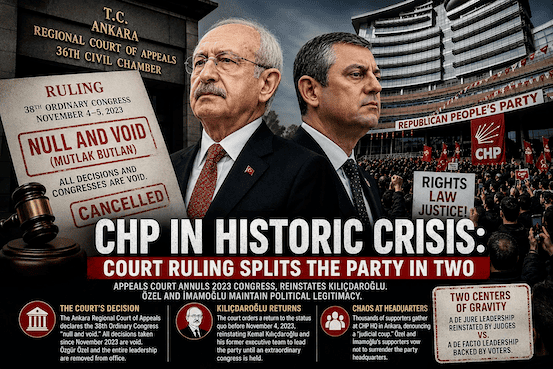
Western governments, international media and regional capitals describe Ankara court ruling as a “judicial coup” against Türkiye’s opposition. Financial markets tumble as Washington and Brussels warn of further democratic erosion
A dramatic ruling by the 36th Civil Chamber of the Ankara Regional Court of Justice annulling the Republican People’s Party’s (CHP) November 2023 congress, suspending party leader Özgür Özel and paving the way for the return of former chairman Kemal Kılıçdaroğlu has triggered fierce international backlash, with Western capitals and global media openly questioning the future of democratic pluralism in Türkiye.
The ruling, which effectively invalidated the leadership structure that emerged after the CHP’s sweeping 2024 municipal election victories, was widely framed abroad not as a routine judicial dispute, but as a politically engineered intervention aimed at fracturing President Recep Tayyip Erdoğan’s strongest opposition force ahead of the next presidential cycle.
Across Washington, Brussels, London, Berlin and Athens, reactions converged around one theme: Türkiye’s political struggle is increasingly being fought not at the ballot box, but in courtrooms.
Washington signals deep concern
Officials in United States Department of State circles expressed what diplomats described as “deep concern” over the court’s intervention into the internal democratic mechanisms of Türkiye’s oldest political party.
According to diplomatic assessments circulating in Washington, the ruling represented “the systemic targeting of opposition leadership,” a development seen as undermining “the foundational principles of electoral democracy.”
Senior members of the U.S. Senate Foreign Relations Committee reportedly described the verdict as “political engineering disguised as law,” arguing that the decision appeared designed to trigger internal collapse inside the CHP after its strong performance in the 2024 local elections.
American officials and analysts also linked the latest ruling to the broader judicial campaign surrounding jailed Istanbul Mayor Ekrem İmamoğlu, widely viewed as Erdoğan’s most formidable electoral challenger.
Brussels: “A devastating regression”
To understand the sharpness of Brussels’ reaction, it is essential to recognize that European institutions were already in a posture of deep alarm before the ruling landed. European officials had warned in a joint letter that “the current situation is weakening democracy in general by undermining the rights of voters to freely choose their representatives,” adding that they had “systematically raised concerns regarding these issues through political dialogue with Turkish authorities.” That letter came only weeks before the ruling, meaning Brussels was not starting from a position of optimism.
The institutional backdrop was equally stark. The European Parliament had already adopted a formal report warning that Türkiye is “increasingly sliding into an authoritarian model,” and criticized the arrest of Istanbul Mayor İmamoğlu as a “politically motivated move aimed at preventing a legitimate challenger from standing in the upcoming elections.” EU accession negotiations with Türkiye, which began in 2005, have been entirely stalled because of the country’s continued regression in democracy, the rule of law and fundamental rights.
The ruling therefore lands inside a pre-built framework of condemnation. That is precisely why European observers characterize it as a “devastating regression”: not a new concern, but a radical acceleration of an existing one.
The “kayyum model” extended to the national party headquarters
The most analytically pointed European reaction centers on the kayyum parallel. The European Parliament had already formally condemned the trustee strategy at the municipal level, “strongly” criticizing the Turkish government’s decision to dismiss democratically elected mayors and replace them with government-appointed trustees. It described that practice as “a blatant attack on the most basic principles of local democracy.”
The ruling is now being read in Brussels as the same logic applied one tier higher. The kayyum template, previously used to neutralize opposition-controlled municipalities, has effectively been deployed against the central headquarters of the country’s oldest and largest political party. The judicial mechanism changes, but the structural outcome is identical: an elected leadership is displaced and replaced by a figure more compatible with the prevailing political order.
The procedural anomaly alarming European legal observers
European legal and diplomatic commentators have focused on the procedural mechanics of the reversal as the clearest evidence of a politicized judiciary. In October 2025, an Ankara court dismissed the earlier vote-buying case on the grounds that it had no substance. Prosecutors appealed, and the appellate court ruled in their favor.
For Berlin and Paris, this procedural sequence is the crux of the democratic objection. The principle that political disputes must be resolved through ballots rather than through courtrooms is a foundational norm of European democratic culture. Analysts argue that the appellate chamber has now visibly shattered that norm.
Türkiye’s accelerating democratic isolation
The broader European diplomatic conclusion is that this ruling accelerates Türkiye’s isolation. The European Parliament had already stated that Türkiye’s “geopolitical and strategic importance cannot make up for the government’s democratic backsliding, and EU membership criteria are not up for negotiation.”
For European capitals, a country where government and opposition run close in the polls, yet where appellate chambers can surgically remove the opposition’s elected leadership, presents a model of competitive authoritarianism incompatible with the EU’s foundational values, regardless of Türkiye’s strategic importance as a NATO member and major emerging market.
The verdict from Brussels, in short, is not merely diplomatic displeasure. It is the recognition that what was once described as democratic backsliding has crossed into something qualitatively different: the judicial administration of opposition party leadership.
Reuters: “Latest blow to Erdoğan’s challengers”
Reuters described the ruling as “the latest blow to Erdoğan’s challengers,” noting that the decision effectively removed Özel while reinstating Kılıçdaroğlu. The agency reported that the ruling intensified internal turmoil within the opposition and raised fresh concerns about democratic backsliding in Türkiye.
Reuters also highlighted the severe financial fallout. Türkiye’s BIST 100 index plunged nearly 6 percent, triggering circuit breakers, while sovereign bonds recorded their sharpest decline since the political turbulence surrounding İmamoğlu’s arrest last year.
Financial Times: “Erdoğan tightens grip”
The Financial Times framed the ruling as a dramatic consolidation of presidential power, arguing that the court decision tightened Erdoğan’s grip over Turkish politics while weakening the country’s already embattled opposition ahead of the 2028 elections.
The paper emphasized market panic, noting that Turkish equities fell more than 6 percent and banking shares nearly 8 percent as investors questioned the sustainability of Türkiye’s economic stabilization efforts.
AP: “Opposition leadership wiped out”
The Associated Press focused on the technical implications of the “absolute nullity” ruling. It noted that because the appeals court invalidated the 2023 congress, subsequent CHP leadership decisions and emergency congresses could also be legally jeopardized.
The agency drew particular attention to the simultaneous sidelining of Türkiye’s leading opposition figures. With İmamoğlu already detained and Özel legally removed, the upper tier of the opposition appeared to have been neutralized in a single afternoon.
The Guardian: “A struggle between democracy and autocracy”
The Guardian described Özel as one of the few remaining senior opposition politicians not directly entangled in legal proceedings before the ruling. The paper argued that the CHP’s strong showing in the 2024 local elections had intensified pressure on the opposition, pointing to detentions of mayors, judicial investigations and restrictions on protests.
Its analysis concluded that the political confrontation in Türkiye is increasingly viewed internationally as a struggle between democracy and autocracy.
The Economist frame: “Rewinding the opposition”
The analytical core of Western policy commentary centers on a single observation: the court has not merely resolved a legal dispute, it has attempted to reverse the CHP’s political evolution.
After Özel took over the CHP in 2023, he led the party within months to a resounding victory in the 2024 local elections, dealing Erdoğan his worst electoral defeat in more than two decades. The court’s intervention is therefore being read not as an administrative correction, but as an attempt to forcibly rewind that transformation.
By reinstating Kılıçdaroğlu, a 77-year-old politician associated with repeated electoral defeats, the ruling effectively swaps a rising electoral force for a figure linked to past failures. Western analysts identify the strategic logic as engineered fragmentation: rather than banning the CHP outright, which would be internationally toxic, the ruling manufactures a paralyzing internal leadership war.
European media: “Weaponization of the judiciary”
Continental European outlets framed the ruling as the most explicit proof yet of lawfare: the systematic use of legal mechanisms as political weapons. Their coverage focused on three elements: the reversal of the October 2025 judgment, the continuation of a judicial sweep against CHP figures after the 2024 local elections, and the extension of the “judicial trustee” model from municipalities to the national opposition headquarters.
The shock to Türkiye’s democratic credibility registered immediately in financial markets. The verdict triggered turmoil inside the country’s largest opposition party and shook investor confidence, with trading on the BIST 100 temporarily halted after the benchmark index fell more than 6 percent.
BBC and CNN focus on Ankara tensions
BBC and CNN broadcast live images of crowds gathering outside CHP headquarters in Ankara as tensions escalated after the verdict. International television coverage juxtaposed Özel’s defiant statement, “We will endure the pain, but we will not surrender,” with Kılıçdaroğlu’s more cautious calls for calm and unity.
Commentators warned that a prolonged internal struggle inside the CHP could further destabilize Türkiye’s already polarized political landscape.
Greece and Greek Cypriots fear regional spillover
In neighboring Greece, and among Greek Cypriot analysts, attention quickly shifted to the potential geopolitical consequences of instability inside Türkiye. Kathimerini warned that a politically cornered Ankara could seek to redirect domestic tensions outward, potentially hardening rhetoric in the Aegean and Eastern Mediterranean.
Greek commentators also noted that the weakening of a secular and dialogue-oriented opposition reduces the number of predictable interlocutors available to Athens. Media in Cyprus similarly argued that domestic political warfare in Türkiye has historically correlated with tougher nationalist rhetoric on Eastern Mediterranean energy disputes and the Cyprus issue.
Türkiye enters a more fragile era
Regional outlets, including Al-Monitor and Al Jazeera, portrayed the verdict as one of the most consequential escalations yet in the government’s confrontation with the opposition.
The dominant conclusion across regional and Western analyses was that Türkiye is entering a period marked simultaneously by political polarization, institutional mistrust and heightened economic vulnerability.
As one regional analyst quoted in international coverage summarized: “This is no longer simply about a party leadership dispute. It is increasingly viewed as a struggle over whether electoral competition in Türkiye can survive independent of judicial intervention.”