



The same open-ended, timetable-free model that produces no consequence in the event of failure must not be repeated. The party that overturns the table or walks away from it must bear a cost.
Over the past four months, renewed activity on Cyprus has prompted a familiar question: are talks resuming? Yet the issue at hand is not a return to the negotiating table, for no such structured table currently exists. What we are witnessing is not negotiation but contact, probing exchanges and the careful positioning of actors.
Analyses that fail to distinguish between discussion and negotiation risk misreading the moment. A discussion is a declaration of intent. A negotiation, by contrast, is a structured process with defined parameters, a timetable, clear objectives and a mechanism for conclusion. The debate unfolding in Cyprus today revolves precisely around this distinction.
The Turkish side’s proposed modality
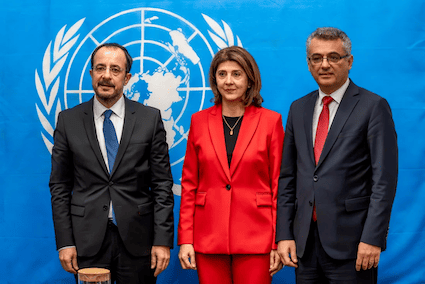
Recent television interviews, public statements and panel interventions by Turkish Cypriot President Tufan Erhürman reveal a coherent and deliberate framework. This is not rhetorical repetition. It is public diplomacy aligned with a consciously designed process proposal.
Even though the ultra-conservative Turkish Cypriot Foreign Minister Tahsin Ertuğruloğlu appears deeply dissatisfied with it, the new Turkish Cypriot position rests on a simple question: why should a method repeatedly proven to fail be expected to produce a different outcome this time?
The essence of the four proposed elements is clear. Political equality, encompassing rotating presidency and effective participation, must be clarified at the outset rather than negotiated as an open question. The process should not restart from zero; all convergences reached up to Crans-Montana remain valid. The negotiations must operate within a defined timeframe. And if the table collapses, there should be no automatic return to the status quo.
This framework was shaped, above all, by the 2017 Crans-Montana experience. That conference ended when the Greek Cypriot side withdrew, reinforcing the perception that an open-ended format provided a cost-free exit.
The message from the Turkish Cypriot side today is straightforward: the same open-ended, timetable-free model that produces no consequence in the event of failure must not be repeated. The party that overturns the table or walks away from it must bear a cost. If negotiations commence, the isolation imposed on Turkish Cypriots should be lifted. Should the process fail again due to the stance of the Greek Cypriot side, there must be no automatic reversion to the previous status quo.
This is not an evasion of solution. On the contrary, it is an effort to prevent yet another predictable failure.
The Greek Cypriot call to “start immediately”
Greek Cypriot leader Nikos Christodoulides maintains his position: let talks resume without delay. He argues that negotiations should continue from where they left off in Crans-Montana and that the United Nations parameters are clear.
Yet the critical question remains: begin, yes, but how? If the method remains unchanged, why should the result differ?
The Greek Cypriot approach seeks to anchor the political ground within existing U.N. parameters. The Turkish Cypriot side contends that the problem lies not only in the political end-state but in the design of the process itself. This is less a debate over federation versus sovereign equality than a debate over the architecture of negotiation.
One side says, let us begin. The other says, let us first agree on how we will begin. The diplomatic difference between these two sentences is profound.
The unexpected position of the United Nations
Perhaps the most striking development has emerged from the United Nations. The letter published by the Secretary-General’s Special Envoy for Cyprus, María Ángela Holguín Cuéllar, followed by Secretary-General António Guterres’ public expression of “full confidence,” carried a message that extends beyond conventional diplomatic neutrality.
Holguín noted that domestic political calendars and institutional responsibilities, including the forthcoming EU Council Presidency, may affect leaders’ willingness to assume risk. This was phrased in diplomatic language, yet its implications were unmistakable.
The Secretary-General’s open endorsement of that assessment suggests that stagnation cannot be attributed solely to competing end goals. It signals that the format itself may be subject to scrutiny.
In other words, the United Nations does not appear inclined to defend automatically a method that has repeatedly failed to generate progress. Instead, it has subtly opened the door to reconsidering the format of the process.
That shift alters the direction of diplomatic pressure.
A shift in pressure
In previous years, international pressure tended to focus on urging the Turkish Cypriot side to “return to the table.” Now the emphasis appears to be shifting toward whether the existing process design is capable of producing movement.
This recalibration carries three significant implications.
First, the Turkish Cypriot side is no longer cast as the defender of the status quo but as the proponent of procedural reform.
Second, the phrase “let us begin immediately” no longer carries automatic credibility. The question that follows is unavoidable: under what rules?
Third, the demand for performance rather than rhetoric is rising. Confidence-building measures, crossing points and tangible steps that ease daily life are no longer symbolic gestures. They function as tests of political will.
This explains why Erhürman’s remark that “leaders who cannot open two crossing points cannot negotiate a comprehensive settlement” has resonated so widely. It is a call to test the grand vision through practical action.
Energy and security dimensions
The debate is not confined to constitutional models. Energy projects in the Eastern Mediterranean, regional security alignments and the military presence on the island form part of the wider backdrop.
The Turkish side argues that energy initiatives excluding Türkiye amount to political exclusion. The Greek Cypriot side frames these projects as exercises of sovereign right.
This divergence illustrates that the Cyprus question is no longer merely an intra-island dispute. It is embedded within a broader regional architecture.
The real question
The February 24 leaders’ meeting will not mark the start of formal negotiations. It will, however, serve as a test of intent regarding how the process might be designed.
The question is clear: will we once again attempt a method that has repeatedly proven incapable of delivering results, or will we construct a genuinely different process?
The central debate in Cyprus today is not federation versus two states. It is whether the method itself will change.
In diplomacy, a shift in tone often precedes a shift in direction. The tone has changed.
But in Cyprus, the essential challenge is not to alter the tone. It is to alter the outcome.