



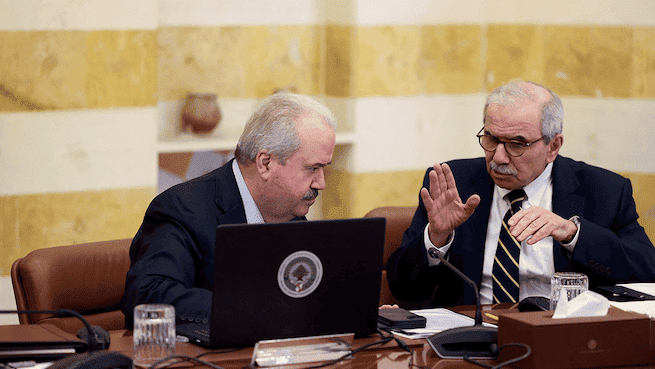
The financial gap resolution plan announced by Nawaf’s government is being marketed as a path toward order, reform, and eventual recovery. In reality, it does something far more dangerous: it legitimizes the state’s historic robbery of depositors, absolves years of fiscal and monetary recklessness, and locks Lebanon into prolonged economic stagnation.
At its core, the plan refuses to confront the original sin of Lebanon’s collapse: the state spent the deposits. Through decades of fiscal mismanagement, chronic deficits, and a rigid monetary policy that fixed the lira at 1,500 to the dollar long after it had become unsustainable, deposits were systematically consumed to finance the state. This was not an accident. It was policy.
Yet nowhere in the plan is the Lebanese state tied down to a clear, binding number it must repay to the central bank. The debt owed by the government to Banque du Liban—at least USD 16.5 billion, before accounting for the broader quasi-fiscal losses embedded in the system—is left deliberately vague. This omission is not technical; it is political. By refusing to quantify and commit, the state quietly escapes accountability for having hollowed out the financial system.
Instead, the burden is shifted—once again—onto depositors and banks.
A Slow Confiscation of Deposits
The plan is particularly treacherous for depositors. It proposes a drawn-out “recovery” horizon stretching 10 to 20 years, a timeframe that ignores Lebanon’s demographic reality. A large share of depositors with significant balances are over the age of 60. For them, this is not restructuring—it is delayed confiscation. Many will be in their eighties, if alive at all, by the time they are supposed to recover their savings.
Even the oft-cited promise of up to USD 100,000 per depositor raises serious doubts. The implied liquidity requirement to fullfil this commitment could easily exceed USD 15 billion. No part of the Lebanese system—neither the central bank, nor the banks—currently possess anything close to that level of deployable liquidity. Pretending otherwise is reckless.
Worse still, the very architecture of the plan destroys the conditions needed to ever generate that liquidity.
Killing the Banking System, Killing the Economy
The plan calls for a total equity wipeout of the banking sector, while simultaneously stripping banks of their ability to operate as going concerns. A banking system without capital, profitability, or trust cannot generate liquidity. A broke Government does not generate liquidity. Central banks regulate and backstop, they also don’t generate liquidity.
Only banks generate liquidity, by extending credit to households and businesses, by financing productive activity, by intermediating savings into growth. By annihilating the banking sector without replacing it with a viable alternative, the plan ensures that liquidity will never return to the economy.
The result is predictable: suppressed consumption, collapsed consumer confidence, and long-term stagnation. An economy cannot recover when its citizens are told their savings are frozen in time and its banks are rendered economically inert.
No Restructuring, No Growth, No Future
Despite its rhetoric, the plan does not genuinely restructure the financial system. It does not restore trust. It does not recapitalize banks in a way that allows them to function. And it does not create fresh liquidity. Instead, it institutionalizes paralysis.
What makes this outcome especially troubling is that alternatives existed.
The government should have negotiated far more aggressively with the IMF, particularly on debt sustainability assumptions. A rigid insistence on a 50% debt-to-GDP threshold in an economy as distorted as Lebanon’s was never realistic. A higher ratio such as 70%, paired with growth-oriented reforms and credible governance conditions, could have preserved depositors’ rights while stabilizing the system.
Equally important, the government should have explicitly recognized and structured the state’s debt to Banque du Liban, rather than burying it in ambiguity. Without addressing the state’s liability, any so-called financial resolution is a legal fiction.
Entrenching the Cash Economy and Grey-Listing Lebanon
By rendering banks insolvent, non-operational, and unrecoverable, the plan accelerates Lebanon’s descent into a cash-based economy.
When banks cannot recapitalize, because shareholders are wiped out and any future profits are structurally impossible—there is no incentive left to rebuild formal intermediation. Economic activity migrates entirely outside the banking system: wages in cash, transactions in cash, savings under mattresses.
This collapse of financial intermediation deepens opacity, undermines tax collection, and entrenches Lebanon’s position on the FATF grey list. A country without functioning banks cannot meet basic AML/CFT standards, regardless of how many laws it passes on paper. Rather than restoring compliance and credibility, the plan locks Lebanon into prolonged financial isolation, where capital inflows dry up, correspondent banking relationships vanish, and the economy survives—but only informally, inefficiently, and permanently below its potential.
Legalizing the Heist
This plan does not correct the injustices of the past. It sanctifies them. It converts what should have been recognized as a massive transfer of wealth from citizens to the state into an accepted baseline. It asks depositors to wait decades for money that was already spent, while dismantling the very institutions that could have helped rebuild the economy.
That is why this plan is not merely flawed—it is dangerous. It legitimizes the heist of the century and calls it reform.
Lebanon does not need cosmetic balance-sheet solutions. It needs accountability, growth,liquidity and a financial system that works. This plan delivers none of the above—and risks ensuring that the country remains trapped in economic limbo for a generation.