



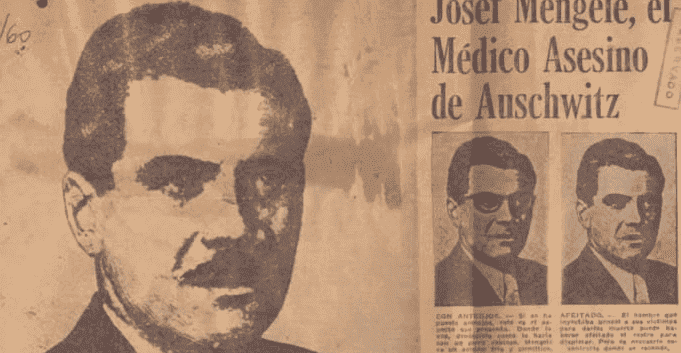
Argentinian president Javier Milei ordered the declassification of a series of 1850 documents about Nazis and their activities in Argentina, revealing Mengele’s life in Buenos Aires.
Infamous Nazi doctor Josef Mengele lived a comfortable life in an affluent Argentinian suburb after fleeing Germany, according to a comprehensive Fox News Spanish-language analysis of declassified documents.
Argentinian President Javier Milei ordered the declassification of a series of 1,850 documents about Nazis and their activities in Argentina, as well as secret and classified presidential decrees from 1957 to 2005.
The almost 400-page dossier on Mengele was released in May; however, an analysis of its contents now reveals key information, including that the Argentinian government was aware of Mengele’s past and compiled an intelligence file on him.
Mengele was known as the “Angel of Death” for his power over the fate of prisoners in Auschwitz during the Holocaust and also for his gruesome experiments on twins and pregnant women.
After World War II, Mengele managed to escape to South America via the so-called ratline. Like many other Nazi criminals, he exploited the chaos and confusion that prevailed after the war, going into hiding shortly after Auschwitz was liberated by the Red Army in early 1945.
Mengele entered Argentina with an Italian passport on June 22, 1949, under the alias Helmut Gregor. He obtained an immigrant ID under this name in 1950, and the declassified documents show that Argentina was aware of his real identity. He later applied for a new ID card, including reverting to his actual name and surname, on November 26, 1955.
Following the restoration of his identity, Mengele traveled to Uruguay to marry his brother’s widow, and the two returned to live in Argentina. According to the documents, the two lived comfortably in the upmarket Vincente López neighborhood in Buenos Aires, and Mengele ran a medical laboratory business named Fadro Farm in Carapachay.
Argentina knew Mengele was in the country
The analysis of the documents shows that Argentina was aware of his identity. One clipping contains the testimony of an Argentinian citizen born in Poland, José Furmanski, who was a victim of Mengele, who said: “I met Mengele. I knew him well. I saw him many times in the Auschwitz camp, with his SS colonel’s uniform and, on top of it, the white doctor’s coat.”
“He gathered twins of all ages in the camp and subjected them to experiments that always ended in death. Between the children, the elderly, and women… what horrors. I saw him separate a mother from her daughter and send one to certain death. We will never forget,” Furmanski said.
The archives also show how Argentina systematically collated Mengele’s documents, including copies of foreign passports under aliases, photographs of suspected associates, handwritten operational notes, immigration ledgers, investigative summaries prepared for political superiors, and correspondence between Argentinian officers and international investigators.
In 1959, he requested permission to travel to West Germany to visit his ill father.
After receiving the request, the Federal Republic of Germany asked the Argentinian government to extradite him. However, the German Foreign Office stated it had no information confirming whether Mengele actually traveled to West Germany during that period.
“But when the Argentinian security forces arrived, Mengele had already fled,” noted Prof. Daniel Feierstein from the Center for Genocide Studies in Buenos Aires.
Mengele had fled to Paraguay in 1959. There, he obtained citizenship and lived under a false name. Allegedly, the then-leader of Paraguay, dictator Alfredo Stroessner, protected Mengele. Stroessner’s family and Mengele’s family came from the same town in Bavaria. Meanwhile, Mengele’s wife and her son (with his brother) moved to Switzerland.
In 1960, after the capture of Adolf Eichmann by the Mossad, Mengele fled to Brazil. His entry to Brazil was helped by German farmers in the country who were Nazi sympathizers, the documents show. He continued to live under the pseudonym Peter Hochbichler until his death in 1979 from a stroke while swimming. He was buried under the pseudonym Wolfgang Gerhardt, and his body was only exhumed and identified by Brazilian authorities in 1985.