



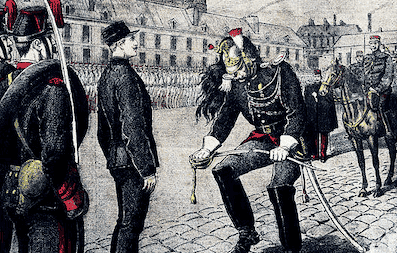
1895 illustration depicts the public degradation ceremony of French army officer Alfred Dreyfus at the height of the Dreyfus Affair in Paris
*
French army captain Dreyfus posthumously promoted to rank of brigadier general, 130 years after wrongful treason conviction in one of France’s most notorious cases of antisemitism
Alfred Dreyfus, a French Jewish army captain wrongly convicted of treason in 1894, was promoted on Tuesday to the rank of brigadier general as an act of reparation in a notorious case of antisemitism that has caused outrage for generations.
The law is seen as a symbolic step in the fight against antisemitism in modern France, at a time of growing alarm over hate crimes targeting Jews in the country in the context of the Gaza war.
President Emmanuel Macron and Prime Minister Sébastien Lecornu signed the promotion into law on Monday, and it was published in the Journal Officiel of new legislation on Tuesday. “The French nation posthumously promotes Alfred Dreyfus to the rank of brigadier general,” the law reads.
Yaël Perl-Ruiz, great-granddaughter of Alfred Dreyfus, hailed the decision. “This is a historic moment. The long-awaited correction has come! My great-grandfather’s life and career were destroyed, and he bravely resisted the false charges against him. He never harbored a trace of hatred toward his accusers. He is a model of courage and loyalty,” she said.
“It is painful that this correction comes only after his death and that he will never know of it. But amid the rise in antisemitism in France and around the world, it is heartening that this bill—initiated by [former French prime minister]Gabriel Attal—was adopted unanimously by the French National Assembly.”
Dr. Yoav Heller, historian and head of the Fourth Quarter Movement, added: “It took 131 years for the libel against Dreyfus to be erased! Now the question is, how long will it take the Western world to retract the blood libels it spread against Israel during the war—accusations of genocide, starvation and other lies. These charges are the product of rotten international institutions (the UN, the Hague court) and of deep-rooted antisemitism and anti-Zionism that are spreading like a virus across both the Muslim world and the West.”
The Dreyfus affair: from accusation to exoneration
Alfred Dreyfus was born in Mulhouse, Alsace, into a well-off, assimilated Jewish family. After studying at the prestigious École Polytechnique, he enlisted in the French army. In 1892, he was promoted to the rank of captain and assigned to the General Staff—at the time, he was the only Jew serving there.
In 1894, French military intelligence obtained a document sent by a French officer to a German embassy official in Paris. Suspicion fell on Dreyfus, who was brought before a court-martial. In December of that year, Dreyfus was convicted of treason. A month later, he was publicly degraded, stripped of his rank and sentenced to life imprisonment on the notorious Devil’s Island penal colony in French Guiana. The trial was deeply flawed—no substantial evidence was presented, as none existed—yet antisemitic elements in the military and public inflamed sentiment against him.
Meanwhile, a public campaign for his exoneration began, led by journalist Bernard Lazare. During this period, the new head of military intelligence, Lt. Col. Georges Picquart, discovered that the real spy was another officer—Maj. Ferdinand Walsin Esterhazy, an adventurer of Hungarian descent. Picquart’s predecessor, Maj. Hubert Joseph Henry—who had discovered the original letter attributed to Dreyfus—had forged documents to discredit Picquart. Picquart was dismissed and sent to Africa.
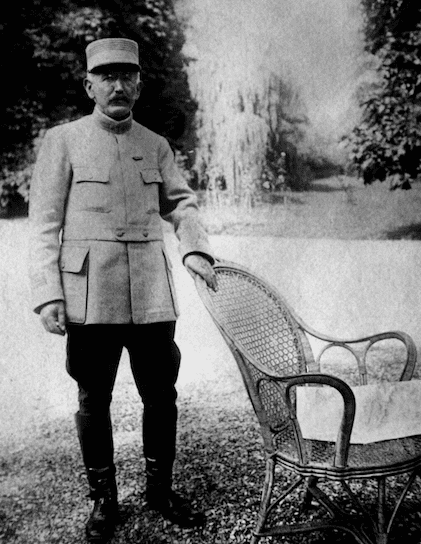
Picquart passed his findings to prominent left-wing politicians, further intensifying the national controversy. Although Esterhazy was brought to trial, he was acquitted. In January 1898, author Émile Zola published his famous open letter, J’accuse, denouncing those who had framed Dreyfus. The affair continued to reverberate across the globe and deeply divided France into pro- and anti-Dreyfus camps. Among Dreyfus’s supporters was future prime minister Georges Clemenceau. The affair also split the French military, undermined public trust, and led to sweeping reforms in its structure and leadership.
In the summer of 1898, Henry’s forgeries were exposed. He was arrested and later committed suicide in prison. The government annulled the original verdict, and in September 1899, Dreyfus was granted a retrial. Despite the renewed proceedings, military officers repeated their accusations, and the court again found Dreyfus guilty—but this time sentenced him to just ten years in prison.
Public outcry persisted, and in 1906, a court of appeals ruled that the evidence against Dreyfus had been baseless. He was reinstated in the army with the rank of major, served in World War I and died in 1935 at the age of 76.
The public uproar surrounding the Dreyfus Affair—especially its antisemitic underpinnings—sparked wider debate about the “Jewish question.” Theodor Herzl, then an Austrian journalist covering the trial, was deeply affected by the antisemitic chants during Dreyfus’s public degradation on January 5, 1895, when his insignia were torn from his uniform and his sword broken. These events shaped Herzl’s vision of Zionism.
Over time, the term “Dreyfus Affair” became shorthand for the wrongful conviction of innocent people, and the case itself a lasting symbol of antisemitism and hatred of Jews. Dreyfus’s letters and memoirs have been published in several volumes.