



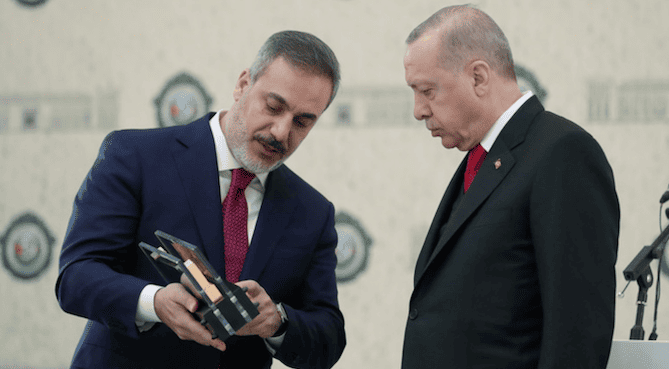
President Recep Tayyip Erdoğan has positioned himself as one of the most visible leaders on the international stage. In recent weeks he addressed the United Nations General Assembly, repeating his familiar call that “the world is bigger than five.” Soon after, he travelled to Washington for a high-profile meeting at the White House with U.S. President Donald Trump, where economic cooperation, defense sales, and regional crises dominated the agenda. Back in Ankara, he has continued to host visiting heads of state while at home presiding over demonstrations and official ceremonies that underline his outspoken stance on Gaza.
Through these appearances Erdoğan seeks to portray Türkiye as an indispensable actor — at once mediator in conflicts, defender of the oppressed, and a country that cannot be ignored.
Yet beneath the grandstanding lies a more sobering reality: Türkiye is bound, not free. Four stubborn knots tighten around its foreign policy. They are less visible than summits and less dramatic than Erdoğan’s declarations, but they define the contours of Ankara’s room for maneuver.
These knots — economic fragility, security fixation, global overextension, and domestic polarization — are not temporary inconveniences. They are structural constraints, habits cultivated over years, and traps into which Türkiye repeatedly falls. Erdoğan has mastered the art of improvising within these binds. His unpredictability and pragmatism keep the system running. But improvisation is not strategy, and theater is not freedom.
The latest news cycles illustrate this perfectly: a new “Kurdish opening” already mocked as doomed to fail, Erdoğan’s heavy hand tipping the scales in the Turkish Cypriot presidential race, Israeli forces seizing the Sumud flotilla and arresting Turkish nationals, and pro-government loyalists clashing on live television and even in front of the White House about what Türkiye’s “official line” actually is. If Ankara’s critics say the country exports polarization instead of stability, these episodes are their evidence.
Knot one: Economic fragility and diplomacy in chains
The first knot is brutally simple: money.
Türkiye’s economy has been in chronic crisis mode for years. Official inflation exceeds 60 percent, and unofficial figures run even higher. The Turkish lira, once a symbol of economic confidence in the 2000s, has become a punchline, bleeding value against every currency that matters. Central bank credibility has evaporated after years of political interference.
Dependency in disguise
Erdoğan speaks of an independent foreign policy, one unbound by Western dictates. Yet nearly half of Türkiye’s exports go to the European Union. The customs union with the EU, frozen in time since the mid-1990s, remains both a lifeline and a straitjacket. When German automakers sneeze, Turkish suppliers catch cold. When European demand dips, factories in Bursa and Gaziantep fall silent.
At the same time, Ankara’s survival increasingly depends on Gulf petrodollars. Swap lines from Qatar, sovereign fund injections from the UAE, and direct real estate purchases by Saudi capital have kept Türkiye afloat in moments of peril. These inflows are presented as symbols of Ankara’s strategic depth — “we can look East as well as West.” In reality, they are loans with political conditions attached.
“No foreign policy is independent if your economy is dependent,” CHP leader Özgür Özel observed recently. The phrase stuck because it rings true.
Erdoğan’s double game
Erdoğan, of course, knows all this. He plays the contradictions to his advantage. When courting Riyadh or Abu Dhabi, he frames the deals as signs of Türkiye’s indispensability in the Gulf. When addressing EU leaders, he points to Türkiye’s role as Europe’s second-largest trading partner outside the union, daring Brussels to risk rupture.
Cynics translate the line differently: “We borrow from the Gulf to pay salaries, and we sell textiles to Europe to pay for imports.”
It is diplomacy by necessity, not design. But Erdoğan’s unpredictability allows him to package dependence as choice. Partners never know whether Ankara will lean their way or pivot elsewhere, and that uncertainty buys Türkiye leverage — at least in the short term.
The opposition’s stagnant critique
The opposition hammers the point relentlessly: Türkiye is mortgaging its sovereignty for Gulf inflows and EU markets. They demand the return of central bank independence, judicial reform, and renewed EU anchoring. These are sound prescriptions — but they are also echoes of the early 2000s, before Erdoğan discovered that volatility can be politically useful.
The economy is the stage upon which foreign policy is performed. And on that stage, Türkiye’s independence is spoken loudly but mortgaged quietly.
Knot two: Security fixation – foreign policy as border patrol
The second knot is psychological, rooted in fear and geography.
Türkiye sits in one of the world’s most volatile neighborhoods. The PKK insurgency persists in shifting forms across Syria and Iraq, keeping Ankara on permanent alert. Greece presses its claims in the Aegean and Eastern Mediterranean, usually with the political and military backing of the EU and the United States. The Cyprus problem remains a chronic irritant — not only poisoning relations with Brussels but also complicating many of Türkiye’s bilateral dealings. Iran seeks influence in both Iraq and Syria, often at odds with Ankara’s ambitions. Russia’s military presence dominates the Black Sea, limiting Türkiye’s room for maneuver. And the United States continues its balancing act — formally listing the PKK and its Syrian extension, the YPG/SDF, as terrorist organizations, while in practice treating them as tactical partners on the ground.
Fear as compass
“We no longer have a foreign policy. We have national security policy, nothing more,” a retired ambassador sighed recently. He was not exaggerating. Every diplomatic choice is filtered through a threat matrix: does it weaken the PKK, block Greece, limit Iran, contain Russia?
Even economic and cultural initiatives abroad — schools in Africa, embassies in the Balkans — are justified in terms of security: preventing FETÖ infiltration, blocking PKK lobbying, countering Iranian propaganda. Ankara is rarely talking to neighbors as neighbors; it is talking to enemies as potential enemies.
The “Kurdish opening” that already closes
In this climate, with his nationalist partner Devlet Bahçeli’s suggestion, Erdoğan’s decision to launch a parliamentary “Kurdish opening” — establishing a special committee to examine Kurdish grievances and explore reforms — looks almost surreal. Supporters hail it as proof of Erdoğan’s pragmatism and his ability to reinvent himself yet again. Opponents scoff: “We’ve seen this film before. It will end with more mistrust.”
And indeed, memories of previous “openings” that collapsed into recriminations are fresh. For many Kurds, such initiatives are designed not to heal but to buy time, to present the façade of inclusivity while security operations continue unabated. For Erdoğan, the committee is tactical: a tool to calm restive Kurdish voters ahead of future elections, while also signaling to Western capitals that Ankara is not deaf to rights discourse.
Like a knot pulled tight and then briefly loosened, the “opening” exists only to prove that it can close again.
Gaza and the Sumud Flotilla
Nowhere is Türkiye’s rhetorical assertiveness more evident than on the Gaza war. At the United Nations rostrum, President Erdoğan accused Israel of genocide, declaring that “those who stay silent in the face of massacre share the guilt.” His warning that history will judge complicit world leaders echoed across much of the Global South.
Foreign Minister Hakan Fidan, meanwhile, has been on a whirlwind of regional diplomacy — shuttling between Riyadh, Doha, and Abu Dhabi to press for a ceasefire and uninterrupted humanitarian corridors. Türkiye’s tone is moralistic and unapologetically confrontational, framing itself as the conscience of the Muslim world in an era of Western double standards.
That moral posture, however, was tested when 137 activists and aid volunteers detained by Israel — including 36 Turkish citizens — were flown to Türkiye aboard a chartered aircraft, following days of tense behind-the-scenes negotiations. Their release was celebrated in Ankara as a “diplomatic victory,” though critics noted it also exposed how easily humanitarian missions can become geopolitical liabilities.
At the center of the controversy lies the “Sumud Flotilla” — a civilian convoy that set out to challenge Israel’s naval blockade of Gaza. Pro-government commentators hailed it as a symbol of Türkiye’s solidarity with Palestinians and as proof that “Ankara acts when others merely speak.” But opposition outlets warned of dangerous déjà vu: the specter of the 2010 Mavi Marmara tragedy, when Israeli commandos killed nine Turks aboard a similar ship, still haunts the national memory.
“We cannot afford another disaster at sea,” cautioned Sezgin Tanrıkulu, a veteran CHP deputy. “The government is playing with fire. If even one Turkish citizen is harmed again, Ankara will face renewed international isolation. We must lead with diplomacy, not adventurism.”
Foreign observers share that unease. Michael Stephens, a London-based Middle East analyst, told The Guardian: “Erdoğan has boxed himself in. He wants to be the loudest voice on Gaza, but he also fears the costs of confrontation. The flotilla, the arrests, and the dramatic airlift home all illustrate his dilemma — to champion the cause risks escalation; to step back risks accusations of betrayal.”
In the end, the episode revealed both the potency and the peril of Türkiye’s Gaza policy: a blend of humanitarian zeal and strategic brinkmanship, where moral conviction collides with diplomatic constraint.
Knot three: Overextension or global ambition on regional means
Türkiye’s global activism is impossible to ignore. From Mogadishu to Sarajevo, from Tripoli to Baku, the Turkish flag is everywhere. Humanitarian agencies, airlines, mosque-builders, mercenaries, and drones all form part of this sprawling apparatus.
Bandwidth illusions
But as Sinan Ülgen of EDAM has warned: “We are trying to be a global actor with regional resources. This is not sustainable.”
Türkiye’s GDP is smaller than Italy’s, its defense budget a fraction of France’s. Yet Ankara spreads itself as though it were a global power with limitless means. Ambition may win headlines, but it also drains coffers and stretches credibility.
Cyprus: The exhibit A
The Turkish Cypriot presidential election on October 19 has become the latest stage for Ankara’s overreach. Erdoğan’s government openly backs incumbent Ersin Tatar, the champion of the two-state solution Ankara has adopted as dogma.
But the heavy hand is resented. In 2020, Ankara tilted the race against Mustafa Akıncı, a president who dared to criticize Erdoğan’s policies and insisted that Turkish Cypriots should not be treated as Ankara’s subordinates. Ministers, party officials, and Turkish media all campaigned against him. He lost narrowly to Tatar. Many Turkish Cypriots still describe that election not as democracy, but as “annexation” of their ballot box.
Now, opposition candidate Tufan Erhürman of the Republican Turkish Party (CTP) invokes that memory: “This election is about whether Turkish Cypriots still have a voice, or whether Ankara decides.” Serdar Denktaş warns that “when Türkiye leans too hard, it suffocates us.” Kudret Özersay calls it “an insult to the dignity of the community.”
In the cafés of Lefkoşa, the sentiment is expressed without ceremony: “We vote, Ankara decides.” It is a shorthand for the frustration many Turkish Cypriots feel when their electoral will appears overshadowed by the preferences of the mainland. That perception is reinforced from the other side of the divide as well. Greek Cypriot leader Nikos Christodoulides has put it even more starkly: “The ultimate decisions of the Turkish Cypriots are made in Ankara.” His remark, meant as a political jab, also echoes the grievance voiced in northern Cyprus — that local politics are too often reduced to extensions of Turkish domestic calculations rather than expressions of the community’s own choice.
Exporting polarisation
The irony is brutal. At home, Ankara is accused of exporting polarization rather than stability. In Cyprus, that accusation materializes in real time. Instead of fostering unity, Türkiye’s intervention splits Turkish Cypriots between those resigned to Ankara’s dominance and those who resent it.
The knot of overextension is visible here: Ankara wants to shape outcomes abroad, but its tools — intimidation, pressure, interference — generate discord, not stability.
Knot four: Polarization
The final knot may be the tightest: polarization. Foreign policy once united Turkish parties. NATO membership, EU accession, Cyprus red lines — these were bipartisan positions. Today, every foreign handshake is reframed as betrayal or victory.
Erdoğan’s trips to Gulf capitals are mocked as “begging tours” by opposition figures. Government media recast them as proof of global leadership. EU dialogues are portrayed either as humiliating dependency or as evidence of Türkiye’s indispensability. Every move abroad is ammunition at home.
Opposition figures quip: “We are not exporting stability. We are exporting our polarization.” The quip is accurate.
When even loyalists split
Lately, polarization has spread beyond government vs. opposition. Even Erdoğan’s loyalists now contradict each other. Pro-government pundits clash on live television over whether Türkiye should stay in NATO or quit it. Social media trolls and penslingers in the media loyal to the government snipe at each other, undermining coherence.
When even defenders of the official line cannot agree on what the line is, credibility erodes fast.
Erdoğan’s talent
And yet, here lies Erdoğan’s genius: he thrives on polarization. Criticism confirms his embattled narrative. Clashes among loyalists create the illusion of pluralism. Discord itself becomes proof that he alone can keep the system together. Polarization is not just a knot; it is his chosen rope.
The four knots, pulled tighter
Türkiye’s foreign policy show will continue. Erdoğan will keep oscillating between Washington and Moscow, Riyadh and Brussels, Gaza and Geneva. He will turn crises into narratives, bottlenecks into proof of indispensability.
But the knots remain:
None of this is new. The latest Kurdish committee recalls earlier failures. The Sumud flotilla revives Mavi Marmara. The 2025 Cypriot election mirrors 2020, when Mustafa Akıncı was pushed aside. Türkiye does not escape its knots; it repeats them.
For Erdoğan, unpredictability ensures survival. For the opposition, critique without a vision ensures irrelevance. For Türkiye, the knots endure — tighter each year, harder to untangle, yet perversely functional. Because in this theater, being bound is still better than being absent from the stage.