



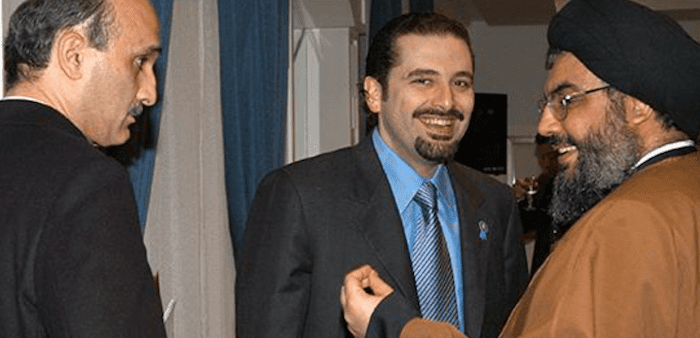
On Sunday, Sheikh Nabil Qaouq, a Hezbollah official, denounced the continued deadlock in Lebanon over electing a new president, but offered (what he considered) a sliver of good news. Amid the deadlock and tension, Qaouq said, “the only ray of hope in the country is the dialogue between Hezbollah and the Free Patriotic Movement,” led by Gebran Bassil.
Two questions immediately came to mind in reading Qaouq’s remarks. The first is how has he, and Hezbollah in general, been allowed to present the FPM as the leading Christian interlocutor with which Hezbollah must speak over the presidency, even though the Lebanese Forces received a greater number of votes in the elections of 2022, Christian votes in particular, and have a larger bloc in parliament? The second is, where on earth are the Lebanese Forces today, because when it comes to politics they are nowhere to be found?
I exaggerate? Certainly, we do hear quite frequently from the party’s leader Samir Geagea, and occasionally from the Lebanese Forces’ parliamentarians. But that’s not the point. When it comes to offering an alternative to the failed governance structure that exists today in Lebanon, what does the party propose? It has been years since the Lebanese Forces have participated in a government, let alone imposed themselves as a pivotal actor in the affairs of the country. Since 2019, the party seems to have retreated into a form of splendid, calcified isolation. In July, Geagea shared his thinking when he said that he would not engage in discussions with Hezbollah, justifying this on the grounds that there was no point “wasting additional time on a dialogue that will not lead anywhere.”
One has to wonder, then, what it means to have the largest Christian bloc in parliament if you just sit back and do nothing with what you’ve attained? Worse, Geagea has seen his sectarian alliances suffer. His relations today with most of the major communities are bad. He doesn’t speak to Hezbollah, is on polite but cool terms with Walid Joumblatt, and has hit a brick wall with the Sunni community, especially the remnants of Saad Hariri’s followers. His ties with the Aounists are transactional, until they no longer will be and the Lebanese Forces and FPM can go back to the familiarity of being hostile.
Bassil has been cleverer on this front. His dialogue with Hezbollah is aimed at achieving several things. First, it ensures that he remains relevant, at a time when quite a few people had written Bassil off after Michel Aoun’s departure from office. He also remains at the heart of resolving the main national crisis today—the inability to elect a president. Second, Bassil has allowed Hezbollah to anoint the FPM as the “most prominent Christian party,” which it isn’t. By going along with that illusion, Bassil is refloating a sinking FPM ship and eroding the Lebanese Forces’ advantage, which Geagea has done nothing to consolidate, Third, Bassil is talking to Lebanon’s most powerful party, a necessity for anyone who wants to play a political role in the country. Geagea, in turn, is only playing coy.
Bassil is also trying to reanimate his interactions with the other communities. In early August, he inaugurated a youth center in the Shouf, the main area of influence of the Druze leader Walid Joumblatt, and made a conciliatory speech. He stated that “there is no reason why the [FPM] should be hostile to any Lebanese because of their affiliation or thinking, because we accept the thinking of everyone. We can quarrel with people because of their behavior or deeds, but not because of their sect or party or thinking.”
This came only a few weeks after he congratulated Teymour Joumblatt on his election as head of the Progressive Socialist Party. Bassil also pointedly congratulated Walid Joumblatt on the occasion, and expressed “all good wishes for a quiet transition of the leadership of the party, and hope for cooperation for the good of the country.”
While Bassil has had a tougher time with the Sunnis, even before the departure of his father in law from the presidency last year he began to mend fences with the community. This was natural insofar as by that time he knew that Hezbollah would not back his presidency, so he wanted to widen his sectarian reach. In September 2022, Bassil visited the mufti of the Republic, Abdel-Latif Derian, with an FPM delegation, during which he defended the Taif Agreement. Taif gave considerable constitutional powers to the Sunni prime minister, at the expense of the Maronite president, so Bassil’s remarks were an effort to reassure the Sunnis that the Maronites did not seek to dissolve the agreement.
Geagea, in turn, remains on poor terms with most of the major Sunni political forces. Hariri’s followers still blame him, fairly or unfairly, for the way the Saudis turned against the former prime minister. They also remember that on two occasions, Geagea’s refusal to endorse Hariri as prime minister denied him Christian legitimacy, crippling Hariri’s already difficult cabinet-formation efforts. Geagea’s history with those in the community who come from an Arab nationalist, or pro-Palestinian, background was never good, and little has changed.
One gets a sense that Geagea, since the uprising of October 2019, has sought to take a distance from the corrupt political class to avoid being tarred with the same brush. His way of doing so, apparently, is to keep his party outside government and sit behind a neutralizing barrier of principle. But nor has he appealed to the new political forces that emerged from the uprising. His dealings with the so-called Change bloc of parliamentarians who emerged from civil society have been fraught. Geagea, it seems, cannot quite understand why they refuse to follow his lead, missing the perfectly obvious point that the bloc, for all its missteps, insists on remaining independent from the traditional political leadership.
The risk for the Lebanese Forces is that by refusing to take on any responsibility for governance, they will become largely irrelevant. That’s a shame, because in the past the party appointed quite credible people as cabinet ministers. But being perpetually on the outside looking in and criticizing from the sidelines becomes a tiresome habit after a while. I would wager fresh dollars that unless Geagea’s strategy changes, the Lebanese Forces will lose votes in 2026.
For a start, Geagea should act like the leader of the largest Christian party and not allow Hezbollah to outmaneuver him by portraying Bassil as its most representative Christian counterpart. That means, quite simply, that Geagea must talk to Hezbollah, even impose himself. It makes no sense to refuse to communicate with a potent force in the country, nor to give Hezbollah the latitude to delegitimize the Lebanese Forces. It’s not as if Geagea has never engaged in a dialogue with Hezbollah before, because he has on more than one occasion—in 2006 and again in 2008. Moreover, his parliamentarians interact with Hezbollah’s regularly.
Geagea is right that Hezbollah has an agenda on which it is unlikely to concede very much. However, he and Bassil did succeed in uniting and sidelining for a time the party’s choice of Suleiman Franjieh as president when both men backed Jihad Azour as a candidate, forcing Hezbollah to step back and search for a solution. Yet it should have been Geagea, the leader of the largest Christian parliamentary bloc, who should have capitalized on this success by engaging with the party in resolving the stalemate over the most prominent of Maronite Christian positions, not Bassil. But the reality is that it was Bassil who used Geagea to gain leverage in his negotiations with Hezbollah, not the other way around.
Some people admire those who stick to their guns against all odds. Maybe, but the last time Geagea did this, he spent eleven years in a cell. After his release, the Lebanese Forces managed to rebuild themselves, construct cross-sectarian alliances, and become a major player in Lebanon’s political landscape. Yet today the party’s sectarian alliances are very brittle. The Lebanese Forces may be the largest Christian bloc in parliament, but really aren’t that essential to domestic politics because they’ve chosen to remain largely outside the snake pit of daily bargaining. If the party’s role has receded to being a periodic wellspring of unfulfilled injunctions, then elections mean nothing and politics even less so.
حين يروج مايكل يونغ للهزائم أو حينما يتوهم أن حزب الله لبناني يمكنك التفاهم معه!
ماذا استفاد لبنان من الحوارات مع حزب الله. كيف ناوى الحزب و كيف انقض على تساؤلات الحريري معه. ليس الموضوع موضوع ذكاء ،بل الموضوع من يخدم الحزب مقابل الحصول على توافه خاصة له و له شخصيا.في 2010 كان مايكل يونغ معجبا بجعجع ،يبدوا لي أن يونغ الذي تواجد كثيرا في بيروت خلال تلك الفترة داعماً لما للمتغيرات اللبنانية/ الخارجية إلى أدت إلى انتهاء هينة النظام السوري على لبنان،قد انقلب بعد عقد إلى المطالبة ب” مشي حالك” مع الحزب. هل يتصور يونغ أنه سيبقى شيئا في لبنان أو المنطقة أن واصلت ايران انتصاراته ،مفيدا .سهى عن ذاكرة يونغ أن الحزب مرجعيته… Read more »