



Military coup attempt failed to control information
by ROBERT BECKHUSEN
A military coup attempt by what appears to be a conspiracy within the Turkish military has failed. At least 265 people are dead and one of the strongest NATO armies, dealing with the fallout of the civil war in Syria, is in chaos.
It’s unclear who precisely within the military was behind the coup attempt, the most violent intervention of the armed forces in Turkish politics since 1980. The exact reasons are opaque, although the military — with a strong attachment to secularism — has been averse to the Islamist politics of Pres. Recep Tayyip Erdogan.
There is little, doubt, however, that the coup attempt has collapsed and hundreds of soldiers have been taken into custody. Turkish military chief Gen. Umit Dundar said “the coup attempt was rejected by the chain of command immediately.”

It also seems the plotters failed to secure one the first major targets of military coups — the means of communication. Although they did try.
During the opening hours of the putsch, access to services including Twitter, Facebook and YouTube were intermittent or available only through proxy servers — indicating a possible attempt to shut off access. But this failed to prevent Turkish civilians and journalists from uploading a deluge of video footage of the coup attempt as it was underway.
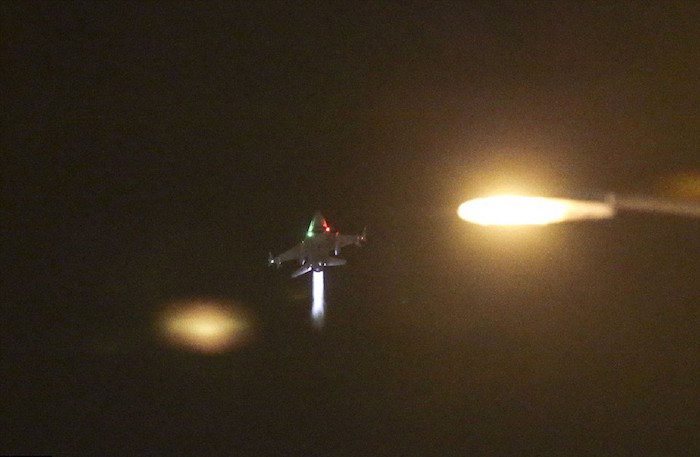
Armed soldiers blocked the bridges over the Bosphorus. Fighter jets raced low and fast over Istanbul and Ankara, their sonic booms reflecting off the pavement. Helicopters armed with machine guns fired onto the streets and appeared to strike down civilians. A tank drove into a crowd, goring people to death. Air strikes hit the parliament building in Ankara.
The plotters seized the headquarters of the state-owned Turkish Radio and Television Corporation and stormed the offices of CNN’s Turkish affiliate. The seizure of TRT prevented Erdogan from going on the air, but within hours he appeared on CNN Turk via the FaceTime app, where he urged the public to resist the rebellious soldiers.
“There is no power higher than the power of the people,” Erdogan said. “Let them do what they will at public squares and airports.”
CNN Turk’s offices were soon overrun. But for the coup plotters, it appeared too little, too late. By dawn both broadcasters were back on the air and the coup was unraveling.
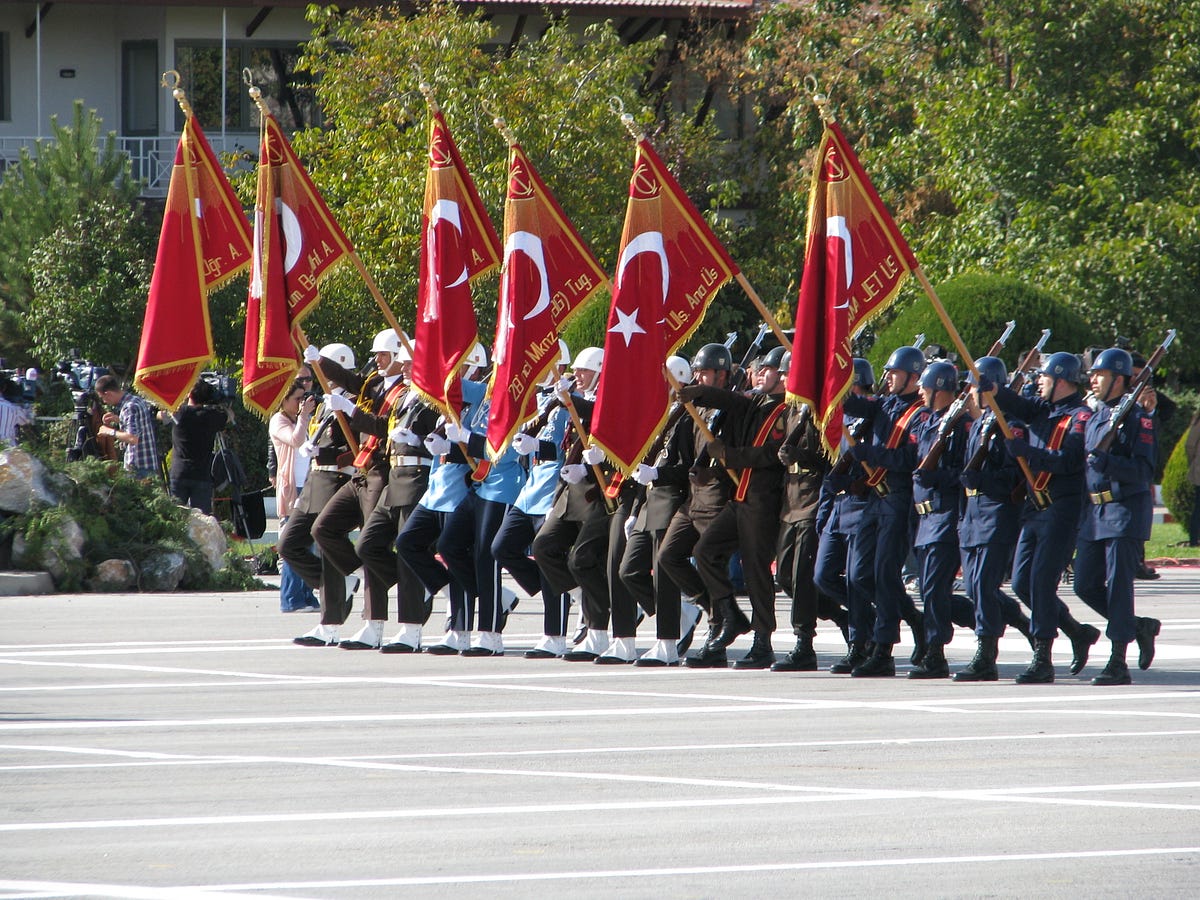 Turkish soldiers march in Ankara in 2012. Ex13/Wikimedia photo
In 1968, the political scientist and gadfly Edward Luttwak wrote a satirical guide for toppling governments titled Excerpts From Coup d’Etat: A Practical Handbook. Although tongue-in-cheek and addressed to a hypothetical audience of like-minded conspirators, it contains a great deal of truth about what it takes for a coup to succeed.
Luttwak noted “the need for maximum speed in the transition phase, and the need to neutralize fully the forces which could oppose us both before and immediately after the coup … [our]far more flexible instrument will be our control over the means of mass communications.”
“Moreover, the confused and dramatic events of the coup will mean that the radio and television services will have a particularly attentive and receptive audience.”
Coup attempts depend on presenting a perception of strength. A coup is often an act by a small minority of military officers attempting to impose their will on an entire country. As a result, the slower the coup moves and the longer it takes to seize control of the media, the more the true nature of the plotters’ inherent weakness becomes evident.
Due to the need to keep the conspiracy secret, it’s less common when the entire armed forces rise up together — there are often differences in factional loyalties that necessitate speed on the part of the conspirators.
In Turkey, by the time soldiers had taken control of CNN Turk’s offices, Erdogan had already addressed the nation and called on people to confront the plotters.
Luttwak also wrote his guide at a time before mobile phones, the Internet and social media. It was a time when a coup staged in the middle of the night — and targeting centralized sources of information — had a feasible chance of succeeding. Successful Turkish military coups in 1960, 1971 and 1980 played out in this pattern.
“If, in the operational phase of the coup, we are at any stage delayed, then our essential weakness will emerge,” Luttwak wrote. “We shall probably acquire a definite political coloration, and this in turn will lead to a concentration of those forces which oppose the tendency we represent.”
But the battle of perception surrounding the 2016 Turkish coup attempt played out in real time, drastically shortening the window the plotters had to fool the public into believing they were in control.
Within hours of the military mobilizing, it was clear Erdogan and Binali Yildirim — the prime minister — had not been deposed. The plotters’ grip on society proved far more tenuous than its initial pronouncements appeared.
On July 16, the Turkish government “appeared to press ahead with a purge of judiciary officials with alleged links” to Turkish preacher Fethullah Gulen, according to the Guardian. Erdogan alleged Gulen — who lives in exile in Pennsylvania — was behind the coup attempt, but the Gulen Movement denied the claim.
Hours later, with the strength and credibility of the coup attempt in question, crowds of civilians and police — under the control of the Interior Ministry — disarmed soldiers and swarmed armored vehicles linked to the coup attempt.
The perception tactic failed. And the pre-social media days of taking over a government at night, when most people received their news from print newspapers, television and radio — and before the state’s institutions can react — may be over.