



As the UN turns 80, it looks silent in Gaza, selective in Ukraine, fractured under Trump, and sidelined in the Pacific; trapped in the mold of 1945, it cannot meet the crises of 2025 without real reform.
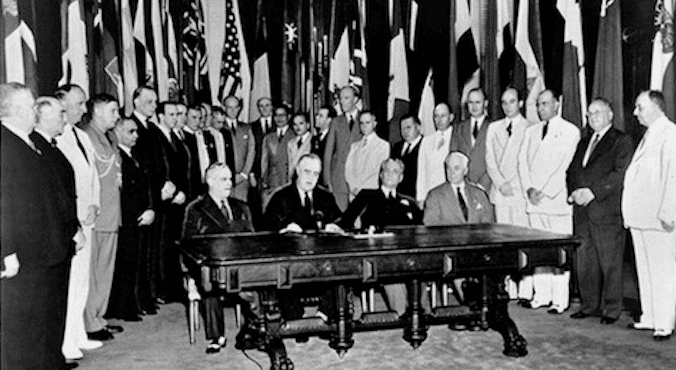
When the United Nations Charter was signed in San Francisco in June 1945, the world was a cemetery of ideas as much as of lives. Fifty million people had perished in two global wars, cities were reduced to rubble, economies lay in depression, and faith in unilateral power had collapsed. The victors of World War II pledged that “we the peoples” would never again allow the scourge of war to devastate future generations.
Eighty years later, that promise has been shattered. Gaza suffers constant bombardment; Ukraine is caught in the deadliest war in Europe since 1945; Sudan remains divided by conflict; and the Pacific feels the pressure of escalating U.S.–China rivalry. In this tense context, the UN holds its 80th General Assembly in New York from September 9 to 23, 2025 — serving more as a condemnation than a celebration.
The UN is still present, still symbolically universal, still coordinating humanitarian relief and development. But in its core mission — restraining aggression, upholding international law, giving voice to the weak against the strong — it is paralyzed. Worse still, it is seen by much of the world not as an impartial guardian but as an instrument of power, most often of Washington.
The 80th anniversary, then, is a mirror. It reflects not only the UN’s achievements — decolonization, human rights covenants, humanitarian aid — but also its failures. Above all, it exposes a structural crisis: the body that was supposed to embody collective security has been successively hostage to Cold War blocs, and since the 1990s, captured by U.S. hegemony. Gaza, Ukraine, Trump’s America, and the Pacific eclipse are the four burning symbols of this decline.
The Cold War cage: Born into division
From its birth, the UN was a paradox. It promised universality but embedded hierarchy: the five permanent members (P5) of the Security Council were granted veto power. In theory, this ensured that the great powers would remain inside the system. In practice, it meant the UN could never act against them.
The Cold War quickly turned the UN into an arena of stalemate. The Soviet Union vetoed resolutions on Hungary in 1956 and Afghanistan in 1979. The United States blocked criticism of its interventions in Latin America, Southeast Asia, and, increasingly, the Middle East. Peacekeeping missions emerged — in Cyprus, the Congo, Sinai — but they were limited, underfunded, and politically constrained.
Yet the UN retained symbolic legitimacy. Even when blocked, it provided a stage where global opinion was registered. Decolonized states used the General Assembly to advance independence movements and condemn apartheid. The Security Council’s paralysis was thus partially offset by the Assembly’s moral weight. Still, the lesson was clear: the UN could only act decisively when the superpowers allowed it.
After 1990: From paralysis to American capture
The collapse of the Soviet Union raised hopes that the UN might finally achieve its purpose. The 1991 Gulf War seemed to confirm this: Iraq’s invasion of Kuwait was condemned, and a U.S.-led coalition, under UN authorization, expelled Saddam Hussein’s forces. For a brief moment, collective security appeared to function.
But even this case foreshadowed capture. U.S. troops were deployed before the Security Council authorized action; the resolutions effectively ratified decisions already made in Washington. The Gulf War was less a triumph of multilateralism than its appropriation.
In the 1990s and 2000s, this pattern hardened. Afghanistan in 2001 was endorsed by the Council under counterterrorism language, but Iraq in 2003 was not. When Washington could not secure a second resolution authorizing war, it invaded anyway. Secretary-General Kofi Annan later declared the invasion “illegal,” but the damage was done. The message was unmistakable: the UN’s authority was conditional on alignment with U.S. priorities.
This was the unipolar moment. The U.S. used the UN when convenient, bypassed it when inconvenient, and ensured that no binding resolution could restrain its closest allies — above all, Israel.
Gaza: The UN’s darkest hour
No case better illustrates the UN’s impotence than Gaza. Since October 2023, Israel’s military campaign has devastated the enclave. Entire neighborhoods were reduced to rubble, more than half the population displaced, hospitals overwhelmed, famine conditions spreading. UN agencies themselves — OCHA, UNRWA, WHO — issued reports describing the situation as “unprecedented humanitarian catastrophe.”
Journalists were killed at record numbers; aid convoys struck; refugee camps flattened. The International Court of Justice, responding to a South African petition, warned of a “plausible risk of genocide.” It was a sad demonstration of humanitarian collapse. Yet the Security Council remained silent in practical terms. Draft resolutions demanding ceasefires, humanitarian corridors, or sanctions were repeatedly vetoed by the United States. In such a context, remaining neutral, refusing to condemn, or seeking a false balance is no less than complicity in a crime against humanity.
The silenced delegation – The crisis reached farcical proportions on the eve of the 80th General Assembly. The United States denied visas to the Palestinian president and his delegation, preventing them from addressing the Assembly in person. For Palestinians, this was not only humiliation but proof that access to the supposedly universal forum of nations was mediated by U.S. discretion. The very institution that promised equality of states was reduced to a host city gatekeeper.
Recognition momentum and Erdoğan’s pledge – Yet silence breeds counter-voices. Several prominent Western countries, long reluctant to move beyond rhetorical sympathy, announced during this General Assembly their intention to formally recognize the State of Palestine. Spain, Ireland, Norway, and others declared that enough was enough: recognition was no longer a matter of timing but of principle.
Türkiye’s President Recep Tayyip Erdoğan went further. Declaring that he would “be the voice of Palestine” in New York, he pledged to challenge the moral bankruptcy of the Council. His speech is expected to be one of the Assembly’s central moments, emblematic of a world where middle powers, not the P5, articulate the conscience of international society.
Impunity as structure – Yet for all the symbolism, the structural reality remains: Israel enjoys impunity at the UN because of the American veto. Resolutions dating back decades — declaring occupation illegal, settlements void, annexations inadmissible — remain unenforced. Gaza in 2025 is not an exception but a culmination. The UN has become not the protector of Palestinian rights but the archive of their abandonment.
Ukraine: Selective universality
Where Gaza reveals silence, Ukraine reveals selectivity.
When Russia annexed Crimea in 2014, the General Assembly condemned it by overwhelming majority. When Moscow invaded Ukraine in February 2022, emergency sessions passed resolutions reaffirming sovereignty and demanding withdrawal. Western states coordinated unprecedented sanctions, and military assistance flowed.
The legal principle was clear: territory cannot be acquired by force. But compare this with Israel’s annexation of the Golan Heights (1981, later recognized by the Trump administration in 2019) or its de facto annexation of parts of the West Bank. No comparable mobilization occurred. The same principle is universal in law but selective in practice.
For much of the Global South, this double standard is corrosive. Leaders in Africa and Asia ask: why sovereignty in Kyiv but not in Rafah? Why sanctions on Russia but not on Israel? The perception is not only of hypocrisy but of hierarchy: international law applies fully only when Western interests are at stake.
This gap undermines the UN’s credibility. It is seen less as an impartial body and more as a stage where Western priorities are elevated and others sidelined.
Trump’s return and the fracture of the West
Donald Trump’s re-election in 2024 has deepened this crisis. From his first weeks back in office, he questioned NATO’s Article 5, demanded that allies “pay up or defend themselves,” and hinted at transactional deals with Russia. In Europe, leaders scrambled: some clung tighter to Washington, others whispered about a European defense identity independent of the U.S.
This incoherence spills into the UN. The Western bloc, once a coherent liberal voice, is now fragmented. On Ukraine, support remains but wavers as Trump hints at compromise. On Gaza, Europe is split: some governments move toward recognizing Palestine, others defer to Washington. The result is paralysis compounded by disunity.
The death of “Western leadership” – For decades, the UN was underpinned by the idea of Western leadership in defending democracy, human rights, and the rule of law. Trump’s America has stripped this narrative bare. He does not cloak policy in universality; he speaks bluntly of “America First” bargains. Allies are clients, adversaries are transactional partners.
For the UN, this is devastating. The pretense that U.S. power was aligned with collective values is gone. What remains is naked unilateralism — sometimes wrapped in procedure, often not.
Cyprus: A forgotten file
Amid the headlines dominated by Gaza and Ukraine, another conflict — older than both — quietly resurfaces at the 80th General Assembly: Cyprus. For the United Nations, the island has long been a paradox. On one hand, it is a showcase of persistence: UN peacekeepers have patrolled the Green Line since 1964, making UNFICYP one of the organization’s oldest missions. Countless resolutions have reaffirmed the goal of a bi-communal, bi-zonal federation. On the other hand, it is also a symbol of failure: sixty years of “temporary” peacekeeping without a durable settlement.
This September, the two communal leaders — the Turkish Cypriot president and the Greek Cypriot leader — are expected to meet Secretary-General António Guterres on the sidelines of the General Assembly. The meeting is presented as an attempt to keep the flame of dialogue alive, but few expect dramatic breakthroughs. The UN has been here before: the Annan Plan of 2004 collapsed in referenda, Crans-Montana in 2017 ended in mutual recriminations, and the subsequent years produced only fatigue.
Still, timing matters. UN-sponsored — though so far informal — five-party talks, including the two communities and the three guarantor powers (Türkiye, Greece, and the UK), are scheduled to resume in November, just one month after the Turkish Cypriot presidential elections. The outcome of that vote may determine whether negotiations tilt toward looser models of cooperation or remain locked in the familiar federal framework. For Guterres, the General Assembly meeting is less about breakthroughs than about survival: keeping the Cyprus file from slipping into irrelevance at a time when crises elsewhere consume global attention.
Cyprus also illustrates the deeper problem of UN diplomacy. It is the only platform where the two communities of Cyprus are participating on the basis of equality. On paper, the UN provides legitimacy, frameworks, and mediators. In practice, progress depends entirely on the will of the parties and the calculations of guarantor powers. Greece leverages EU membership; Türkiye stresses sovereign equality and two-state models; the UK balances its guarantor status with diminished influence after Brexit. The UN becomes less an arbiter than a convener — a table at which the real power brokers decide whether to eat or walk away.
The issue also resonates with the broader reform debate. If the world is truly “bigger than five,” as President Erdoğan insists, then the persistence of Cyprus as an unresolved conflict inside the EU’s own territory exposes the gap between rhetoric and reality. The Security Council can adopt endless resolutions on Cyprus, but without enforcement or adaptation, they remain decorative. The General Assembly can issue statements of solidarity, but they carry no binding force. Cyprus thus sits in the same category as Gaza and Ukraine: proof that the UN can produce words but not solutions when powerful states pull in opposite directions.
Cyprus is indeed a reminder of continuity. The island’s division predates most current conflicts; it is woven into the very fabric of the UN’s post-1945 history. If the organization cannot resolve a conflict it has managed for six decades — in a country where two communities still share a common EU framework and geography — then what hope is there for Gaza, Ukraine, or the Indo-Pacific? Cyprus is not only a frozen conflict; it is a frozen reflection of the UN itself, still trapped in 1945 mechanisms, still hoping for 2025 miracles.
The Indo-Pacific turn: The UN sidestepped
As Washington turns its gaze eastward, the UN is further sidelined. The central arena of great power rivalry is now the Indo-Pacific, and it is being shaped not by UN frameworks but by minilateral alliances: the Quad (U.S., Japan, India, Australia), AUKUS (Australia, UK, U.S.), and a growing lattice of bilateral pacts.
These structures bypass New York entirely. South China Sea disputes, Taiwan tensions, and AI-driven arms races are debated in Washington, Tokyo, Canberra, and Delhi — not in the General Assembly.
The result is a hollowing of the UN’s role in the most consequential security competition of the century. Unlike the Cold War, where U.S.–Soviet rivalry played out within the UN chamber, the new U.S.–China rivalry largely ignores it. The UN risks becoming a humanitarian agency with a debating hall, not a strategic actor.
The Global South and alternative forums
Disillusioned with the paralysis of New York, many states are increasingly looking elsewhere for voice and leverage. The once-unquestioned monopoly of the United Nations as the stage of world politics has been cracked open by a mosaic of alternative forums.
BRICS — originally a loose acronym, now a club of major emerging economies — has expanded to include new members from the Middle East and Africa. It presents itself as an alternative pole to Western-dominated institutions, promising development financing and political solidarity without the lectures of Washington or Brussels. For leaders from Brasília to Pretoria, the Gaza war has been a turning point: if the Security Council cannot muster even a humanitarian ceasefire because of a U.S. veto, then the moral authority of the Council is hollow. Within BRICS, the debate is no longer whether to criticize the UN, but how to build parallel structures that bypass it.
The African Union, long treated as a secondary actor, has finally been granted observer rights at the G20 and pushes with growing confidence for a permanent Security Council seat. For a continent of more than 1.4 billion people to be excluded from the Council’s permanent table is increasingly indefensible, and leaders from Abuja to Pretoria remind the world of it at every opportunity. Ukraine has made this imbalance even starker: African states saw how quickly Western powers rallied sanctions against Moscow, while similar demands for accountability over Gaza were brushed aside. To many African diplomats, this confirmed that without their own permanent seat, their perspectives will never shape decisions of war and peace.
Meanwhile, the Shanghai Cooperation Organization (SCO) has grown into a Eurasian security bloc, binding China, Russia, India, Central Asia, and now extending toward Iran and Türkiye. It cannot match the UN’s universality, but it offers an arena where major non-Western powers shape security debates without U.S. vetoes hanging over them. In Moscow and Beijing, Ukraine has been framed not only as a NATO war but also as proof that the UN system is weaponized by the West. The SCO, though imperfect, is cast as the antidote: a forum where Western vetoes and sanctions cannot dictate the agenda.
At the regional level, experiments multiply. In the Sahel, where coups and insurgencies have destabilized governments, African regional organizations attempt to craft their own security frameworks, sometimes at odds with Western advice. In Latin America, CELAC has become a forum to discuss integration and coordinate positions independent of Washington’s Organization of American States. In Southeast Asia, ASEAN quietly nurtures its own brand of conflict management, however limited.
None of these bodies rival the global reach or legal weight of the United Nations. Yet together, they signal a deeper truth: the UN’s monopoly on legitimacy is gone. Gaza and Ukraine have exposed its double standards too clearly, too painfully. The world is moving toward a patchwork of arenas where influence is contested and legitimacy negotiated. The blue flag still flies, but it no longer flies alone — and, increasingly, it no longer flies first.
Reform paralysis at eighty
Calls for UN reform are as old as the institution itself. Every General Assembly season, presidents and prime ministers step up to the podium and deliver familiar demands: enlarge the Security Council, curb the veto, give the General Assembly more authority. As Türkiye’s President Recep Tayyip Erdoğan never tires of repeating, “the world is bigger than five.” The phrase has become shorthand for the frustration of more than 180 states who are told they are sovereign and equal, yet whose collective will is routinely vetoed by a handful of powers.
The remedies are not obscure. Expand permanent membership to include India, Brazil, and South Africa — countries with regional weight, demographic clout, and global relevance. Restrict or suspend vetoes in cases of genocide and mass atrocities, so that humanitarian principles cannot be blocked by the political interests of one capital. Empower the General Assembly to pass binding resolutions on crises where the Council is paralyzed.
But reality is grim. Washington clutches its veto as a shield for Israel. Every draft resolution calling for a ceasefire in Gaza — no matter how carefully worded, no matter how many states support it — has died at the tip of an American veto pen. Moscow and Beijing wield theirs to block criticism of their own interventions, Ukraine first among them. Paris and London, relics of an imperial past, refuse to surrender privileges that no longer reflect their real weight in global politics.
The irony is bitter. The Security Council was created to guarantee peace and security. Today, it is the very body that prevents the UN from adapting to crises. Gaza demonstrates what happens when the veto silences humanitarian urgency; Ukraine shows how the veto entrenches geopolitical confrontation. In both cases, the Council becomes less a guardian of peace than a stage for power games.
At eighty, the UN is trapped in amber. Its structures reflect the power map of 1945, not the realities of 2025. Unless the “bigger than five” principle is taken seriously, the organization will remain incapable of meeting the defining crises of this century — from state aggression to climate breakdown. Reform is not simply desirable; it is existential. Without it, the UN risks becoming a fossil of world order, a chamber of speeches while the world outside burns.
An institution between voice and silence
Eighty years after its founding, the United Nations stands at a cliff edge. It was born in the ashes of world war with the promise to protect humanity from itself. Today, it struggles to protect even its own credibility.
Gaza has become its darkest hour: an open wound where U.S. vetoes shield Israeli bombardments from accountability, leaving the UN to count the bodies but not stop the killing. Ukraine is its double standard: sovereignty defended with thunderous declarations in Kyiv but diluted into whispers in Rafah. Trump’s return to the White House has stripped away the last illusions of Western coherence — exposing a “bloc” that cannot even agree on whether to recognize Palestine, much less on how to reform global security. And in the Indo-Pacific, the most consequential rivalry of the 21st century plays out not under the blue flag but in minilateral pacts and military build-ups far beyond the reach of New York.
In this grim tableau, Erdoğan’s slogan — “the world is bigger than five” — rings like both a warning and a demand. Reform is no longer a matter of diplomatic housekeeping; it is the only way to rescue the UN from irrelevance. A Council that reflects 1945 cannot govern 2025. An Assembly whose majority is muzzled by five vetoes cannot claim universality. A body that denies Palestinians the right to even speak at its rostrum cannot pretend to embody equality of states.
The UN’s 80th General Assembly will be full of applause lines, commemorative speeches, and polite references to “shared values.” But history will remember less the words spoken in that chamber than the wars raging outside it. Unless the United Nations democratizes itself — unless it proves that international law can constrain the strong as well as the weak — it will enter its ninth decade as little more than a relic: a stage for speeches, a flag over relief convoys, and a fossil of what might have been.
The choice is stark. Either the UN reclaims its founding promise — to save succeeding generations from the scourge of war — or it will be remembered as the institution that failed in both voice and silence.