



At a time when the global financial system is celebrating stablecoins as the breakthrough moment for mainstream adoption, a darker reality is unfolding in parallel.
Stablecoins, cheap, fast, and borderless, are not only transforming payments. They are also becoming one of the most efficient tools for moving money in conflict zones.
According to Dennis Luks of intelligence firm Nominis, as much as 90% of modern terrorism financing now involves crypto, with stablecoins on the Tron network playing a central role.
That figure is controversial. But even if debated, the broader trend is not.
Crypto Didn’t Invent Crime. It Scaled It.
Terrorist financing did not begin with cryptocurrency. For decades, networks relied on: Cash couriers, Hawala systems, Front charities and Wire services like Western Union.
Crypto did not replace these systems, it enhanced them.
What blockchain introduced was:
In fragile economies like Lebanon, where banking restrictions, currency collapse, and capital controls have reshaped daily life, crypto adoption has grown out of necessity.
The same properties that make stablecoins useful for ordinary people make them equally attractive for illicit actors.
Lebanon: A Case Study in Hybrid Finance
Lebanon offers a real-world example of how crypto integrates into existing informal economies.
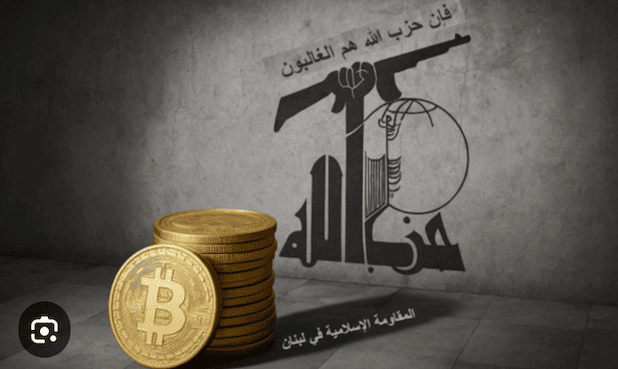
In 2025, reporting on the ground revealed that “Used” car markets—many linked to networks associated with Hezbollah were accepting stablecoins as a form of payment. Employees of Hezbollah affiliated institutions were also being paid in Crypto stablecoin USDT. The queues forming outside crypto-to-cash exchange shops at end of the month confirmed the story. These were not isolated anomalies. They reflected a shift.
Rather than cashing out traceable lump sums, funds are increasingly structured into smaller payments, distributed over time and Cashed out OTC through local Crypto-to-Cash stores, orat foreign exchange dealers.
In 2025 Nominis traced a UAE exchange wallet TFOD that wired money to Hamas, Central bank of Iran, Lebanon brokers, and IRGC. Most of the payments seem to come from Wallets in Turkey or the UAE.
Iran, Crypto, and the Scale of the System
The geopolitical dimension is equally significant.
Recent blockchain analytics estimate that Iran’s crypto ecosystem reached $7.78 billion in 2025. The Islamic Revolutionary Guard Corps (IRGC) accounted for over $3 billion in inflows while Iran’s central bank accumulated at least $507 million in USDT, using it to bypass the dollar system.
These figures are tied to publicly sanctioned addresses—which means they likely represent only a portion of the total activity.
Globally, illicit crypto transactions are estimated to have reached $50 billion in 2024 and surged to $150 billion in 2025.
Whether that increase reflects greater adoption, worsening geopolitical conditions, or improved detection remains unclear.
What is clear is the direction of travel.
The Transparency Myth
Blockchain is often described as “transparent by design.” Technically, that is correct. But transparency shows transactions, not intent.
A blockchain can tell you:
It cannot tell you:
Without context, blockchain data is incomplete.
Why Wallet Analytics Alone Fall Short
Most compliance systems today focus heavily on on-chain data, tracking wallets, clustering addresses, and flagging suspicious flows.
But this approach captures only part of the picture. If the underlying infrastructure exists in:Physical compounds, sanctioned state entities and organized trafficking networks, then analyzing wallet activity alone is like investigating a crime by only looking at bank statements.
The missing layer is off-chain intelligence:
This is where “CIA for crypto” firms are needed to work with the central bank or law-enforcement officials—by combining blockchain analytics with real-world intelligence to capture the crime.
KYC vs. Reality
There is a common assumption that crypto platforms operate without oversight. In reality, regulated exchanges require KYC (Know Your Customer).
But KYC has limitations. It is a snapshot:
It tells you who someone was at onboarding, not what they do afterward.
It does not, trace indirect exposure to sanctioned entities, detect layered transactions across multiple wallets or identify individuals unknowingly acting as intermediaries
That responsibility falls to transaction monitoring, and even that only works when paired with real-world intelligence.
The Cost of Ignoring the Financial Layer
As geopolitical tensions escalate, including recent U.S. and Israeli strikes on Iran—the financial dimension of conflict is becoming harder to ignore.
Because funding is not a side issue. It is the system that sustains everything else. If financial networks remain intact, operations continue, recruitment persists and loyalty is maintained
Disrupting these flows is not just about compliance, it is about strategy and real on the ground intelligence.
Conclusion: A System That Reflects the World Around It
Crypto is not inherently criminal. It is a mirror of the systems it connects to. For the unbanked, it offers access. For those under authoritarian regimes and US sanctions it offers escape and for organized networks operating in the shadows, it offers efficiency.
The real question is no longer whether crypto is being used in terrorism financing. In Lebanon it is the most common way now that Hezbollah is being financed and the way it pays its loyalists.
It is whether the systems designed to monitor it are sophisticated enough to understand what they are actually seeing. Multiple intelligence agencies politically aligned to different leaders are not communicating with each other to exchange information.
On-chain transparency without off-chain intelligence is not clarity.
It is illusion.