



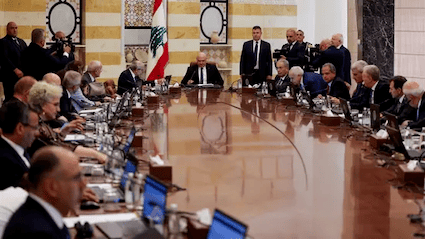
In Lebanon’s ever-mutating political theatre, silence has become the governing class’s most reliable instrument. As the country reels under economic collapse, institutional decay, and the suffocating weight of armed non-state power, the political class’s passivity has taken on a symbolism of its own—a silence so loud it resembles complicity.
This silence is nowhere more striking than in the ongoing tensions surrounding Central Bank Governor Karim Souaid and the public attacks directed at him by Hezbollah’s new chief, Naim Qassem. The accusations, pressure, and rhetoric targeting the governor have escalated as Souaid attempts to introduce tighter oversight on the cash economy—particularly measures such as enhanced KYC requirements for transfers as small as $1,000, a step designed to disrupt money-laundering channels and curb informal, opaque financial flows.
But these measures, modest as they may seem, strike at the heart of Lebanon’s shadow-finance ecosystem—an ecosystem that political parties, militias, and entrenched patronage networks rely upon to maintain influence. According to critics and analysts, this is precisely why the reforms have provoked hostility: in an election year, small cash transfers are political fuel. They buy votes, reinforce loyalty, and sustain clientelist welfare structures that replace the state’s absent social safety net.
For Hezbollah and other political actors, the ability to distribute micro-patronage—whether through “social security support,” welfare assistance, or community payments—is not just benevolence but leverage. It is power, obedience, and control, especially in communities impoverished by decades of conflict and economic mismanagement. Any disruption to this mechanism is therefore interpreted not as financial policy, but as political threat.
And yet, as this confrontation unfolds, Lebanon’s political class remains mute.
Not a word in defense of institutional integrity.
Not a whisper in support of the rule of law.
Not a syllable acknowledging that a state official attempting to implement basic financial compliance should not be left isolated against the fury of an armed political organization.
This is the silence of the lambs—a silence rooted in fear, calculation, and the instinct of self-preservation. The ruling elite, decades into their mutually beneficial coexistence with militia power, have learned that survival often means obedience, and stability means surrender.
So the governor stands alone.
The political class pretends not to hear.
And Lebanon sinks deeper into a reality where reformers are abandoned and institutions hollow out from within.
Silence, in this context, is not neutrality.
It is endorsement by omission.
It is the quiet that allows intimidation to thrive.
And it is a silence that Lebanon—desperate for sovereignty, accountability, and a functioning state—can no longer afford.