



After Saad al-Hariri’s withdrawal from political life last January, the big fear in Lebanon was that other leading Sunni leaders would be compelled to do the same. This would lead to a de facto Sunni boycott of parliamentary elections in May. Now that three current or former prime ministers (who are Sunni by political custom)—Najib Mikati, Fouad al-Sanioura, and Tammam Salam—have all announced that they would not be candidates, we are much nearer to that possibility.
How will Sunnis react to the fact that Hariri, Mikati, Sanioura, and Salam are not candidates? The sensible assumption is that second-tier Sunni parliamentarians who would have been elected on their lists will also not participate. This will favor Sunni candidates who enjoy less communal backing, but who could enter parliament because they will be on lists endorsed by Hezbollah.
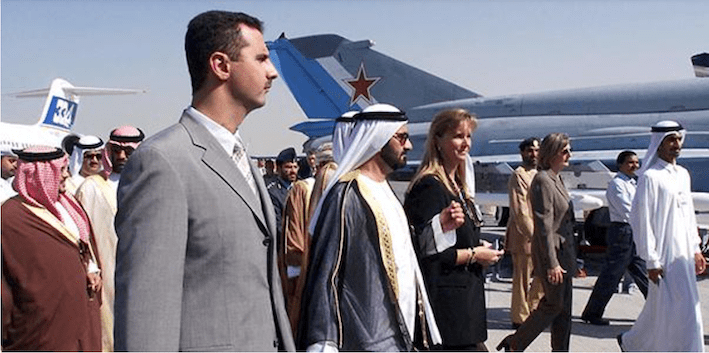
If so, Hezbollah and its allies could conceivably come out of the forthcoming elections with more seats than they have today. But who exactly will Hezbollah’s allies, or rivals, be this time around? Will Syria’s local partisans necessarily have the same agenda as Hezbollah and Iran? The reality may be more interesting than that. Helping us to better understand what may lie ahead is the visit last week of Syrian President Bashar al-Assad to the United Arab Emirates.
From the perspective of the Arab states, giving Syria a role in the Arab world, particularly in the Levant, has been regarded as one way of pushing back against Iran regionally. Their belief is that if Syria’s regime is reinforced, it will leave less room for Tehran to impose its agenda in Syria and Lebanon. In the past, this thinking allowed the Assad regime to play the Arab states off against Iran, and gain from both in the process. Today, Assad is navigating in a more convoluted environment, in which two additional actors, Russia and Israel, have carved out a role for themselves.
Is revived Syrian dominance of Lebanon realistic? Many will scoff at such a question, assuming that Syria’s regime is too weak to challenge Iran at home or in Lebanon. But the derision goes down a notch if we factor in Russia, which seeks openings in Syria and Lebanon to advance its own interests. The idea is not that Syria, Russia, and Iran will enter into a confrontation, because they will not. Rather, each has priorities it will pursue that may rub up against the priorities of the other. What may come out of this is a realignment of forces that has a major bearing on the region.
We are rapidly seeing the emergence of regional relationships that could pose significant problems for Iran. The major Arab states, even as they improve ties with Syria and maintain a good relationship with Moscow, also formally or informally have very good relations with Israel. Israel, in turn, has preserved open channels to Russia, on the back of its improving ties with the Gulf states. What appears to be taking shape, therefore, is an informal coalition of different actors who have the latitude to set limits on Iran’s consolidation of power in Syria and Lebanon.
In this way, the Arab states—the major Gulf powers, Egypt, and Jordan—would benefit by reversing Iran’s regional gains. Syria would see an opening to secure funding for reconstruction, return to the Arab mainstream, and revive its sphere of influence in Lebanon (no different than what Russia seeks in Ukraine). Israel would bolster Arab and Russian delimitation of Iran’s ambitions in Lebanon and Syria with a military component. And Russia would slowly reequilibrate its power relationship with Iran, while taking on a pivotal role among a broad range of Middle Eastern actors.
What does this mean for Lebanon? For starters, it suggests that the upcoming presidential election will probably be the first major indicator of the direction such dynamics take. Syria will want Suleiman Franjieh as president, whose election will be a significant lever in reasserting its sway over the country. To limit Syria’s reach, Hezbollah and Iran may prefer a Gebran Bassil presidency, and are doing everything possible to ensure he is successful in the upcoming parliamentary elections. If this creates tensions, Syria and Iran may opt to find a middle ground with a third candidate.
The lack of interest that Arab states have shown for giving direction to the Sunni community inside Lebanon suggests they may seek to do so from Damascus. This sounds counterintuitive, given the animosity many Sunnis feel toward the Assad regime. However, facing Iran’s and Hezbollah’s hegemony they are likely to prefer Syria, if it is supported by the Arab states and Russia. And if Hezbollah has to deal with a reinvigorated Sunni community, it may be compelled to compromise.
A revival of the nuclear deal with Tehran would only accelerate the alignment of interests among the Arab states, Russia, and Israel, while the United States disengages from the region and leaves others to fill the void. No one should bet on a conflict with Iran. What the Arab states and Russia, and to a lesser extent Israel, will want to do is maneuver in such a way that Iran cannot but accept that others have stakes in Syria and Lebanon too, and that these have to be respected.