
Close Menu
    Facebook Instagram LinkedIn
    • العربية (Arabic)
    • English
    • Français (French)
    Facebook Instagram LinkedIn
    Middle East Transparent
    • Home
    • Categories
      1. Headlines
      2. Features
      3. Commentary
      4. Magazine
      5. Cash economy
      Featured
      Headlines Shaffaf Exclusive

      Talk and Plot: Teheran Double Game with the Sharaa Regime

      Recent
      6 January 2026

      Talk and Plot: Teheran Double Game with the Sharaa Regime

      5 January 2026

      When “law enforcement” looks like piracy: The Maduro seizure, Türkiye’s caution, and the “precedent” problem

      5 January 2026

      The Financial Stabilization and Deposits Repayment Act: A Controversial Step in Lebanon’s Crisis Management

    • Contact us
    • Archives
    • Subscribe
    • العربية (Arabic)
    • English
    • Français (French)
    Middle East Transparent
    You are at:Home»Categories»Features»Seeing no end to power crisis, Gazans turn to solar power

    Seeing no end to power crisis, Gazans turn to solar power

    0
    By Ynet on 16 April 2016 Features

    With the problem of power outages seemingly unsolvable, Palestinians have begun adopting solar technology, with more and more public institutions and private residents are getting cheaper, abundant energy.

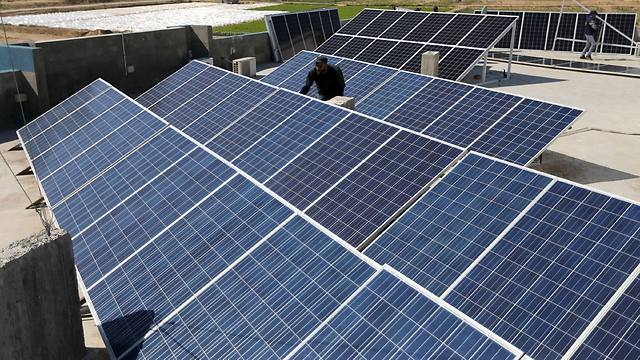
    Faced with power blackouts lasting anything from eight to 12 hours a day, residents and businesses in Gaza are increasingly turning to the sun to supply their enery needs.

    REUTERS

    Not only are solar panels more reliable and cheaper in the long run, but in some cases, including that of Tamer al-Burai, they have become essential to staying alive.

    To me, power is not just about lights or entertainment, it’s a matter of life and death, said Burai, 40, who suffers from a severe sleep disorder that affects his breathing and has to be hooked up to an oxygen ventilator at night.

    Burai used to spend around 18,000 shekels ($4,600) a year on fuel to run a generator that helped make sure he could weather the daily blackouts. Now he has invested in solar panels, making the long-run costs much cheaper.

    I paid $5,000 to get solar energy for the entire house and that will provide relief for years to come, the father of four told Reuters proudly.

    Whereas three or four years ago only a handful of Gaza’s 1.95 million people could afford to think about solar panels, in the past couple of years, as prices have come down, it has become a much more accessible option.

    Schools, hospitals, shops, banks and even mosques have started to install panels on their roofs across the Gaza Strip, a self-governing Palestinian enclave which suffered considerable damage in 2014 during a seven-week war between Israel and Palestinian armed groups based in the territory.

    Nabeel Marouf, the general manager of the Gaza-based Renewable Power Engineering and Contracting Company, said he had been overwhelmed with orders. Two years ago, he might have had a dozen clients, he said, but now it’s in the thousands.

    People have lost hope for a solution to the power crisis, and on top of that there’s the fuel crisis, he said, explaining that the regular power supply, interrupted for years, was a mess and fuel for generators was costly and problematic.

    Sunshine galore

    Looking across the rooftops of downtown Gaza City, it is clear solar is catching on, with glinting panels on almost every building. New technology even allows people to hang panels over the edge of their balconies.

    Most of the equipment, including batteries and controllers, is imported from China, where they are made by US, Canadian or German companies, said Marouf. They are imported via Israel, which allows them into Gaza via one of its crossings.
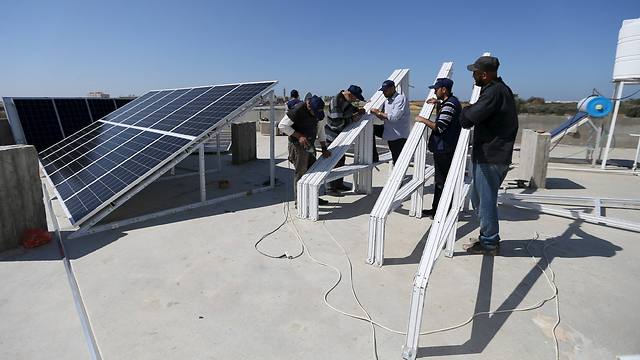
    Photo: Reuters
    Photo: Reuters

    Costs for a system range from $1,500 to $30,000, depending on the amount of energy people need.

    Gaza has three usual sources of power around 60 Megawatts generated by the enclave’s only power plant, 30MW imported from Egypt and 120MW that is supplied from Israel.

    Solar power – abundant the year-round in Gaza, perched as it is on the edge of the southeastern Mediterranean between Israel and Egypt – may provide the territory with a degree of energy independence.

    In Khan Younis, a town in the southern Gaza Strip, Mohammad Abu Jayyab watched workers as they installed panels on his home.

    It has become clear that there are no solutions (to the energy crisis) in the near future, said Abu Jayyab, a local economist. The situation became tragic, so we resorted to an alternative – solar power.

    YNET

    Share. Facebook Twitter LinkedIn Email WhatsApp Copy Link
    Previous ArticleHow two Red Sea islands shed light on secret relations between Israel and Saudi Arabia
    Next Article The Turbulent World of Middle East Soccer
    Subscribe
    Notify of
    guest
    guest
    0 Comments
    Newest
    Oldest Most Voted
    Inline Feedbacks
    View all comments
    RSS Recent post in french
    • La liberté comme dette — et comme devoir trahi par les gouvernants 2 January 2026 Walid Sinno
    • La « Gap Law »: pourquoi la précipitation, et pourquoi les Français ? 30 December 2025 Pierre-Étienne Renaudin
    • Au Liban, une réforme cruciale pour sortir enfin de la crise 23 December 2025 Sibylle Rizk
    • Le Grand Hôtel Abysse sert toujours des repas en 2025 16 December 2025 Walid Sinno
    • Au cœur de Paris, l’opaque machine à cash de l’élite libanaise 5 December 2025 Clément Fayol
    RSS Recent post in arabic
    • ردّاً على فاخر السلطان: إما قانون دولي يُحترم، أو فوضى يدفع ثمَنَها الجميع 5 January 2026 د. فيصل الصابغ
    • بيان جمعية المصارف حول “مشروع قانون الانتظام المالي واسترداد الودائع” 5 January 2026 الشفّاف
    • فنزويلا الملاذُ الآمن لقيادات حزب الله والعلماء النوويين الإيرانيين! 4 January 2026 خاص بالشفاف
    • دونالد ترامب ممزّق بين الإمارات العربية المتحدة والمملكة العربية السعودية 4 January 2026 خاص بالشفاف
    • هَلَّلتُم لاعتقال “صدام”.. فلماذا اعتقالُ مادورو “بلطجة”! 3 January 2026 فاخر السلطان
    26 February 2011

    Metransparent Preliminary Black List of Qaddafi’s Financial Aides Outside Libya

    6 December 2008

    Interview with Prof Hafiz Mohammad Saeed

    7 July 2009

    The messy state of the Hindu temples in Pakistan

    27 July 2009

    Sayed Mahmoud El Qemany Apeal to the World Conscience

    8 March 2022

    Russian Orthodox priests call for immediate end to war in Ukraine

    Recent Comments
    • P. Akel on The Grand Hôtel Abysse Is Serving Meals in 2025
    • Rev Aso Patrick Vakporaye on Sex Talk for Muslim Women
    • Sarah Akel on The KGB’s Middle East Files: Palestinians in the service of Mother Russia
    • Andrew Campbell on The KGB’s Middle East Files: Palestinians in the service of Mother Russia
    • farouk itani on A Year Later, Lebanon Still Won’t Stand Up to Hezbollah
    Donate
    © 2026 Middle East Transparent

    Type above and press Enter to search. Press Esc to cancel.

    wpDiscuz