



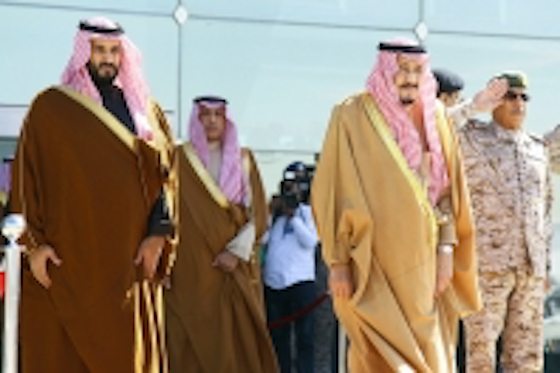
Speculation is widespread that King Salman may soon abdicate in favor of Crown Prince Muhammad, but that is just one of several possible options.
Last June, King Salman of Saudi Arabia, one of the oldest heads of state in the Persian Gulf region, gave the title of crown prince to his favorite son Muhammad bin Salman, known as MbS. The thirty-two-year-old prince was the third to hold that title since Salman ascended to the throne in 2015, but he is widely regarded as his father’s true choice to become the next king. When that happens and under what circumstances could have important consequences for Saudi Arabia, the wider Muslim world, and the international oil market.
Saudi succession law does not lay out a strict system of primogeniture — it merely states that rule passes to the sons and grandsons of the country’s founder, Abdulaziz (Ibn Saud). This loose edict allows succession from brother to brother, creating a problem that has been growing with each transition — the sons of Ibn Saud have been acceding to the throne at older ages and living longer while in power, eventually straining their physical and mental capacities for leadership (click on chart below for high-resolution version). The accession of MbS could resolve that problem for years to come.

King Salman has two other titles as well: “Custodian of the Two Holy Places” and prime minister. This broadens the range of possibilities for transferring responsibilities to MbS. The scenarios could unfold as follows:
Salman abdicates and MbS becomes king. “Abdication” is probably not a favored option in the kingdom. It was last used in 1964 when the spendthrift King Saud was forced to give up after six years of tension with his half-brother Faisal, who replaced him. More recently, in 2013, Emir Hamad al-Thani of Qatar abdicated in favor of his son Tamim but retains much influence, along with the official title of “Father Emir.” Given Riyadh’s current bad blood with Qatar, the chances of Salman emulating the “Father King” model are likely zero, but a different slice of history could make full abdication more acceptable.
In 1902, Ibn Saud (only twenty-two at the time) led a group of fighters from exile to recapture his family’s ancestral village of Dariyah in central Arabia. In response, his father Abdulrahman ceded leadership of the House of Saud to him. Today, King Salman is said to see Ibn Saud’s character in his son, and the Wall Street Journal reports that he has already made a video announcing that MbS will be king.
Salman gives up the throne but remains Custodian. Since Ibn Saud captured the holy cities of Mecca and Medina in 1925, successive rulers have taken responsibility for the Islamic shrines. King Fahd formalized this role in 1986, changing his title from “majesty” to “Custodian of the Two Holy Places.” Retaining the religious title but relinquishing political leadership would be consistent with the sense that the former is more important — a key ingredient in Saudi Arabia’s claim to leadership of the wider Arab and Muslim worlds.
Salman appoints MbS prime minister. At present, the king is prime minister and the crown prince is deputy prime minister. Yet the weekly meetings of the Council of Ministers, which are chaired by the prime minister, are not the country’s most crucial decisionmaking forums. That honor goes to the Council of Political and Security Affairs and the Council of Economic and Development Affairs, two bodies that were created in 2015 and are now chaired by MbS. Administratively, naming MbS as prime minister would arguably be tidier than the current arrangement. But this may be a delicate issue: Faisal and King Saud engaged in a long tug-of-war over bureaucratic control before the former’s accession, so Salman would have to be truly willing to give up the job if this division of labor is to work today.
MbS becomes regent. When Salman travels abroad, as he did to Moscow earlier this month, he “deputizes” MbS “to administer the state’s affairs and take care of the interests of the people during his absence,” according to the Saudi Press Agency. A version of this option — regency — is available in circumstances of illness or lengthy medical treatment abroad. Yet a protracted regency could be contentious. After King Fahd suffered a debilitating stroke in late 1995, Crown Prince Abdullah was appointed regent, but he held the title for only a few weeks — apparently because Fahd’s powerful full brothers (Sultan, Nayef, and Salman) were anxious to deny Abdullah complete authority. Despite the king’s poor physical condition thereafter, Abdullah did not assume full formal power until his own accession in 2005.
Salman dies. As crown prince, MbS would become king provided his leadership is acknowledged by senior members of the House of Saud, who must give him the oath of allegiance. Yet reported schisms in the royal family could lead some figures to contest his new authority. When Salman made MbS crown prince four months ago, three of the thirty-four princes on the Allegiance Council voted against him. According to the New York Times, his predecessor, Muhammad bin Nayef, did not give up the role and swear loyalty to MbS until he had been denied sleep and access to his medication; he reportedly remains confined to his palace today. Another potential opponent is Mitab bin Abdullah, son of the previous king and head of the National Guard, a significant military force if the succession is contested.
If his father passes away, MbS may be able to manoeuver around these family obstacles by carefully selecting a new crown prince, as is the king’s right. At present, though, it is far from obvious who that might be. Alternatively, he could delay that appointment, as King Faisal did in the 1960s before eventually naming Khalid. Earlier this year, the king sought to reduce royal family opposition to his son’s appointment as crown prince by changing the kingdom’s law of succession; the new law makes the young sons of MbS ineligible for that title. Prince Khalid, brother to MbS and ambassador to Washington, is ineligible as well
POLICY IMPLICATIONS
Regardless of internal hurdles, the transition toward MbS becoming king is already well established, and the main question is when it will be completed. Although the inner workings of the House of Saud are the ultimate determinant, domestic and foreign policy factors may be important as well. The crown prince’s ambitions for economic and social change, typified by his “Vision 2030” project and the recent announcement allowing women to drive, are currently enhancing his credentials and popularity. But the succession process could also be shaped by how he deals with external factors such as the stalemated war in Yemen, intra-Gulf tensions with Qatar, and a host of problems with Iran.
The United States has multiple policy concerns wrapped up in the succession, but few ways of influencing palace politics. Royal family thinking is often difficult to discern. Past Saudi decisionmaking has been marked by caution and consensus, but neither characteristic fits the personality of MbS. The Washington bureaucracy is still coming to terms with the demise of Muhammad bin Nayef, who was a key interlocutor on counterterrorism issues when he served as interior minister and crown prince. For now, the greatest advocate for MbS appears to his father, which suggests that the crucial final steps in promotion — namely, using the power of the throne to block opposition and authenticate the new arrangement — need to be taken sooner rather than later.
Simon Henderson is the Baker Fellow and director of the Gulf and Energy Policy Program at The Washington Institute, where he authored the books After King Fahd: Succession in Saudi Arabia (1995) and After King Abdullah: Succession in Saudi Arabia (2009).