



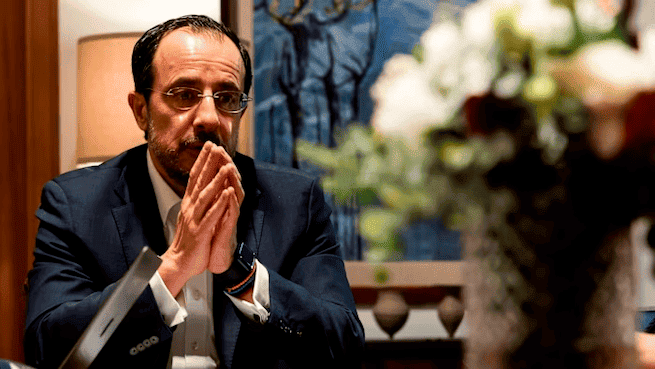
Cyprus politics has always excelled at a particular acrobatic trick: governing provisionally while speaking permanently. The corruption scandal now enveloping President Nikos Christodoulides has merely exposed how well rehearsed that trick remains, especially when power, history and selective legality collide.
What began as allegations of campaign finance impropriety has widened into a full-blown credibility crisis. A senior adviser resigned. Police probes multiplied. International media descended. Then came a telling gesture: the first lady stepped down from the chairpersonship of a foundation whose donor networks and political proximity had entered the public debate. Officials insist there is no wrongdoing. Politically, the move functioned as a firebreak. Symbolically, it confirmed that scrutiny has reached the household perimeter of power.
Yet the real issue is not a resignation. It is legitimacy. And on Cyprus, legitimacy is never a neutral word.
A government by “necessity,” power by habit
From a Turkish Cypriot perspective grounded in the island’s founding order, the problem predates any leaked video. The Republic of Cyprus established in 1960 was not a unitary Greek Cypriot state. It was a bi-communal partnership anchored in international treaties, a shared constitution and a system of guarantees involving Türkiye, Greece and the United Kingdom.
Despite persistent claims to the contrary by Christodoulides and Greek Cypriot hardliners, that system did not collapse because Turkish Cypriots abandoned it. It was dismantled unilaterally in 1963 by Greek Cypriot leadership through force and constitutional manipulation, explicitly aimed at excluding Turkish Cypriots from governance. The trigger was Turkish Cypriot refusal to accept constitutional amendments proposed by President Makarios that would have ended their effective political participation and reduced them to a “privileged minority.”
What followed was not lawful continuity, but usurpation. The administration that has governed since then survives not as the legitimate government of the whole island, but as a provisional authority operating under the so-called “necessity clause,” a legal fig leaf later tolerated internationally for convenience.
This distinction matters. When today’s Greek Cypriot-run administration speaks in the name of “the Republic,” it does so without the consent, participation or political equality of one of the island’s two constituent peoples. Power may be effective. Legitimacy is not.
It also means that corruption within this structure is not merely a governance failure. It is a failure within an already compromised constitutional order.
Clean hands, familiar networks
Cyprus has two languages and one corruption vocabulary. In Greek, it is rousfeti. In Turkish, rüşvet. Both describe the same practice: bending rules through relationships. Both predate the republics that pretend to regulate them.
The scandal gripping the Greek Cypriot-run south mirrors dynamics long visible in the north, albeit under different legal and political conditions. In the north, non-recognition and dependency create grey zones. In the south, EU membership and international recognition provide protective armour. Different shields, similar outcomes.
Money flows. Access is monetised. Politics becomes transactional. When exposed, the reflex is identical on both sides of the Green Line: look outward, invoke threats, blame geopolitics.
The irony is painful. Cyprus’ unresolved status has become the ultimate all-purpose excuse. Corruption? The conflict complicates governance. Weak institutions? Blame the division. Lack of accountability? National survival comes first.
In such an environment, the line between patriotism and impunity dissolves. The flag does not merely cover the scandal; it absorbs it.
Christodoulides rose to office promising to end rousfeti. Instead, his presidency now struggles to explain why donations, access and political visibility appear intertwined in ways indistinguishable from the past.
The resignation of the Director of Office of the President and the first lady’s resignation illustrates the point. The foundation she chaired was presented as philanthropic and civic. Yet as donor identities and access questions emerged, it became clear that in a small polity, philanthropy rarely exists in a vacuum. Social good and political capital share the same air.
The president insists he has nothing to fear. Legally, that may yet be proven true. Politically, the optics are devastating. A leader elected on moral renewal now argues technicalities, timing and conspiracies.
At this point in Cypriot politics, the script rarely changes.
When accountability knocks, history answers
As scrutiny intensified, the response pivoted swiftly to national rhetoric. Cyprus, the public was reminded, is once again under threat. Shadowy external forces are allegedly at work. Conveniently, the timing coincides with the EU Council presidency.
This is the moment when history is deployed as crowd control.
President Christodoulides’ political comfort zone lies in an uncritical sanctification of the armed struggle narrative. Within this framing, liberation is pure, violence is selective and responsibility is one-sided. For Turkish Cypriots, however, the same period marks the beginning of organised intimidation, forced displacement and bloodshed, culminating in the intercommunal violence of 1963, 1964 and 1967.
Figures ranging from Grivas to Giorgiades, along with hundreds of others, are honoured on one side of the island as heroes. On the other, they are remembered as perpetrators of killings, abductions, collective punishment and enduring trauma. The very individuals celebrated today were responsible for indiscriminate attacks on Turkish Cypriot communities across the island, forcing the population out of 103 villages from which they could not return until 1974.
Despite public confessions given in media interviews at the time and later, none were ever called in for questioning, let alone held accountable.
Commemorating the suffering of 1974 while remaining blind to the trauma endured by Turkish Cypriots between 1963 and 1974 is not a foundation for peace. It is a recipe for resentment and mistrust.
Invoking such selective memory amid corruption allegations is neither incidental nor innocent. It reframes accountability as disloyalty and scrutiny as hostility. In doing so, it revives the very mindset that rendered the 1960 constitutional order unsustainable in the first place: the belief that power does not require consent.
Peace talks without parity
This brings us to the most uncomfortable question, one rarely asked south of the Green Line: with what legitimacy can a Christodoulides who has openly endorsed the violence of 1963–1964 against Turkish Cypriots claim to negotiate peace?
Peace on Cyprus cannot be reduced to confidence-building measures or photo opportunities. It must rest on political equality, effective participation in governance and respect for both the letter and spirit of the founding treaties. Given the long record of last-minute withdrawals and collapsed negotiations, Turkish Cypriots are fully justified in demanding not only a clear time frame, but also a firm “no return to the status quo” clause should another process fail due to Greek Cypriot intransigence.
Any leader who denies the constitutional reality of 1960 while claiming to represent the entire island speaks from an inherent contradiction. How persuasive can a peace narrative be when it is delivered by a Greek Cypriot leader who embraces the ideological justifications of 1963 violence, yet asks Turkish Cypriots to trust his goodwill?
Peace requires moral symmetry. It requires acknowledging that the Republic, as currently constituted, is not the lawful continuation of the 1960 partnership but a provisional administration sustained by international inertia. Without that acknowledgement, negotiations risk becoming theatre.
The late Glafcos Clerides once captured this reality in a candid exchange with Rauf Denktaş during talks in Glion:
“You know and I know that I do not represent the Turkish Cypriot people. But the world recognises me as such. Don’t expect me to stand up and say the world is wrong.”
That admission encapsulates the hypocrisy and short-sighted hegemonic ambition that have long obstructed a settlement on the island.
EU presidency, old habits
The EU Council presidency assumed by the Greek Cypriot leadership was expected, at least in principle, to project institutional maturity and European values. Instead, it has once again revealed a familiar paradox: an administration that speaks the language of transparency while struggling to practice it, and that invokes legality while grounding its authority in the doctrine of necessity rather than full constitutional legitimacy.
Europe may continue to look the other way. It usually does. The Turkish Cypriot position, however, remains clear and consistent. Legitimacy does not flow from recognition alone. It derives from consent, equality and fidelity to the 1960 founding agreements. As UN Secretary-General Kofi Annan stated in 2004, “the relationship between them is not one of majority and minority, but of two communities who share the same homeland.”
Corruption scandals unfolding within a governance structure born of unilateral usurpation do more than erode trust. They expose the fragility of a system sustained by habit and international indulgence rather than constitutional fidelity.
Expecting progress toward a settlement while ignoring the Turkish Cypriot people and their leadership is not strategic realism. It is the political equivalent of looking for a calf under an ox.
Provisional power cannot deliver permanent peace
Christodoulides may survive this scandal. Greek Cypriot leaders often do. Institutions built on necessity are resilient. But survival is not legitimacy.
From a Turkish Cypriot perspective loyal to the 1960 order, the lesson is clear. A leadership that cannot account transparently for its conduct, that sanctifies a one-sided history and governs without constitutional parity cannot credibly negotiate the island’s future.
Cyprus does not lack peace plans. It lacks honesty. Until the provisional nature of power is acknowledged, the usurpation of 1963 confronted, and accountability replaces rhetoric, peace will remain what it has long been on the island: endlessly discussed, selectively remembered and indefinitely postponed.
And corruption, like history, will continue to be managed not through reform, but through memory, myth and the comforting excuse of necessity.