



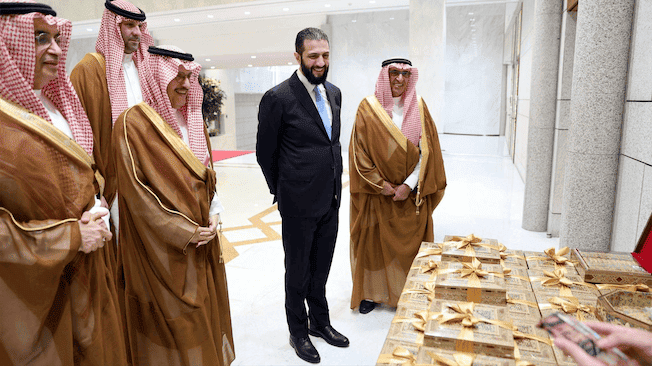
The high-level Saudi delegation to a Damascus investment conference indicates Riyadh is betting on President Sharaa.
In late July, a 130-strong delegation of Saudi business executives led by Investment Minister Khalid al-Falih—a former oil minister—attended an investment conference in Damascus that was originally scheduled for June but delayed by the Iran-Israel twelve-day war. The planned visit was announced at the July 22 Saudi Council of Ministers meeting in Riyadh. Significantly, the meeting was chaired by King Salman, who rarely makes public appearances these days.
Syrian President Ahmed al-Sharaa, who ousted Bashar al-Assad in December, made his first visit to Saudi Arabia in February, and he has clearly bonded with Saudi Crown Prince Muhammad bin Salman, or MbS, as the kingdom’s effective leader is known. During President Trump’s May visit to the Gulf, the photo of the U.S. leader warmly shaking hands with the former Sunni terrorist while MbS looked on was a major takeaway. Trump’s description of Sharaa as a “young attractive tough guy” and his declaration that U.S. executive branch sanctions would be lifted are now being further emulated by the Saudi crown prince.
Reports indicate that during the July conference the two sides explored cooperation opportunities, even as few concrete details emerged. Yet as many as forty-seven agreements were signed, covering energy, telecommunications, finance and banking, and investment funds. The activity was facilitated by the July 27 signing of a memorandum of understanding in Riyadh between Syrian Oil Minister Muhammad al-Bashir and Prince Abdulaziz bin Salman, a Saudi cabinet minister and half-brother of MbS. An initial potential value of $4 billion was upped within a couple of days to $6 billion. But as the Financial Times reported, “Many of the proposed deals were at an initial stage, and contained limited detail.”
Reflecting the gap between headline figures and reality, Saudi Investment Minister Falih and his Syrian counterpart opened a comparatively modest $20 million cement project near Damascus during the visit. Reuters reported that the Saudi minister had also broken ground on a retail tower project worth around $100 million, backed by a Saudi investment firm. And there was reported interest in Syria’s energy and hospitality sectors. As Falih put it, “We expect Syria to need hundreds of billions to rebuild, and tens of billions for productive projects targeting regional and international markets.” Experts estimate reconstruction after fourteen years of civil war will cost $400 billion, according to the Financial Times. As yet, however, there is no apparent reconstruction plan, nor a list of priority sectors, so the investment conference and Saudi visit remain merely indicative of MbS’s political support for Sharaa.
So far, the energy sector has attracted the most foreign interest. Damascus has signed a $7 billion power deal with Qatar. Syria, once a modest oil exporter, must now reestablish its oil and gas production, at the very least repairing or rebuilding its domestic infrastructure. The specialist energy newsletter MEES has reported that American oil and gas executives have visited Damascus for talks in the last month. Other countries involved in the energy and infrastructure sectors include Azerbaijan, Turkey, and the United Arab Emirates, so the market will be competitive for Saudi Arabia to penetrate, even though Riyadh won early favor by paying off (with Doha) Syria’s debt to the World Bank. A particular handicap will be the kingdom’s lack of a common border with Syria. In late July, Azeri gas started flowing from Turkey to northern Syria, where it will fuel a power station.
Continuing political instability will affect the scale and rate of economic development in Syria. Elections have been announced for September but are unlikely to be meaningful. The Sharaa government does not control the whole of the country, notably the southern Druze city of Suwayda, where several hundred Druze reportedly died in recent clashes with Bedouin tribesmen. An uneasy truce was established there after Israel, which has its own small but significant Druze population, bombed targets in Damascus and southern Syria. Jerusalem reportedly has direct contact with Damascus but is narrowly focused on the Druze and border issues, while the status of possible Israeli gas supplies to southern Syria remains unclear.
Simon Henderson is the Baker Senior Fellow at The Washington Institute and director of its Bernstein Program on Gulf and Energy Policy.