



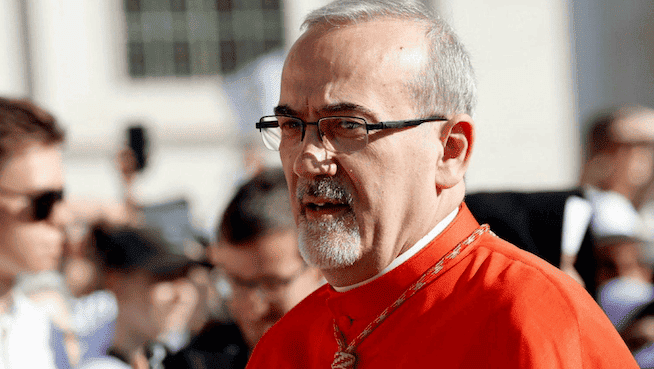
Each day between now and the conclave to elect a successor to Pope Francis, on a date yet to be set, John Allen is offering a profile of a different papabile, the Italian term for a man who could be pope. There’s no scientific way to identity these contenders; it’s mostly a matter of weighing reputations, positions held and influence wielded over the years. There’s also certainly no guarantee one of these candidates will emerge wearing white; as an old bit of Roman wisdom has it, “He who enters a conclave as a pope exits as a cardinal.” These are, however, the leading names drawing buzz in Rome right now, at least ensuring they will get a look. Knowing who these men are also suggests issues and qualities other cardinals see as desirable heading into the election.
ROME – When Cardinal Pierbattista Pizzaballa heard the news Easter Monday that Pope Francis had died, he immediately cancelled his appointments and packed his bags for Rome. As he was leaving the headquarters of the Latin Patriarchate of Jerusalem, where he has led the Catholic flock in the Holy Land for the last decade, a small group of aides, employees and friends gathered outside as he was getting in the car to head to the airport.
A visibly touched Pizzaballa watched as they sang to him in Arabic: “May the Lord guide your steps with his wisdom, fill your heart with his spirit, and be with you if it’s his prayer that you should lead his Church.”
Aside from being a sweet gesture, the impromptu serenade also had the feel of a farewell, since the people making up that cluster knew there’s a decent chance they won’t be seeing the 60-year-old Pizzaballa again anytime soon except on a TV screen as pope.
Pizzaballa was born in 1965 in the small community of Castel Liteggio in Bergamo, the same province that gave the Church St. John XXIII, “Good Pope John,” whose memory still lives in countless ways in the region. He felt a religious vocation at a young age and entered the minor seminary, eventually becoming a member of the Franciscan order.
In Bologna the young Pizzaballa studied philosophy and theology, where he came to the attention of Cardinal Giacomo Biffi, an archconservative and a man of deep learning and culture who would eventually ordained Pizzaballa to the priesthood in 1990.
Shortly thereafter Pizzaballa made his way to Jerusalem, where he studied at the Studium Biblicum Franciscanum and earned a degree in Biblical theology. He later studied modern Hebrew and Semitic languages at the Hebrew University of Jerusalem before entering into the service of the Franciscan Custody of the Holy Land, with primary responsibility for the Hebrew-speaking Catholic population.
Pizzaballa became the 167th Custodian of the Holy Land in 2004, and for the next twelve years he would become known as one of the few figures in that perennially divided corner of the world to forge friendships across the usual divides. He earned trust among Israelis, Palestinians, Jordanians and Egyptians alike, developing a reputation as a moderate man of patience, listening and dialogue.
As one fruit of that profile, in 2014 Pope Francis entrusted Pizzaballa with organizing a peace prayer in the Vatican Gardens between then Israeli president Shimon Peres and Palestinian leader Mahmoud Abbas, in the presence of both the pope and Orthodox Patriarch Bartholomew of Constantinople.
In 2016, Pizzaballa was named the apostolic administrator of Jerusalem, effectively taking over the governance of the Church in the Holy Land from Jordanian Patriarch Fouad Twal. At the time the appointment raised some eyebrows, since the appointment of Patriarch Michel Sabbah in 1987, and then Twal, was believed to have ended the Italian monopoly on the position and marked a transition to elevating patriarchs from the local Catholic population.
Yet those who knew the situation on the ground reported that the local clergy was divided, and in any event, they no longer regarded Pizzaballa as an outsider.
His first challenge was to address a deep financial crisis caused by Twal’s insistence on pouring money – some estimates claim as much as $100 million – into the construction of a Catholic university in Jordan without a clear business plan. Pizzaballa eventually righted the ship through a combination of aggressive fundraising, cutting costs and selling off assets, including real estate holdings in Nazareth.
In 2020 Pizzaballa formally took over as patriarch, and in 2023 he was created a cardinal by Pope Francis. Almost immediately the war in Gaza broke out, and ever since Pizzaballa has found himself trapped between his friends in Israel and the Jewish world on one side and his largely Palestinian and Arabic-speaking flock on the other. To the extent anyone can, he’s tried to show sympathy and understanding for both sides: He’s sharply criticized what he sees as the excesses of the Israeli military operation, but he also offered himself as a hostage in exchange for the Israeli citizens held by Hamas.
Personally, Pizzaballa sometimes comes off as a bit brusque upon first contact, but progressively warmer and with a keen sense of humor as one gets to know him. He’s also said to have a prodigious work ethic.
The case for Pizzaballa as pope?
First of all, precisely because his life has been dominated by the complexities of the Middle East and the Israel/Palestinian divide, he’s never really been forced to take clear public positions on divisive doctrinal and pastoral issues. Where he might stand on, say, the blessing of people in same-sex unions or the ordination of women deacons is something of a mystery.
As a result, he doesn’t bring a lot of baggage into the conclave in terms of past ecclesiastical controversies, potentially making him attractive both to those seeking continuity with Pope Francis and those hoping for change.
Moreover, Pizzaballa’s record of straddling the Israeli/Palestinian divide, sometimes achieving the rare feat of seeming to be on both sides at once, could be a selling point in a conclave in which healing the internal Catholic divisions unleashed by the Pope Francis era may well seem a priority.
Certainly Pizzaballa’s reputation for astute financial management would come in handy at a time when the Vatican is facing a deep fiscal crisis, including looming shortfalls in its pension funds. The hope might be that if he bailed the Patriarchate of Jerusalem out of debt, maybe he could so the same thing for the Holy See.
Utterly unscientifically, you just look at Pizzaballa and you sort of see a pope. He’s tall, with a distinguished-looking Van Dyke and the bearing of a serious man. Taken together with his background and reputation, it’s a compelling package.
One final consideration: A pope is also the Bishop of Rome, and although Pizzaballa isn’t Roman he does have a claim on local affections. His uncle, Pier Luigi Pizzaballa, was a goalkeeper in Italy’s top-flight soccer league, Serie A, in the 1960s and 70s, including a stint with the Roma squad from 1966 to 1969. Given how passionate Romans are about their soccer, they’d might be inclined to transfer some of that to their new bishop.
The case against?
The argument against Pizzaballa generally begins with his age, 60, which could augur for a longer papacy than some cardinals may wish. Yet his age could also work the other way, assuring cardinals wishing stability that they won’t have to go through the upheavals of a papal transition again anytime soon.
In addition, the lack of a clear indication of where Pizzaballa stands on many contested Catholic issues could frighten some voters, leading them to his a Pizzaballa papacy as too much of a journey into the unknown.
For all those who feel the election of another Italian pope would be a step back rather than forward, Pizzaballa obviously would be disqualified on those grounds, even if he’s spent most of his adult life outside Italy.
A final footnote.
In Italian, Pizzaballa’s last name literally means “pizza dance.” Merely contemplating the dancing pizza memes his election would generate suggests he would also be a compelling figure from a media point of view, perhaps affording him the chance to pick up the cultural megaphone left behind by Francis.