



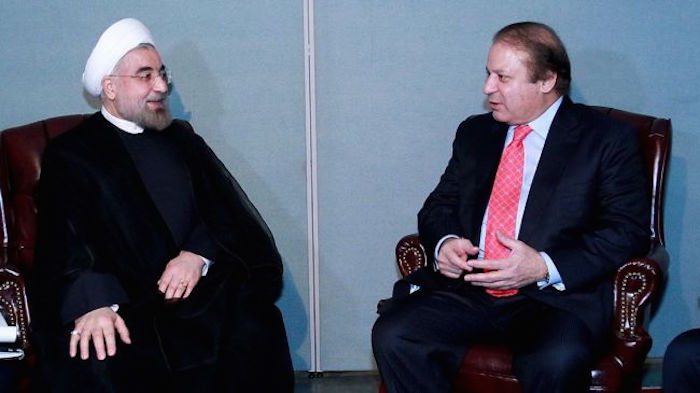
Prime Minister Nawaz Sharif had a comfortable meeting with the Iranian President Hassan Rouhani on the side lines of the UNGA. They talked about further promotion of economic co-operation between the two countries including the progress on Iran-Pakistan gas pipeline and electricity import from Iran and bilateral trade relations. Iranian president also showed keen interest in CPEC.
One must give credit to former president Asif Ali Zardari’s far sightedness for reaching an agreement for gas pipeline with Iran despite it being under severe American sanctions. It was definitely a very bold foreign policy initiative. If sincerely pursued Pak-Iranian gas pipeline would help overcome Pakistan’s energy shortages in the coming years.
The main thrust of Prime Minister Nawaz Sharif during UNGA was to draw the attention of the members of the United Nations to the current explosive situation in held Kashmir. Prime minister apprised President Rouhani of gross human rights violations. Iranian president not committing on the Kashmir situation, however, assured Pakistan that its security was of brotherly interest to Tehran.
Looking at Iran-Pakistan relations in retrospect post revolution, they have always been a matter of debate. But one thing is clear that our ties have been rooted in history which predate to Pakistan as a nation. Language, art, architecture and close interaction between the people have been ingrained in the chemistry of the two nations irrespective of the political systems followed by them.
However, difference in political systems between Iran and Pakistan and the entry of Saudi Arabia as a challenger to Iranian revolution has created a triangle which if not handled properly can plunge the entire region into a quagmire. For Pakistan the Soviet invasion of Afghanistan had been a nightmare which created many formidable challenges for Pakistan already facing a perennial adversary on its eastern borders.
After General Zia’s coup onward we have seen the nation’s plunge from sublime to the ridiculous, nay, even worse. By design society was pushed into quagmire of sectarianism, religious extremism and ethnicity—to conveniently divide and rule. A certain brand of Sunni sect was launched as a sort of state religion.
Though it seemed very strange, yet it happened. Religious parties and even parties of the left were initially very enthusiastic about the Iranian revolution. Jamaat-e-Islami whose founder Maulana Maudoodi had found a common cause with late Ayatollah Khomeini and his Revolution — his party after his death did not have a long honey moon with the Iranian clergy.
Parties of the left that see silver lining in every street revolution, though enamored by the Iranian Revolution took no time to distance themselves from the new leadership when it started targeting the secular forces inside Iran and declared Shiaism as an official religion in the new Iranian constitution.
The Soviet invasion of Afghanistan also saw Iran supporting only Shias among the Mujahideen that had been clobbered by Pakistan and the United States to get Russians thrown out. General Zia got on his American bandwagon all the Wahabi-Sunni Maulvis while Iran supported a separate alliance of Mujahideen that were dominated by Shia and non-Pashtun parties. The result was obvious; the post Soviet Afghanistan was plunged into a fierce civil war between north and south.
Pakistan also chose sides. Despite the fact that Northern Alliance’s Tajik Commander Ahmed Shah Masud was not averse to have a truck with Pakistan; Islamabad put all its eggs in Pashtun basket alienating others forcing them to seek their options with India. Pakistan, however, made a distinction between pro-monarchist parties and religious factions.
Saudis too played a major role in terms of support to the Afghan religious (Sunni) parties. For Saudis, the Jihad in Afghanistan had twin objectives: one to keep the infidel Soviets at bay and, two, preempt Iranian revolutionaries from spreading their tentacles in the Gulf region. The rest, as they say, is history.
However, the worst after effect of the Afghan Jihad was the birth of sectarian parties in Pakistan under the patronage of Iran and Saudi Arabia. Both the “pillars” of Islam fought their battle on the Pakistani soil. For Ziaul Haq rise of religious parties was a golden chance to create his own constituency and to crush the Pakistan People’s Party, his bête noire. But our Muslim brothers following different sects had their own reasons to promote sectarianism in Pakistan. Saudis saw Pakistan as the largest “Sunni” country in the region which could act as a bulwark against Iran’s perceived expansionist designs without sacrificing their own sweat or blood.
Iran, on the other hand, saw Pakistan as the second largest Shia population (after Iran) despite the fact that Shias make only 25 percent of the country’s population. However, in their scheme of things by injecting the revolutionary zeal they thought they could create a substantive pro-Iranian support in Pakistan. And analysts claim this they have done. Predominantly Sunni media reports allege that the Shia revolutionary organisations have recruited Pakistani Shia youths to fight ISIS/Daesh in Syria.
Interestingly both Iran and Saudi Arabia swear by their friendship and brotherhood with Pakistan. This is true to an extent that they have stood by Pakistan whenever the country has been in dire straits. But both the countries have become victims of their own sectarian rhetoric, especially at this crucial juncture of the Middle Eastern politics when ISIS/Daesh is posing a mortal threat to the Gulf monarchies. These monarchies led by Saudi Arabia, with the support of Americans, have thrived in promoting their agendas. But they have been incapable of dealing with challenges inside their own countries or next door. Yemen is a case in point.
Instead of waiting for the UN Security Council to pronounce judgment, Saudis launched attacks on Yemen to put pressure on the US to abandon nuclear talks with Iran which the US refused and the Joint Comprehensive Programme of Action (JCPOA) was signed with lots of fanfare. Ironically, five percent Houthis which are supported by Iran toppled the Hadi government supposedly representing 95 percent of Sunnis. Saudis had to pay the price of ignoring Yemen when it needed their support both politically and economically.
Americans are playing a dangerous game in the region. While they believe that Iran can effectively deal with ISIS/Daesh threat in Syria and Iraq and that Saudis are not only incapable of meeting the threat but are also responsible in promoting Wahabism which is now transformed into a divisive Takfiri ideology. Not only that Americans are running with the hare and hunting with hound in this whole game. They are selling arms to Saudis and other Gulf states by the billions while acknowledging Iran as a major power in the region.
Iran may for the time being project its successes in Syria, Iraq and Yemen, but if history is a guide, Iran should not repeat the mistakes which Soviets did. Militarily Soviet Union was not defeated in Afghanistan. It was the economic burden which broke the back of this super power. Not only in Afghanistan but its liabilities in former Eastern Europe and Africa sapped its economic muscles at the cost of its own break up. Iran cannot be an exception given the limitations it faces in the region and the opposition within to the clergy rule.
Pakistan has learnt a couple of lessons due to Saudi and Iranian competition and rivalry. By not joining the Yemen war Pakistan gave a clear signal to the entire region that it no longer can tolerate sectarian squabbles played by outsiders on its soil or elsewhere. Secondly, its message to Iran has been that its expansionist policies would ultimately consume its energies to the peril of its own people who have been suffering isolation for the past three decades. Thirdly, an effective defense against ISIS/Daesh is only possible if all the countries of the region cutting across their sectarian lines join hands and defeat the forces of ignorance which are responsible for creating xenophobia against Islam and Muslims.
It is sad that the conflict between the two have contributed towards clash of civilizations — divided house of Islam pitched against a united, better organised, financially sound Judaist and Christian civilisations. Instead of fostering overall peaceful co-existence on God’s little earth, it seems clash between rich and the poor – irrespective of religion – would dominate the twenty first century and as we entered a century of terror so shall we end with more terror.
wshwsh786@gmail.com
The author is the former High Commissioner of Pakistan and a veteran journalist.