



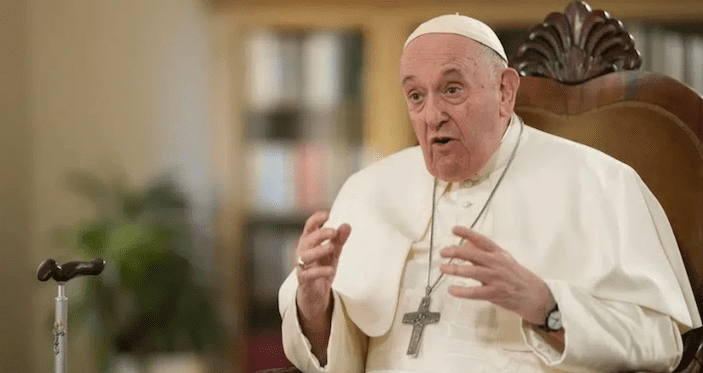
it’s being said that Secretary of State, Cardinal Parolin, and the Vatican’s foreign minister, Archbishop Gallagher, feel uncomfortable with the intransigent line of the Argentine pontiff
ROME – Although the one-year anniversary of Russia’s invasion of Ukraine has come and gone, it still seems premature to talk much about ultimate winners and losers. While Ukraine’s resistance and the West’s resolve, so far, both have outperformed expectations, there are still scenarios in which some combination of battlefield attrition and economic manipulation could yield Putin at least partial victory.
In the meantime, the most obvious loser in the diplomatic arena is the call for a negotiated settlement to the war, a proposal in which absolutely no one seems interested – no one, that is, other than the idea’s most prominent exponent in Pope Francis.
Two days before the recent anniversary, on Feb. 22, Francis was at it again, calling the war in Ukraine “absurd” and “cruel” and publicly calling for a cease-fire that would open a path to a negotiated settlement.
“I appeal to all those who have authority over nations to commit themselves concretely to ending the conflict, to reaching a cease-fire and to starting peace negotiations,” the pope said. “That which is built on ruins will never be a true victory.”
Almost as soon as the words left the pope’s lips, it was clear his call for a cease-fire was destined to remain a geopolitical orphan.
Here’s how veteran Italian journalist Marco Politi, who’s been covering the papacy since the early days of St. John Paul II, summarized international reaction to the pope’s proposal:
“Great Britain ignored it,” Politi wrote. “The American president, Biden, doesn’t want interference. Putin doesn’t consider the Vatican an effective intermediary for arriving at negotiations. Xi Jinping, for reasons of internal politics, doesn’t intend to give much weight to the position of the Holy See. Zelensky, who in the immediate wake of the Russian invasion had floated the possibility of Vatican mediation, now only wants one thing: A papal trip to Kiev, to further isolation Putin.”
In past moments of global drama, Politi notes, including the Cuban missile crisis and the war in Iraq, the international community generally welcomed the Vatican’s efforts at mediation, so the cold shoulder this time around is especially striking.
“Never in the last seventy years,” he writes, “with regard to a matter of such international importance has the Holy See found itself in such a marginal position.”
Indeed, Politi even hints that the pope’s own diplomatic personnel may be quietly frustrated with the situation.
“In some embassies, it’s being said that, at bottom, the Secretary of State, Cardinal [Pietro] Parolin, and the Vatican’s foreign minister, Archbishop [Paul] Gallagher, feel uncomfortable with the intransigent line of the Argentine pontiff,” Politi writes, who clearly does not want to be “the chaplain of the West.”
Yet as Politi himself goes on to observe, the pope’s positioning on Ukraine seems isolated and ineffective only if we restrict the angle of vision to Europe and the West.
For much of the global south, on the other hand, Francis’s unwillingness to clearly take sides in the conflict, and his skepticism about calls for total victory and desire for a negotiated peace, are consistent with how a wide swath of the world’s non-Western population sees the situation.
Francis is, of course, history’s first pontiff from the developing world, and he reigns at a time when the demographic center of gravity in Catholicism clearly has shifted. Today, more than two-thirds of the world’s 1.3 billion Catholics live outside the West, a share that will be three-quarters by mid-century.
In such a world, it’s only logical that the Vatican’s geopolitical homing instincts increasingly will more closely resemble those of, say, the African Union, or India, or even the OPEC states, than those of Washington and Brussels.
Across most of the global south, three things are true vis-à-vis Ukraine.
- First, it’s seen largely as a European conflict, one in which the rest of the world doesn’t necessarily have a direct stake.
- Second, while few are cheering for Putin, most don’t see NATO or the Western powers as entirely blameless either.
- Third, many non-Westerners resent the vast amount of resources being poured into Ukraine while, in their eyes, other pressing global problems are neglected.
Thus, from Beijing to New Delhi, and from Tehran to Abuja, the pontiff’s insistence on a cease-fire and a negotiated end to the conflict, in which no party presumably would be able to claim total victory, resonates well with their own instincts.
In the end, Politi arrives at the same conclusion.
“Francis can seem like an ignored Cassandra only if we limit ourselves to the West. But a planetary geopolitical perspective, which can’t help but impress itself on Vatican policy, every day renders his cry of alarm more lucid and realistic,” Politi writes.
Bipolar power conflicts, whether between Russia and the West or between China and the US, Politi concludes, are dangerous for everyone, and the pope’s call for a Helsinki-style multilateral system of international relations is the only exit strategy.
In the end, therefore, perhaps one can say this about Francis and Ukraine at the one-year mark: Perhaps his line does represent a nadir in terms of the Vatican’s traditional diplomatic role and assumptions. Just maybe, however, it also represents the birth pains of a new geopolitical vision, one which Francis was always destined to engineer.