



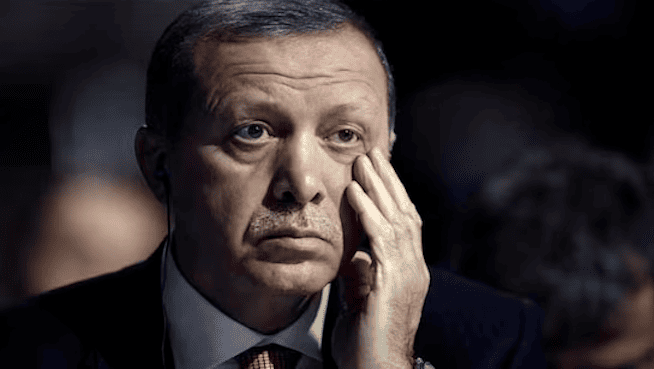
President Recep Tayyip Erdoğan, marking the 23rd anniversary of the AK Party’s 2002 victory, once again declared that his governments have been “the most successful in Turkish history.” Few would dare disagree—after all, redefining “success” as survival is an art form in itself. If poverty were an Olympic sport, Türkiye would have been on the podium for years, clutching a gold medal made of copper.
As the president hailed his “economic miracles,” the rest of the country was busy counting coins, not achievements. Inflation, the phantom enemy that never quite dies, still roams free. Treasury and Finance Minister Mehmet Şimşek continues his crusade of optimism, proudly proclaiming “progress.” Perhaps he’s right—on paper, at least. In the real world, rents soar, vegetables behave like luxury goods, and every trip to the market feels like a visit to a museum of unaffordable items.
In the country that once promised “no one will go to bed hungry,” breakfast itself has become a class privilege. A 14-year-old dies on a construction site; a 69-year-old guard dies still working. In Erdoğan’s Türkiye, youth is a luxury, and retirement a myth.
The alchemy of numbers
The Turkish Statistical Institute (TÜİK), once a modest office where numbers merely counted things, has over the years evolved into something closer to a miracle factory. It now performs transformations worthy of sainthood—turning pain into progress, crisis into charts, and hunger into harmony. Each month it delivers its gospel with divine precision: in October, inflation rose just 2.55 percent on a monthly basis and 32.87 percent year on year. Hallelujah! Salvation, it seems, is now measured by the decimal point.
But this miracle economy appears to reward only those who never enter a market. For everyone else—the ones who buy bread, onions, or a bottle of cooking oil—the experience borders on blasphemy. The cashier’s receipt is the new sacred text, and it reads a very different prophecy.
Independent economists—those still orbiting reality rather than the TÜİK galaxy—tell a less celestial story. The Inflation Research Group (ENAG), which tracks daily prices in real time rather than political time, reports that actual inflation in October was 3.74 percent monthly and nearly 60 percent annually. The gap between TÜİK’s revelations and ENAG’s calculations is no longer statistical; it is metaphysical. TÜİK preaches faith, ENAG records hunger. One speaks in miracles, the other in markets.
The difference between 32 percent and 60 percent may sound abstract, but it defines the border between comfort and collapse. It separates those who discuss inflation in air-conditioned studios from those who live it in overheated kitchens. It is not merely a matter of economics—it’s a matter of theology. The faithful believe the scripture; the hungry know the truth.
And behind those polished figures lies an economy coughing through its own contradictions. Production limps along; optimism sprints ahead. In the country’s factories, one out of every four machines stands idle, silent testimony to the decline behind the slogans. The real sector’s foreign debt now exceeds 350 billion dollars, a mountain so high it casts a shadow over every promise of growth. Each time the lira sneezes, the economy catches pneumonia.
Agriculture, once the pride and poetry of Anatolia, is shrinking faster than a politician’s conscience before an election. Wheat yields have fallen; the orchards of the Aegean and the plains of Konya whisper stories of neglect. Farmers sell land to pay for fertilizer; the country that once exported fruit now imports patience.
Yet every official podium insists, with unwavering rhythm, that “Türkiye is growing.” Perhaps it is—but not in the way the slogans intend. It’s growing weary. It’s growing cynical. It’s growing used to watching miracles that never feed it.
In the end, TÜİK may be right about one thing: numbers never lie.
They just learn, over time, whom to tell the truth to.
The currency of illusion
If there is one chart that tells the entire story of Türkiye’s economic metamorphosis—from miracle to mirage—it is the journey of the Turkish lira itself. In 2002, when the AK Party first came to power, one U.S. dollar was worth just 1.6 liras, and one euro cost around 1.5. Back then, the new government boasted of a “strong currency” that symbolized confidence, reform, and a clean break from the inflationary past.
Fast forward twenty-three years, and that once-proud lira resembles a currency that’s been through a long war and lost most of its battles. By December 2025, one U.S. dollar hovers around 37 liras, and the euro surpasses 40. The banknote that once paid for a family dinner now barely buys a loaf of bread and a bus ticket.
Each passing year has carried its own justification: global crises, interest rate conspiracies, “foreign lobbies,” pandemics, wars, and lately, the mysterious powers of “Türkiye’s unique economic model.” But the pattern remains unmistakable—while other currencies fluctuate, the lira specializes in free fall. It no longer competes on value; it competes on velocity.
The devaluation of the lira has quietly redrawn class lines. It created a small, privileged island of those earning in foreign currencies—diplomats, exporters, and the lucky few paid in euros or dollars—surrounded by a sea of citizens whose wages evaporate faster than their hope. Imported medicine, fuel, and even baby formula have become luxury items; travel abroad has turned into an upper-class fantasy.
In this new Türkiye, the exchange rate is more than a number—it is a mirror. Every extra zero added to the lira’s weakness reflects a promise broken, a policy reversed, and a life made smaller. The lira may bear Atatürk’s portrait, but it no longer bears his spirit. It survives on slogans, not stability.
And yet, official voices still call this progress. “The Turkish economy is resilient,” they say. Indeed—it must be. To survive this long against arithmetic itself requires a resilience bordering on the divine.
Bread, oil, and the myth of abundance
To measure Türkiye’s economic progress, there’s no need for data portals or TÜİK’s mystical spreadsheets. The answer sits plainly on the kitchen counter—inside the bread basket, or what’s left of it.
In 2002, when the AK Party first came to power, a loaf of bread cost less than one lira. It was the most democratic of foods: no one went without it, no one flaunted it. Today, the same loaf costs around twelve. In some bakeries, it’s tagged like a mid-range delicacy, not a daily necessity. Bread—the sacred foundation of every Turkish meal—has quietly turned into an index of decline.
Onions and potatoes, the humblest of staples, once bought by the sack, are now chosen one by one like fragile artifacts. Housewives no longer ask, “How many kilos?” but “How many can I afford today?” When the price of onions dominates the evening news, it’s not the farmers who have failed—it’s the policymakers.
And olive oil, once the quiet symbol of Mediterranean abundance, now gleams on supermarket shelves as a luxury item. Bottles have grown smaller, prices larger, and shoppers have learned new rituals of thrift—buying 500 ml instead of two liters, rationing spoonfuls for cooking, stretching every drop as if it were perfume. The oil that once connected culture, cuisine, and comfort now represents a kind of resigned elegance: a middle class pretending abundance while counting teaspoons.
Two decades ago, families could set their tables without arithmetic. Today, every meal requires calculation. Market visits have turned into moral tests of endurance. You overhear fragments of quiet irony between the aisles—“They say inflation is falling”—as if repeating it might make it true.
The government insists that prices are “stabilizing.” And perhaps they are—at new, impossible heights. Official charts show moderation; reality offers mockery. Bread, onions, potatoes, olive oil—all tell the same story: a country no longer nourished by its produce, but by its propaganda.
Meanwhile, the palace glows brighter than the baker’s oven. Its halls are polished, its banquets lavish, its message unwavering: “The worst is behind us.” Perhaps it is. But the worst, like inflation itself, has learned to follow.
In the end, the story of bread and oil is no longer about food—it’s about faith. Faith that the shelves will fill again, faith that numbers will someday mean something, faith that dignity can still be afforded by the liter, not the drop.
Prosperity by definition
In today’s Türkiye, prosperity has been redefined—not as the art of living well, but as the endurance of living worse. According to official logic, the more citizens struggle, the more “resilient” the nation becomes. Suffering has been nationalized, polished, and rebranded as strength. Every hardship is a patriotic test; every empty wallet, a badge of fortitude.
Since January, the purchasing power of the minimum wage has melted away by more than six thousand liras, evaporating faster than the government’s promises of reform. Wages rise, but prices sprint. The poorest fifth of the population earn little more than a statistical rounding error, yet spend nearly one-third of their meager income on food alone. The upper classes debate imported cheese; the lower classes debate whether to buy eggs or onions.
TÜİK, meanwhile, continues to guard its “detailed price lists” as though they were nuclear codes. Court rulings demand transparency, but the institution remains divinely silent, hiding the raw data that could expose the gap between arithmetic and appetite. It insists all is well, and perhaps within its spreadsheets, it is. After all, spreadsheets don’t get hungry.
Yet even TÜİK’s polished figures betray the truth they try to conceal. Producer prices are up 27 percent year-on-year; the cost of water supply alone has skyrocketed 56 percent. Electricity, transport, and fuel have become recurring nightmares for the middle class, while food prices gnaw through what’s left of the working class’s dignity. When even the act of producing becomes unaffordable, consumption itself starts to look like a crime.
And so, a new economic theology takes shape: if people consume less, inflation will indeed fall—simply because no one can afford to participate. It’s austerity by annihilation, the triumph of balance through deprivation. The markets may be full, but the wallets are empty.
In this strange new order, “prosperity” no longer means growth—it means obedience. The poor are told to be patient, the workers to be proud, the hungry to be grateful that they still have statistics to feed on. And while the nation celebrates its “resilience,” it quietly forgets that resilience, when stretched too far, begins to look a lot like despair.
The triumph of decline
And so, the story comes full circle. Erdoğan is not entirely wrong—his government is historic. It has achieved what no administration before could: the transformation of decline into doctrine. Poverty is now patriotism, patience a virtue, endurance an ideology.
Twenty-three years on, the country still stands—but mostly from habit. The statistics shine, the speeches soar, and the slogans multiply. Meanwhile, the people fall—gracefully, obediently, statistically.
The price of bread tells the story better than any minister can. It has risen twelvefold since the day the AK Party came to power. In a way, it’s poetic justice: the same loaf that once symbolized prosperity now serves as a monument to irony.
So yes, Türkiye is rising—just not in the way the charts suggest. The speeches go up, the data goes up, the prices go up.
Only life, it seems, keeps going down.
This despot is facing the lies he committed such as his hidden links with Israel. He’s a deep fool and his reign is over… A deep wanker in fact!