



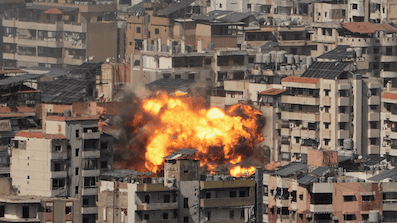
To end its devastating war with Israel, Lebanon pledged to disarm Hezbollah under U.N. Security Council Resolution 1701. After signing the Cessation of Hostilities in November 2024, Beirut stalled for 15 months, until Hezbollah fired six rockets at Israel on Mar. 1. The Lebanese cabinet then banned Hezbollah’s military activity, but it was too late: Israel resumed operations against the pro-Iran militia. Reasons for Lebanon’s failure include weak security forces, no real political will, and endless excuses.
The Lebanese Armed Forces teeter on the brink of collapse. Qatar funds their payroll and the U.S. supplies their rudimentary equipment, but soldiers often have to moonlight as nightclub bouncers and Uber drivers to survive.
Their logistics verge on the farcical: troops in the field frequently beg civilians for drinking water or scraps of food, knocking on doors wherever they deploy. Since the 1991 end of Lebanon’s civil war, first the Assad regime and later Hezbollah itself barred the Lebanese military’s intelligence branch from gathering any information on the pro-Iran militia.
According to Lebanese sources, serious efforts only began about a year ago. Building intelligence networks demands patience, cultivating sources and forging connections. Until recently, the Lebanese Armed Forces groped blindly when confronting Hezbollah, often relying on scraps of intelligence funneled to it by Israel.
Even worse. Hezbollah maintains its own formidable intelligence apparatus, relentlessly monitoring the Lebanese military, profiling each officer and gauging his stance toward the so-called “resistance.” Those deemed sympathetic earn promotions.
Lebanese Armed Forces Commander Rodolphe Haykal himself is widely believed to have received Hezbollah’s tacit clearance. Perhaps this explains why, before every planned Washington visit, the official Lebanese Armed Forces X account posts statements laced with condemnations of the “Israeli enemy” or “Israeli aggression” — a ritual signal to Hezbollah that the army chief remains loyal to anti-Israel rhetoric, even as he courts Israel’s foremost ally.
Beirut and the Lebanese Armed Forces routinely lament their overstretched mandate: to guard the porous Syrian border to the north and east, secure seaports and the airport, manning checkpoints, and conducting nationwide policing. This dilutes an already undersized force, leaving it dangerously exposed against a far better-armed Hezbollah.
The Lebanese regular military lacks the raw strength to impose its authority on the militia by force alone. Still, this military weakness offers no justification for Lebanon’s deeper failure to shame, vilify, and isolate Hezbollah as both a political party and an armed force.
The 2005 Cedar Revolution proved that such resolve is possible. After three decades of Syrian occupation, Christians, Druze, and Sunnis united in a groundswell that overwhelmed Assad’s forces and their Hezbollah allies. Even Hassan Nasrallah’s charisma could not prevent the expulsion of Syrian troops.
That 2005 triumph demonstrated that, with broad domestic consensus and global backing, even absent full Shia participation, Lebanon could compel Hezbollah to yield. Replicating that “March 14 moment,” however, has proven elusive.
Hezbollah quickly fractured the alliance by co-opting Michel Aoun’s Christian bloc, elevating him to the presidency and dismantling the March 14 coalition. (He bears no relation to the current president of Lebanon, Joseph Aoun.)
Aoun’s bloc remains insular and self-serving, unwilling to forge genuine partnerships. Druze leader Walid Jumblatt remains risk-averse, reluctant to defy his longtime friend and Hezbollah ally Speaker Nabih Berri. Sunnis remain fragmented, incapable of unified action against the so-called “resistance.”
Lebanon’s sectarian system compounds the paralysis. The state interacts with citizens almost exclusively through each sect’s patriarchs, so Beirut never directly engages the Shia community — it does so only through Hezbollah and Berri. This frames every confrontation not as state versus militia, but as other sects versus Shia, entrenching divisions rather than transcending them.
To mask this political bankruptcy, successive Lebanese governments deflect blame outward. In Arab political culture, no scapegoat proves handier than Israel. Beirut inverted the ceasefire sequence: instead of disarming Hezbollah first, prompting Israel to halt its enforcement actions and withdraw from five southern hilltops, Lebanon demanded the world to pressure Israel to stand down and retreat first, thus preserving Hezbollah’s pretext for “resistance.”
This tactic echoes the Lebanese playbook from 1993 to 2000. Whenever Israel sought security guarantees for withdrawal from south Lebanon, Beirut insisted that ongoing occupation justified Hezbollah’s arsenal and cross-border war. Remove the occupation, Lebanese leaders argued, and the excuse vanishes, forcing Hezbollah to disarm.
Israel complied, unilaterally withdrawing in 2000 without any agreement. Yet in 2026, Hezbollah remains heavily armed, ostensibly to “defend” Lebanon against imagined Israeli designs.
Since the 1969 Cairo Agreement — when Lebanon ceded its sovereignty to Palestinian, and later pro-Iran militias waging war on Israel from Lebanese soil — the country has failed to produce any coherent plan to reclaim control. Lacking will and capacity, Lebanon left Israel no choice: to dismantle Hezbollah’s threat on its northern border through decisive, unilateral action.
War between Israel and Hezbollah is back, and Lebanon has to bear the brunt of destruction. This would have been avoidable, had the state done its job.
Hussain Abdul-Hussain is the author of “The Arab Case for Israel” and a research fellow at The Foundation for the Defense of Democracies.