



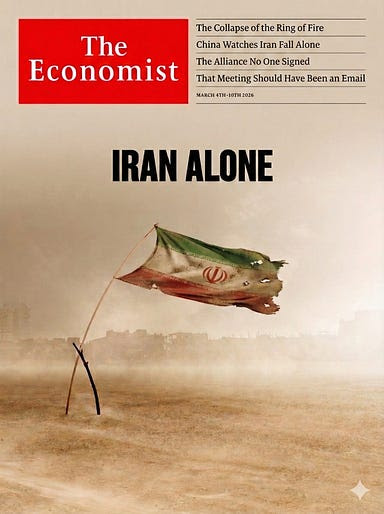
Iran tried to isolate Israel. Instead, it united an entire region against itself.
For decades, the Islamic Republic of Iran pursued a strategy of encirclement. It built proxy armies in Lebanon, Gaza, Syria, Iraq, and Yemen. It funded militias, supplied missiles, and waged shadow wars, all designed to surround Israel with a ring of fire and keep the Arab world divided and afraid. The strategy had a certain logic. As long as Iran’s neighbors feared its reach more than they trusted each other, Tehran could operate with impunity.
That strategy has now produced the opposite of its intended result.
Today, for the first time in the modern history of the Middle East, there is a convergence of interests among Gulf states, the broader Arab world, and Israel that goes beyond diplomatic statements. Iran’s indiscriminate retaliation, launching ballistic missiles not only at Israel but at Bahrain, Qatar, Kuwait, the UAE, Jordan, and Saudi Arabia, should not have surprised anyone. In September 2019, Iran struck Saudi Aramco’s Abqaiq and Khurais oil facilities, temporarily knocking out half of the kingdom’s crude production. Tehran has been targeting its neighbors for years. What changed is that the Gulf states are no longer absorbing these blows in silence.
While Iran fired at Arab capitals, Israel spent the day destroying the Iranian ballistic missile systems aimed at those very countries. That is not an abstraction. It is a new strategic reality.
I watched this reality take shape from the inside. The transformation did not happen overnight. It followed a sequence that is worth understanding, because it reveals how an alliance is built not through speeches but through shared risk.
In 2021, Israel was moved from US European Command to US Central Command, CENTCOM. This was not an administrative adjustment. From the outset, it was understood as a substantive strategic shift. For the first time, Israel was placed within the same military architecture as the Gulf states. Joint exercises became possible. Intelligence sharing deepened. Operational interoperability, the ability to fight together in real time, went from theoretical to practical.
That infrastructure was tested and proven across four escalations with Iran:
In April 2024, Iran launched its first direct attack on Israeli territory from Iranian soil. That was the significance of the moment: its sheer precedent. Israel responded in a focused and calibrated manner, designed to signal and deter. A broader campaign against Iran was premature at that stage because Hezbollah was still at full strength on our northern border. But a critical threshold had been crossed: an international coalition, including Arab states, had participated in defending Israel from Iranian missiles. The precedent was set.
In October 2024, Israel and the United States reached an understanding on striking military targets: air defenses and missile production infrastructure. This was the first stage in which the operational plan I had developed upon entering office as Minister of Defense in January 2023 found expression on the ground. We began creating the aerial corridor to Iran, which would later enable air superiority and the full deployment of our air force against Iranian targets. This was the principal shift, the key stratagem in the plan.
In June 2025, the United States moved from approval to participation. American forces joined Israeli strikes on Iranian missile infrastructure and nuclear-related targets. Without American involvement, the devastating blow to Fordow could not have been achieved. The partnership was now operational.
On February 28, 2026, the United States led a joint and integrated operation alongside Israel. Not support. Not coordination. Joint command, shared targeting, synchronized execution across multiple theaters. Operation Epic Fury and Operation Roaring Lion were two names for one campaign.
This trajectory must also be understood in its political context. The shift in American posture was not only a product of Iranian escalation. It required leadership willing to act. President Trump made a strategic decision that the Iranian threat could no longer be managed through negotiations alone, and backed that decision with force. That clarity of purpose accelerated the timeline and changed the outcome.
In less than two years, the US-Israel posture toward Iran moved from opposition to any response, to American leadership of a combined offensive. That trajectory tells you everything about what changed, in Tehran and in Washington.
But this is not only an American-Israeli story. The regional dimension is what makes this moment historic.
The Gulf states that joined the defensive coalition in April 2024 did so quietly and at considerable risk. Iran’s retaliation this week validated their calculation: Tehran was always going to target them regardless. The question was never whether the Gulf would be drawn into a confrontation with Iran. The question was whether they would face it alone or as part of a coalition with the military capability to win.
That coalition now exists. It was not born in a signing ceremony. It was built through shared intelligence, joint defense, and the recognition that the threat Iran poses cannot be managed. It must be removed.
I have written before about the importance of the coming period for regional order. The defeat of Iran’s proxy network, from Hamas to Hezbollah to Assad’s regime, has already reshaped the map. Now the source of that network is under direct assault. What replaces the old order will depend on whether the nations that fought together can build together.
The ingredients are there. A shared threat that clarified alliances. Military interoperability that proved itself under fire. Economic complementarity between Israel and the Gulf that has only deepened since the Abraham Accords. And American leadership that, for all its complexities, has moved decisively when it mattered.
Iran set out to build a ring of fire around Israel. Instead, it built the coalition that is now closing in on Tehran. The alliance Iran tried to prevent is the alliance Iran created.
This is the beginning of a change. And it is a change that should not be wasted.