



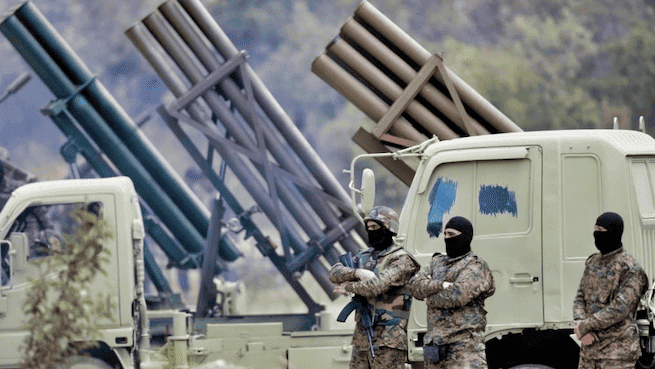
Key Points and Summary – Hezbollah isn’t done. Despite leadership losses, its financing—diaspora-linked laundering and new backing from Turkey to offset Iran—remains resilient.
-Unless President Joseph Aoun disarms Hezbollah by year’s end, Lebanon could face a renewed insurgency: IEDs on LAF vehicles, sniper terror, and voter intimidation in the south.
Hezbollah Isn’t Finished: Why Lebanon Must Prep for Insurgency
In 1982, Israel invaded Lebanon to uproot Palestinian terror cells that had established themselves in the south of the country. Initially, Lebanese—both Christians and Shi’a—welcomed the Israelis with open arms; that honeymoon soon turned into a nightmare as Iran’s Islamic Revolutionary Guard Corps began training Lebanese Shi’a in guerilla tactics and bomb-making.
After a brief intra-Shi’a civil war in the early 1980s, Hezbollah consolidated control over Shi’i representation; anyone who challenged the group’s monopoly or called out their corruption and treason risked their lives.
Hezbollah played diplomats and American analysts in the intelligence community and think tank community for fools by reinventing themselves as a face of Lebanese nationalism. In reality, they were always a force that undercut Lebanese sovereignty for the sake of paymasters and sponsors more than 1,000 miles away.
Hezbollah restarted its war with Israel on October 8, 2023 as it sought to share Hamas’ glory and take advantage of Israel’s distraction. For the Iranian proxy group, it would be a fatal mistake.
Israel unleashed hell on the group, wiping out its top field commanders and military leadership. It has now been just over a year since it simultaneously detonated Hezbollah-issued beepers, largely castrating its officer corps. Many in Washington and Jerusalem believe that Hezbollah is today a spent force, and approach Lebanon policy as if Hezbollah no longer poses a meaningful threat.
The Threat Isn’t Over…
This would be a major miscalculation on par with Israel’s initial underestimation of the group in 1982 for two reasons. First, Hezbollah’s financial network remain largely intact. Perhaps Iranian cash transfers dried up, but Turkish President Recep Tayyip Erdoğan, just as opposed to Israel’s existence as Ayatollahs Khomeini and Khamenei, is seemingly willing to fill some of the gap. Hezbollah’s broader financial network also remains largely intact. Lebanon’s greatest export has always been her people. The Lebanese diaspora across West Africa and South America is more than a century old. In Côte D’Ivoire and other West African states, the Lebanese operate the biggest business and dominate major commerce. Not every Lebanese in Africa and South America is Hezbollah, of course; many wish for a better future for Lebanon, but many of these pillars of their community too face Hezbollah extortion. Until Hezbollah’s money laundering and smuggling networks in Africa are shut down, the group will have the resources to rebuild.
This leads to the second reason a premature “Mission Accomplished” moment would be so counterproductive. So long as Hezbollah remains armed, President Joseph Aoun’s sincerity notwithstanding, Lebanon is at risk for a renewed insurgency. Iran has not given up, and Hezbollah’s new patron in Turkey is also keen to both bleed Israel and distract Aoun while Turkey expands its influence in Tripoli and northern Lebanon.
The Real Threat…
If Aoun fails to disarm Hezbollah by the end of the year—and there will always be reasons both political and tactical to delay—then the group will return. Lebanese Armed Forces vehicles will face improvised explosive devices and Hezbollah snipers will terrorize those who seek to vote to change the order in the south.
Hezbollah’s survivors will not fade into the woodwork and accept a quiet retirement or integrate into the system they once hated like so many American hippies did after the 1960s; Hezbollah embraces an ideology that brokers no compromise.
The Trump administration can help, both with diplomatic pressure on Aoun, assistance for the Lebanese Armed Forces that, for the first time, has an opportunity to rid itself of Hezbollah, and reconstruction of southern Lebanon, perhaps using several billion dollars sitting in Iranian accounts in Qatari banks.
If the White House or Congress worry about diversion of money as in the past, then they should set up alternative mechanisms to bypass Beirut’s corrupt elites.
What Happens Next?
Only one thing is certain: If the White House and Knesset think that Hezbollah will abide by their own timelines, then Hezbollah will re-emerge.
When excising an infection, the worst option is taking 90 percent of the antibiotics just because the wound is closing; to do so guarantees the infection will come raging back, stronger than ever.