



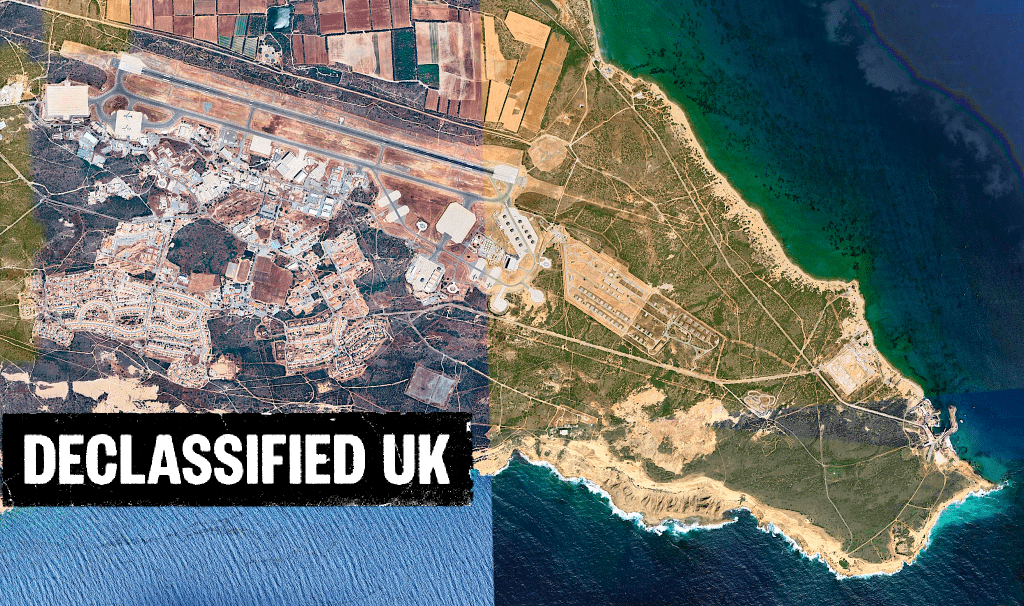
As debate over a “Cyprus-style solution” for Greenland resurfaces, Turkish legal scholars, diplomats and strategic thinkers caution that sovereign base arrangements born of decolonization cannot be casually transplanted into today’s self-determination–centered international order without testing the limits of sovereign equality and political legitimacy.
As discussions intensify over the future of U.S. strategic positioning in Greenland, a striking phrase has re-entered diplomatic vocabulary: a “Cyprus-style solution.” The reference is to the United Kingdom’s Sovereign Base Areas on the island of Cyprus, retained under full British sovereignty when the Republic of Cyprus gained independence in 1960.
The analogy appears deceptively simple. If Britain could retain sovereign military enclaves during decolonization, why could a similar arrangement not be negotiated elsewhere today?
Yet interviews with leading Turkish jurists, diplomats and strategic analysts suggest the comparison obscures more than it clarifies. Their collective assessment converges on a central point: the Cyprus arrangement is legally exceptional, historically contingent and politically difficult to replicate in the contemporary international system.
The debate is not merely about military infrastructure. It is about sovereignty, consent and the structural stability of the post-1945 order.
“This is not base allocation; it is sovereignty”
Professor Dr. Füsun Arsava begins by clarifying a distinction often blurred in public discourse.
“States may grant base rights through international agreements,” she notes. “We can point to NATO member states hosting each other’s bases, such as U.S. facilities in Türkiye or Germany. This practice has nothing to do with the colonial era.”
Cyprus, however, is fundamentally different. “When the United Kingdom transferred sovereignty to the Republic of Cyprus under the 1960 agreements,” she explains, “the territories it uses today as bases were not transferred to the Republic. These lands remained part of the United Kingdom.”
Former ambassador Ahmet Ünal Çeviköz reinforces this with precision:
“The situation in Cyprus is not a ‘base allocation.’ It is a direct and explicit transfer of sovereignty. These areas are not the territory of the Republic of Cyprus. They are British territory.”
This distinction is decisive. In ordinary base agreements, sovereignty remains with the host state and foreign forces operate under negotiated access frameworks. In Cyprus, sovereignty over the base areas was never transferred in the first place. The British Sovereign Base Areas are legally British territory.
That difference transforms the legal and political implications.
A product of decolonization power politics
Retired general and eminent strategist Haldun Solmaztürk situates the emergence of sovereign bases squarely within the logic of decolonization-era geopolitics.
“Sovereign bases emerged as part of decolonization processes,” he explains. “Departing states retained control over areas and facilities they deemed necessary for their interests. Newly established states were compelled to accept these imposed conditions.”
In this framing, sovereign bases were not neutral legal innovations. They were instruments of strategic retention in an era when colonial powers recalibrated influence rather than relinquished it entirely.
Solmaztürk characterizes the British bases in Cyprus as an anomaly sustained by the unresolved nature of the broader Cyprus question:
“Because the Cyprus problem has not been permanently resolved, this anomaly has survived until today. But following a comprehensive settlement, the United Kingdom would ultimately have to withdraw from these areas.”
The bases endure not simply because they are legal, but because the political equilibrium that could redefine them has never materialized.
Göğüş: Sovereignty, continuity and realism
Retired ambassador Hasan Göğüş brings an important stabilizing legal perspective to the debate.
“A state has the sovereign right to host military bases on its territory in whatever status it chooses,” he states. “I do not assume there is an obstacle under international law.”
Göğüş emphasizes that foreign military facilities are “generally established through agreements,” and that the termination conditions are defined within those agreements. His focus is on the structural continuity of international law.
Under the principle of state continuity, he reminds us, agreements remain valid even when governments change. “Under the principle of state continuity, agreements remain valid even if governments change.”
This is a critical point in a world where domestic political shifts are frequent but international commitments endure. Without this principle, the stability of international relations would be severely compromised.
Göğüş also introduces nuance into the sovereignty debate by pointing to operational complexity. In Türkiye, the 1980 Defense and Economic Cooperation Agreement (DECA) establishes that facilities such as Incirlik are Turkish Armed Forces installations, with U.S. access granted under Turkish consent.
Yet he notes, “Incirlik is a Turkish facility under DECA, but Turks cannot enter every section — for example, areas where nuclear weapons are located.”
Operational arrangements may be layered and restricted, but legal sovereignty remains intact. That difference is central to understanding why Cyprus represents a qualitatively different category.
Access versus sovereign territory
Solmaztürk distills the distinction clearly:
“In the first case, such as Incirlik, the use of ‘joint facilities’ remains essentially under the full control of the host country. But a sovereign base is technically the territory of the other country — part of its land. That means not partial transfer, but full sovereignty.”
In other words:
• Base access agreements preserve host-state sovereignty.
• Sovereign base areas transfer full territorial authority.
The British Sovereign Base Areas fall into the latter category. This technical distinction is the fault line of the entire Greenland debate.
Legal validity and political limits
On the legal status of the British bases, Solmaztürk is unequivocal:
“The British bases in Cyprus were included in the founding agreements. They were not transferred later; they are grounded in international treaties and therefore comply with international law.”
Withdrawal, therefore, would not stem from legal invalidity but from political negotiation.
“The United Kingdom’s departure from these areas would not be based on legal compulsion, but on political negotiations and a new agreement.”
Çeviköz underscores the foundational doctrine of pacta sunt servanda:
“International law recognizes, in principle, that treaties bind future governments. Otherwise, state continuity would collapse.”
However, he introduces a critical democratic caveat. If a government, under heavy external pressure and against the clear will of its people, were to transfer sovereignty for a base without democratic legitimacy, “that arrangement would become seriously controversial.”
Here, the debate shifts from formal legality to political legitimacy.
Greenland and the self-determination test
When applied to Greenland, the question becomes sharper.
Greenland possesses recognized autonomy within the Kingdom of Denmark and retains an internationally acknowledged path toward possible independence. Any sovereign territorial transfer affecting Greenland would intersect directly with the right to self-determination.
Çeviköz warns:
“If an arrangement permanently affects the political status of the population living in that territory and effectively makes a future self-determination process impossible, then its legitimacy can be questioned both politically and legally.”
Ali Er, veteran journalist and long-time observer of international law debates, frames the issue similarly:
“The discussion is less about the technical structure of the model and more about the conditions and the will under which it is established.”
Consent, not merely signature, becomes the decisive factor.
Systemic risk: alarmist or realistic?
Çeviköz warns that widespread sovereign base arrangements in asymmetrical power contexts could undermine sovereign equality and represent “a return to power politics” that risks “the collapse of the rules-based international system.”
Solmaztürk adopts a more measured tone:
“I do not believe such arrangements will become widespread; there is no such trend. On the contrary, there is pressure for withdrawal. Even if some new bases are established, they are likely to resemble Incirlik, Qatar or northern Iraq — not full sovereignty transfers.”
Göğüş’s perspective implicitly supports this moderation. International agreements governing military presence are deeply institutionalized. The dominant model remains access, not annexation.
Thus, fears of a sweeping neo-colonial revival may overstate structural realities.
Context over template
The convergence across legal, diplomatic and strategic perspectives is striking.
The British Sovereign Base Areas in Cyprus are legally valid because they were embedded in the founding settlement of a decolonizing state.
They were products of a specific historical moment.
were instruments of strategic retention within a unique constitutional architecture.
They are not easily replicable.
Solmaztürk calls them an anomaly sustained by unresolved politics. Arsava emphasizes that they are not ordinary base agreements. Çeviköz warns against asymmetrical replication. Göğüş highlights treaty continuity and sovereign consent as stabilizing principles.
The lesson is not that sovereign bases are categorically illegal. International law does not prohibit territorial transfers per se.
The lesson is that context determines legitimacy.
In an era defined by sovereign equality, self-determination and democratic accountability, replicating historically exceptional arrangements outside their original context would test not only legal doctrine but the resilience of the international order itself.
Cyprus is less a blueprint than a reminder. Sovereignty, once transferred, is permanent. And permanence in geopolitics is rarely neutral.